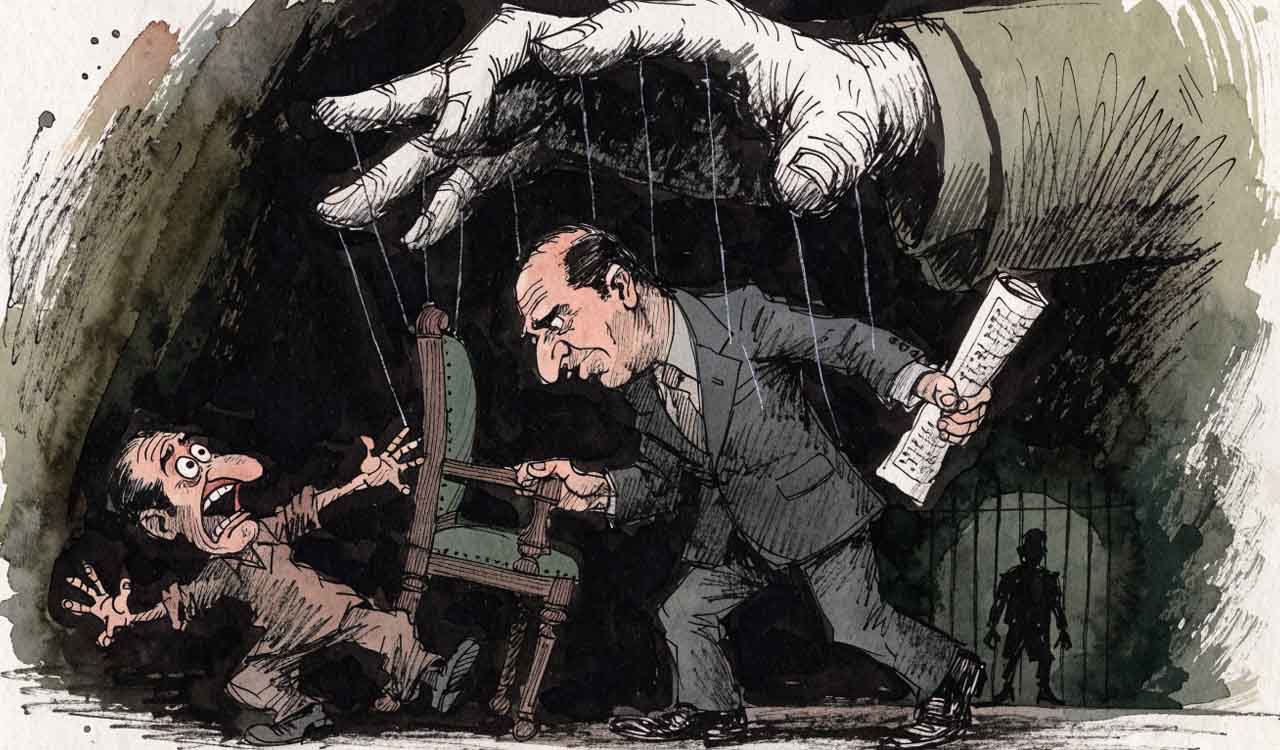
Governor’s Rule in Khyber Pakhtunkhwa raises serious questions about provincial autonomy and military’s role in politics
Published Date – 19 October 2026, 11:07 PM
Illustration: GuruG
The imposition of emergency and Governor’s Rule in Pakistan’s restive Khyber Pakhtunkhwa province marks yet another instance of a brazen power grab remote-controlled by the all-powerful Army. This looks more like a political coup disguised as Governor’s rule. While the coalition civilian government in Islamabad has justified the decision on grounds of a deteriorating security situation and the provincial administration’s alleged disengagement from counterterrorism, the move carries far-reaching political implications and is widely seen as an attempt to further marginalise the jailed former prime minister Imran Khan’s party, Pakistan Tehreek-e-Insaf (PTI). Khyber Pakhtunkhwa is PTI’s last remaining governing stronghold. Critics see the removal of its government after days of escalating tensions over Imran Khan’s imprisonment as politically motivated. Taking direct control of a province through a federal decree weakens Pakistan’s federal framework. The Shehbaz Sharif government has alleged that the provincial administration was working “hand in glove” with the Pakistani Taliban, known as Tehrik-e-Taliban Pakistan (TTP). The move comes as thousands of Khan’s supporters continue to stage anti-government protests demanding his release from jail. Khyber Pakhtunkhwa, which has witnessed an increase in militant attacks in recent months, is a political stronghold of the cricketer-turned-politician, who has been imprisoned since 2023 on corruption and other charges. His PTI party had long governed the volatile province, but Islamabad’s decision to impose emergency rule has now effectively removed it from power. Central rule can never be a substitute for an elected government.
Khyber Pakhtunkhwa sits along the porous border with Afghanistan and has experienced a surge in insurgent violence, particularly from the TTP. Dismantling the local elected setup to manage a security crisis risks further alienating the local population, potentially worsening instability instead of containing it. Decades of contradictory policies towards the Afghan and Pakistani Taliban have left Khyber Pakhtunkhwa mired in insecurity. The question now is whether the federal government’s extraordinary powers can help correct the state’s longstanding strategic failures. Critics point to the timing of the imposition of Governor’s Rule, which coincides with PTI’s planned march to Islamabad, and argue that it fits a pattern in which elected provincial governments opposed to the Centre are removed with the establishment’s backing. The fact that Governor’s Rule automatically brings Army deployment under Article 245 deepens the perception of direct military administration. The development exposes the military’s growing role in Pakistan’s political affairs. Confronted with a provincial executive aligned with an opposition movement that has directly challenged the military leadership, the establishment opted for direct intervention to secure its interests. The civilian coalition government, led by the Pakistan Muslim League-Nawaz (PML-N) and Pakistan Peoples Party (PPP), serves as the political face of the administration, but all major decisions must align with the military’s strategic calculations. By placing security imperatives and state control ahead of political negotiation, the establishment reinforces a familiar pattern in Pakistan’s political history: using constitutional emergency provisions to reset political alignments.