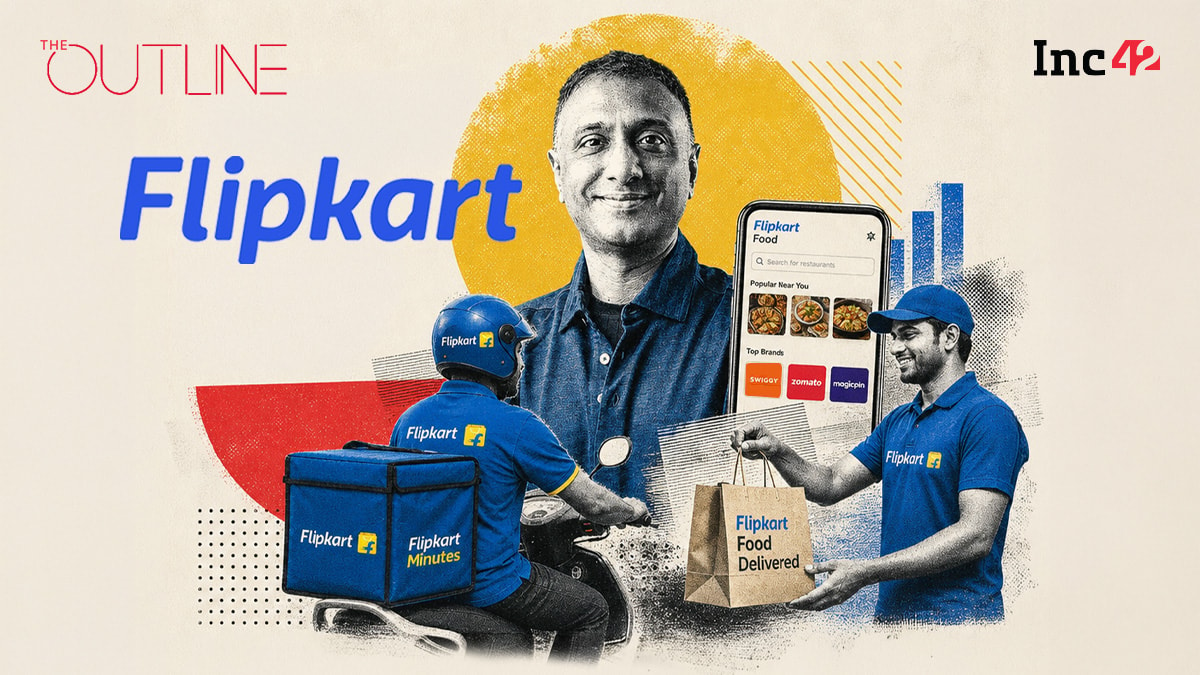
Flipkart has expanded testing of ‘Eat-in by Minutes’ to over 8,000 employees in Bengaluru and is targeting a public launch by October-end
Its proposed lower restaurant commissions and existing customer base could help it compete with Zomato and Swiggy, which dominate India’s food delivery market
The service draws on ONDC-listed restaurants and direct partnerships, uses a dedicated Ekart delivery fleet, and is targeting expansion to five or six cities by December
Walmart-owned ecommerce major Flipkart is reportedly targeting an October-end public launch for its food delivery service, ‘Eat-in by Minutes’, to compete with Eternal-owned Zomato and Swiggy.
The company has expanded its internal pilot in Bengaluru to more than 8,000 employees, according to a TechCrunch report citing people familiar with the development.
National Restaurant Association of India (NRAI) president Sagar Daryani told the publication that Flipkart had informed restaurant partners of plans to launch publicly by October-end and expand to five or six cities by the end of 2026.
Inc42’s queries to Flipkart remained unanswered till the time of publication. The story will be updated on receiving a response.
The expanded trial follows Flipkart’s initial employee pilot in Bengaluru.
Flipkart Taps Ekart, ONDC
Flipkart’s food delivery service currently appears as a separate tab on its main shopping app, alongside its quick commerce offering Flipkart Minutes and travel bookings. The company has also deployed a dedicated fleet of delivery riders through its logistics arm Ekart, separate from the riders handling quick commerce deliveries.
For restaurant onboarding, Flipkart is tapping the government-backed Open Network for Digital Commerce (ONDC), while also signing up restaurants directly.
The company is positioning its food delivery service around a lower-cost model for restaurant partners. Flipkart has reportedly proposed a base commission of around 10%, as per Daryani. This is much lower than the 20%-25% commission that restaurants typically pay established platforms, he said.
However, commissions account for only part of restaurants’ costs on food delivery platforms. Advertising, discounts, and promotions add to their overall expenditure, making the total cost of selling through Flipkart an important consideration for prospective partners.
Beyond restaurant pricing, Flipkart’s existing commerce ecosystem gives it a customer base to which it can cross-sell food orders.
Food Delivery Market Sees Fresh Competition
Flipkart’s planned launch comes amid fresh competition for Zomato and Swiggywith challengers focusing on restaurant commissions and the cost of ordering food online.
Rapido has been expanding Ownly, its food delivery service offering a zero-commission model for restaurants.
Quick food delivery startup Swish has also begun piloting Swish Goallowing users in select Bengaluru pincodes to order from third-party restaurants and cloud kitchens. The service is advertised as charging no packaging or platform fees.
Similarly, cloud kitchen operator Curefoods announced its MegaBite pilot yesterdayoffering dishes priced at ₹49-₹199 from brands across its portfolio. Currently available in Bengaluru’s HSR Layout, the app claims to charge no delivery or platform fees.
These moves reflect growing pressure on incumbent platforms to offer more affordable options to customers while addressing restaurant partners’ concerns over platform commissions and promotional expenses.
For Flipkart, food delivery adds another business alongside its expanding quick commerce operations through Minutes.
The expansion also comes amid uncertainty over its IPO timeline. Former senior executives, including Mukesh Bansal, Sanjay Baweja, and Ankit Nagori, have urged Walmart to buy back their vested ESOPs.
On the financial front, the Flipkart Group reported an 18.2% YoY jump in consolidated revenue from operations to ₹1.45 Lakh Cr in FY26, while its consolidated net loss narrowed marginally by 2.1% to ₹8,468 Cr from ₹8,646 Cr in FY25.