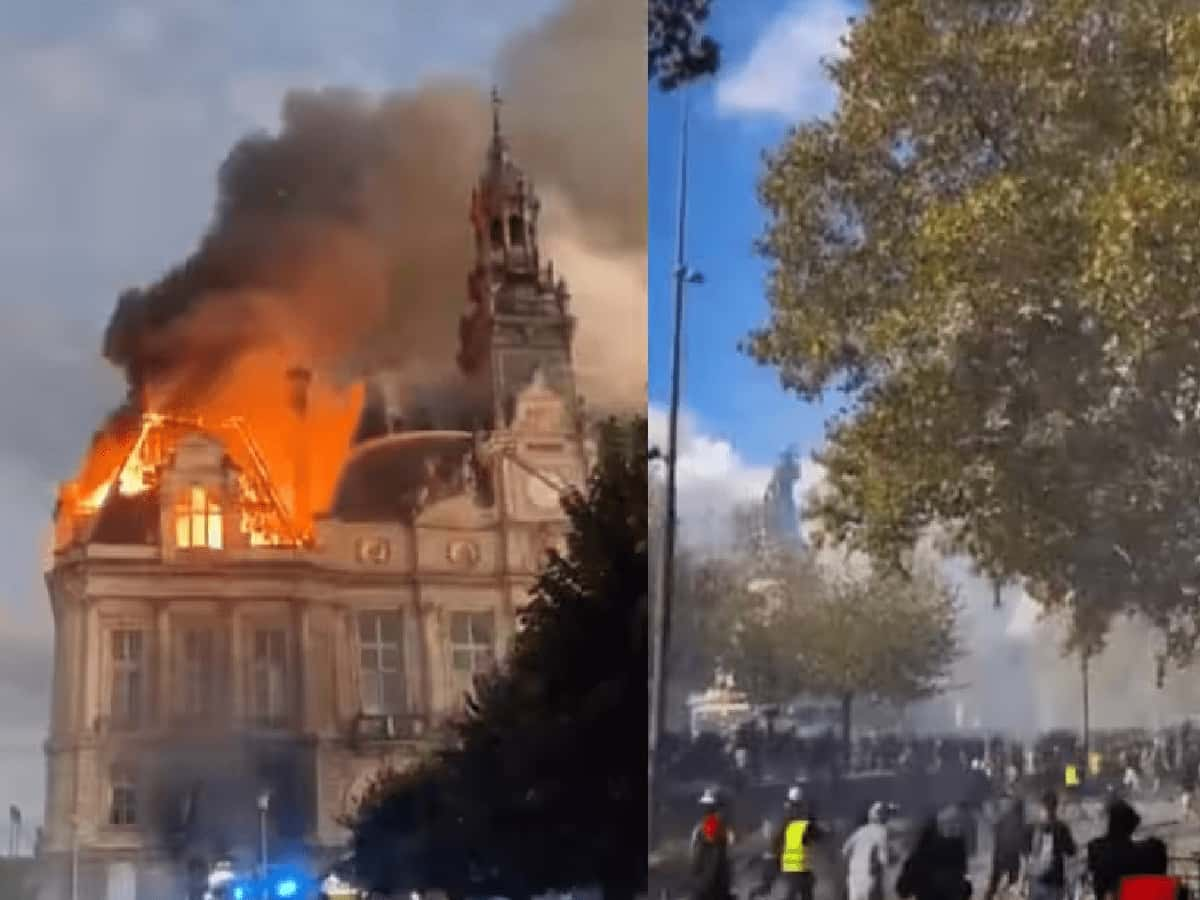
France, one of the most developed and culturally rich countries of the European continent, is currently going through the most serious internal crisis and planned violence in modern history. In the last few days, 10 major cities including the country's capital Paris have witnessed such a horrifying scene of arson, large-scale vandalism, destruction of government properties and open looting of shops, which has shocked the entire world. Common citizens, teachers, students and labor unions across the country took to the streets and started a very disciplined and peaceful march against the rising back-breaking inflation, huge cost of living crisis and the poor system of government schools. On October 17, more than 5 lakh common citizens in different provinces of the country were protesting peacefully on the streets with placards in their hands demanding their basic democratic rights. But as the sun set, there was an unexpected entry of gangs of unruly gangs dressed in black, oversized hoodies and face masks amidst the huge crowd of protesters. Within a matter of hours, these mysterious and organized masked groups transformed a peaceful mass movement into violent anarchy, brutal looting and bloody clashes with the police. The historic city hall of Limoges, built in 1883, was turned into a pile of ashes, the tourist office of Lyon was also burnt down. The main target of these masked miscreants bent on violence were the public buildings related to the historical and architectural heritage of France. The most heart-wrenching incident happened in the historical city of Limoges in central-western France. On Saturday, as about 5,500 people took out a peaceful march in the streets of Limoges against rising inflation, a group of rioters wearing black hoodies and hiding their faces launched a planned attack with petrol bombs on the eastern side of the city hall. Within no time the fire took a huge form. Within three hours, the ancient wooden and metal roof of this historic City Hall, built on the grand lines of the famous 'Hôtel de Ville' of Paris in 1883, burst into flames and was completely burnt to ashes. Apart from this, the doors of the historic City Hall of the port city of Marseille were broken and chaotic slogans and graffiti were scrawled inside, while the world famous Tourist Information Center of the city of Lyon was set on fire. In cities like Paris, Bordeaux, Lille and Marseille, robbers made away with goods worth millions of euros by shattering the windows of luxury fashion boutiques, international supermarkets and expensive Apple stores. Tears in the eyes and deep anger in the heart: 'Can't understand who burnt our city and why' According to the ground report released by France's leading newspaper 'Le Monde', hundreds of local citizens, researchers and students gathered in front of the building early on Sunday morning to see with their own eyes the burnt ruins of their city's 140-year-old architectural heritage. With tears in their eyes, the hearts of the local people were shaken after seeing their own heritage reduced to ashes. Talking to the media, 26-year-old local youth Yasin, who was present at the spot, said that it is a very disgusting and shameful experience to see one's own historical building being destroyed like this. At the same time, 18 year old literature student Marine had tears in her eyes and said very emotionally that she was broken from inside and she could not understand how the situation had reached such a barbarity while fighting the just fight for schools and inflation. On Sunday evening, a massive peace meeting was called at the city's historic 'Place de la République' square to strongly condemn the violence, arson and cowardly actions of the masked men, in which according to the municipal administration, more than 7,000 local citizens lit candles and expressed solidarity with their historical heritage. The roots of heritage conservation are linked to the French Revolution of 1789, strict guard is kept on 45 thousand ancient buildings. The general public of France is considered to be more sensitive and alert about its history, monuments and architectural heritage than any other country in the world. The legal and social system for preserving historic buildings, ancient churches, town buildings and artefacts in French society goes back centuries. The historical roots of this conservation consciousness are deeply linked to the world famous French Revolution of the year 1789. In the initial period of that historical revolution, when there was indiscriminate vandalism and destruction of monuments against the monarchy, the enlightened French thinkers awakened a strong consciousness of protecting their national heritage at any cost. As a result of this consciousness, in the year 1913, the Historical Law for the Protection of Historical Monuments came into force in France, which placed a strict legal ban on destroying, selling or changing any ancient building from its original form. To date, more than 45,000 historical buildings and millions of rare artefacts are protected under legal protection as national heritage in France. In such a country, the burning of more than a century old city hall in this manner is being considered as a direct attack on the cultural identity of every French citizen. Black Bloc Strategy and Violent Infiltration: How Anarchy Breaks the Back of Reasonable Mass Movements Sociologists, security analysts and European think tanks believe that extremist and anarchist tactics like 'Black Bloc' have been active in France for a long time. These masked elements are neither concerned with the issue of inflation nor with the betterment of schools; Their sole objective is to destroy the security system under the cover of the crowd, attack the police and spread economic and physical chaos on a large scale. France's enlightened citizens and union leaders understand very well that as soon as any democratic demonstration involves violence and arson, public discourse and media headlines turn completely away from core issues such as declining purchasing power and wage increases and focus solely on criminal incidents and riots. This violent infiltration directly breaks the backbone of peaceful movements, as after the deterioration of law and order, ordinary families, women and elderly people stay away from protests fearing for their safety, due to which the strength of the mass movement gradually disintegrates.