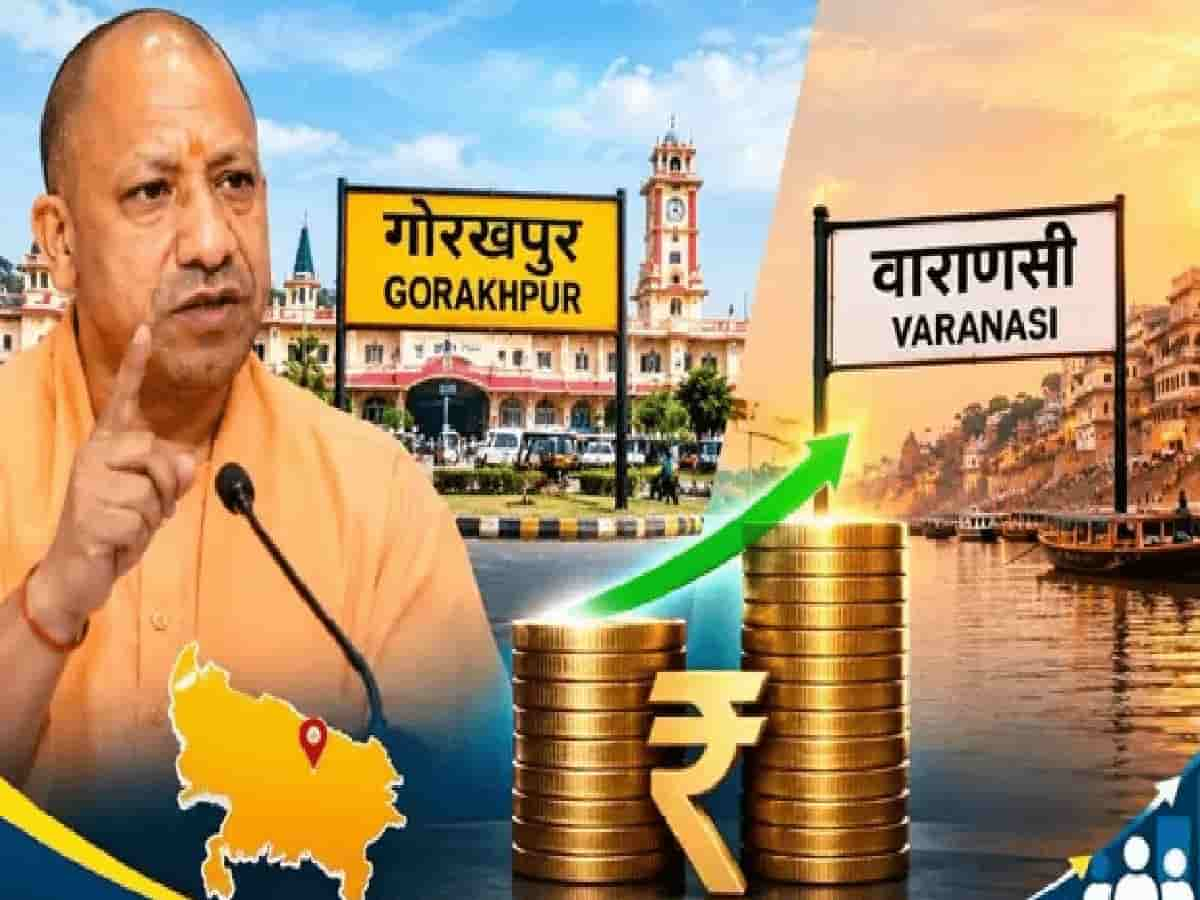
In the economic and industrial scenario of Uttar Pradesh, the two most important VVIP districts of Purvanchal—Gorakhpur and Varanasi—always remain at the center of discussion among policy makers and the general public. The latest official economic data released by the Economics and Statistics Division of Uttar Pradesh has revealed an interesting comparative account of the economic potential and demographic prosperity of these two major power centers of the state. According to these data, the per capita income of Gorakhpur district, the home area of Uttar Pradesh Chief Minister Yogi Adityanath, has been recorded at Rs 1,06,510 annually. At the same time, the per capita income of Prime Minister Narendra Modi's parliamentary constituency Varanasi has been estimated at Rs 1,14,685 per year. A direct analysis of the data makes it clear that the residents of Varanasi are more prosperous than Gorakhpur in terms of personal income, i.e. the annual earnings of the average citizen, but when it comes to the total Gross Domestic Product (GDP) of the district, i.e. the size of the overall economy, Gorakhpur has left Kashi far behind.
The historical and political importance of Gorakhpur is well known throughout the country. This city is considered a very influential axis of the politics of Uttar Pradesh, because from here the Chief Minister of the state Yogi Adityanath himself represents the Gorakhpur urban area in the Uttar Pradesh Assembly. Before becoming the Chief Minister, he was MP from Gorakhpur Lok Sabha constituency for five consecutive terms from 1998 to 2017 and has been continuously leading the development of this region along with holding the command of the state for the last nine years. Gorakhpur also has its own unique identity on the religious and cultural front. The famous Gorakhnath temple located here is the highest global center of Nath Panth, whose presiding deity is Yogi Adityanath himself. Along with this, the historical organization 'Geeta Press', which brings the scriptures of Indian Sanatan culture – Srimad Bhagavad Gita, Ramayana and Mahabharata to every home, is the identity of this city. The city's economy has seen a boom in the last few years due to road connectivity, revival of AIIMS, fertilizer factory and expansion of the industrial corridor (GIDA).
According to the official statistical bulletin of the Department of Economics and Statistics, Government of Uttar Pradesh, the per capita income of Gorakhpur district has been recorded at Rs 1,06,510 per year. This simply means that the average annual income of every citizen living in the district is more than one lakh six thousand rupees. If we talk about the overall economy i.e. total GDP (District Domestic Product) of the district, then Gorakhpur has touched a total size of Rs 63,657.33 crore due to huge economic activities. Gorakhpur's agricultural production, local industry, real estate boom, becoming a regional center for health services and being a major trading hub adjacent to the Nepal border provide a strong base to its total GDP. The construction of Gorakhpur Link Expressway and logistics parks has also significantly increased the overall economic output of the district.
When the chief minister's constituency Gorakhpur is compared with Prime Minister Narendra Modi's parliamentary constituency Varanasi, the figures present a very interesting economic picture. According to the data, the per capita income of Varanasi district is Rs 1,14,685, which is Rs 8,175 more per year than Gorakhpur's Rs 1,06,510. That means an average citizen of Kashi is earning more in terms of personal income than a citizen of Gorakhpur. The main reason behind this is the unprecedented expansion of tourism, hotel industry, silk and handloom trade, handicrafts and service sector after the grand construction of Kashi Vishwanath Dham in Varanasi, which has rapidly increased the per capita income at the local level.
However, when the total economic output i.e. overall GDP of both the districts is compared, the tables turn. The total GDP of Varanasi is estimated at Rs 56,899.78 crore, while the GDP of Gorakhpur is Rs 63,657.33 crore. That means, in terms of total wealth and productivity of the district, Gorakhpur has overtaken Varanasi by about Rs 6,757.55 crore. Gorakhpur's large geographical area, large-scale agricultural production and rapidly growing manufacturing base give it a decisive edge over Varanasi in overall GDP.
This economic competition between Gorakhpur and Varanasi is giving a very positive sign in the state government's ambitious goal of making Uttar Pradesh a 1 trillion dollar economy. While Varanasi is creating new records in per capita income on the basis of service sector, international tourism, religious culture and textiles, Gorakhpur is strongly increasing the size of total GDP on the basis of agro-based processing, manufacturing, heavy industry and regional trade. The huge infrastructure investment taking place in both the VVIP areas is ensuring that in the coming times, Purvanchal emerges as the strongest engine of development of Uttar Pradesh not only politically but also economically.