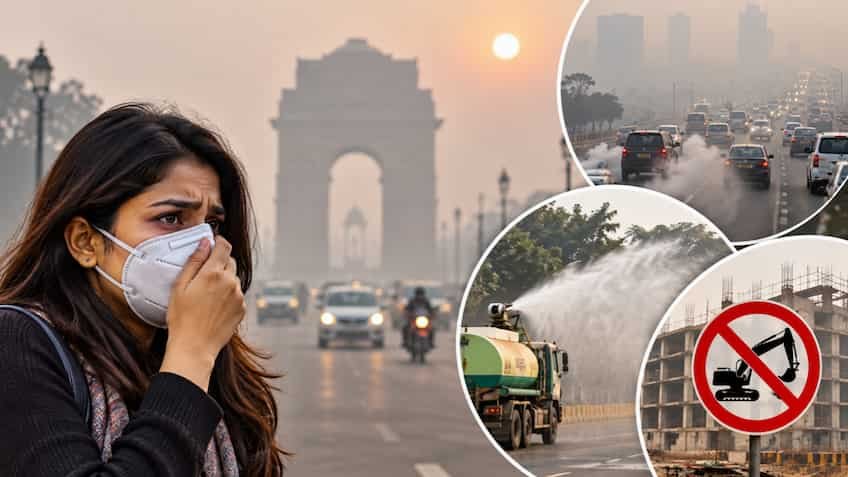
With the onset of winter, the shadow of pollution has started deepening in the national capital Delhi and adjacent NCR areas. As soon as the air quality fell to 'poor' category, the Commission for Air Quality Management (CAQM) took immediate action and implemented the first phase of the Graded Response Action Plan (GRAP-1). Strict guidelines related to pollution control have now been implemented in Delhi including Noida, Greater Noida, Ghaziabad, Gurugram and Faridabad. Due to cold weather and slow winds, pollutants have started accumulating in the atmosphere, due to which a feeling of heaviness in breathing and slight burning sensation in the eyes has started. Putting government agencies on alert mode, clear orders have been given to keep strict vigil at the ground level and impose heavy challans and punitive action against those violating the rules. What is GRAP-1 and when does it come into action? The Graded Response Action Plan (GRAP) is a four-tier emergency framework designed to handle the deteriorating air quality in Delhi-NCR. According to CAQM rules, when the air quality index i.e. AQI is recorded between 201 to 300, it is considered to be in the 'poor' category and the first phase of GRAP is implemented with immediate effect. After this, as the pollution increases, the next stages i.e. Grap-2 (at 301-400 AQI), Grap-3 (at 401-450 AQI) and in extreme cases, Grap-4 (at more than 450 AQI) are implemented. The basic objective of GRAP-1 is to control pollution before it reaches the next dangerous level, so that it does not have a negative impact on the health of the general public, especially the elderly and children. Now strict restrictions on construction sites and dust control: With the implementation of GRAP-1, the strictest restrictions have been imposed on construction and demolition (C&D) activities. Any construction work with an area of 500 square meters or more will not be allowed to proceed without portal registration and a certified dust management plan. It has been made mandatory for builders and contractors to completely cover construction materials such as sand, cement and debris with tarpaulin. Trucks carrying material will also have to be completely covered so that the dust flying on the roads does not poison the air. Along with this, local municipal corporations and development authorities have been directed to deploy anti-smog guns on major roads and ensure regular sprinkling of water along with mechanized sweeping. Traffic police's whip on vehicle smoke and old vehicles. Smoke emanating from road traffic becomes a major factor of pollution in winter, to control which the traffic police has tightened its belt. Under Group-1, intensive checking of valid Pollution Under Control (PUC) certificates has been started and heavy fines are being imposed on vehicles emitting smoke. Citing the orders of the National Green Tribunal (NGT) and the Supreme Court, a complete ban on the operation of 10 year old diesel and 15 year old petrol vehicles is being strictly implemented in Delhi-NCR. Additional traffic police forces have been deployed at the main hotspots of the jam so that stopping of vehicles is minimized and drivers are being made aware to keep their engines off at red lights. Also, commercial trucks whose destination is not Delhi are being diverted to the Eastern and Western Peripheral Expressways. There is a big ban on tandoors in hotels and dhabas, burning of garbage and generators. The smoke emanating from roadside bonfires and garbage in winter makes the local atmosphere extremely poisonous. As per the guidelines of GRAP-1, there is a complete ban on open burning of garbage, biomass, leaves or plastic and those doing so will be fined environmental compensation under the provisions of the NGT. Additionally, the use of traditional tandoors using coal or wood in hotels, restaurants and roadside dhabas has been banned; They are allowed to use only gas or electricity based appliances. Restrictions have also been imposed on the use of uncontrolled diesel generator sets used during power cuts, and generators of prescribed standards have been allowed to run only for essential services and emergency situations. Advisory for common citizens and appeal for change in daily routine. The administration has strongly appealed to the general public for cooperation in this common fight against pollution. According to CAQM's 'Citizen Charter', people have been advised to use public transport like Delhi Metro, RRTS and electric buses as much as possible instead of private vehicles. Office-bound employees are being encouraged to adopt carpooling and work from home or hybrid models if possible. Apart from this, citizens have been urged to keep an eye on the real-time AQI of their area through SAMEER app and if any incident of burning of garbage or violation of construction rules is seen anywhere, they should immediately report it by uploading the photo on the concerned government portal.