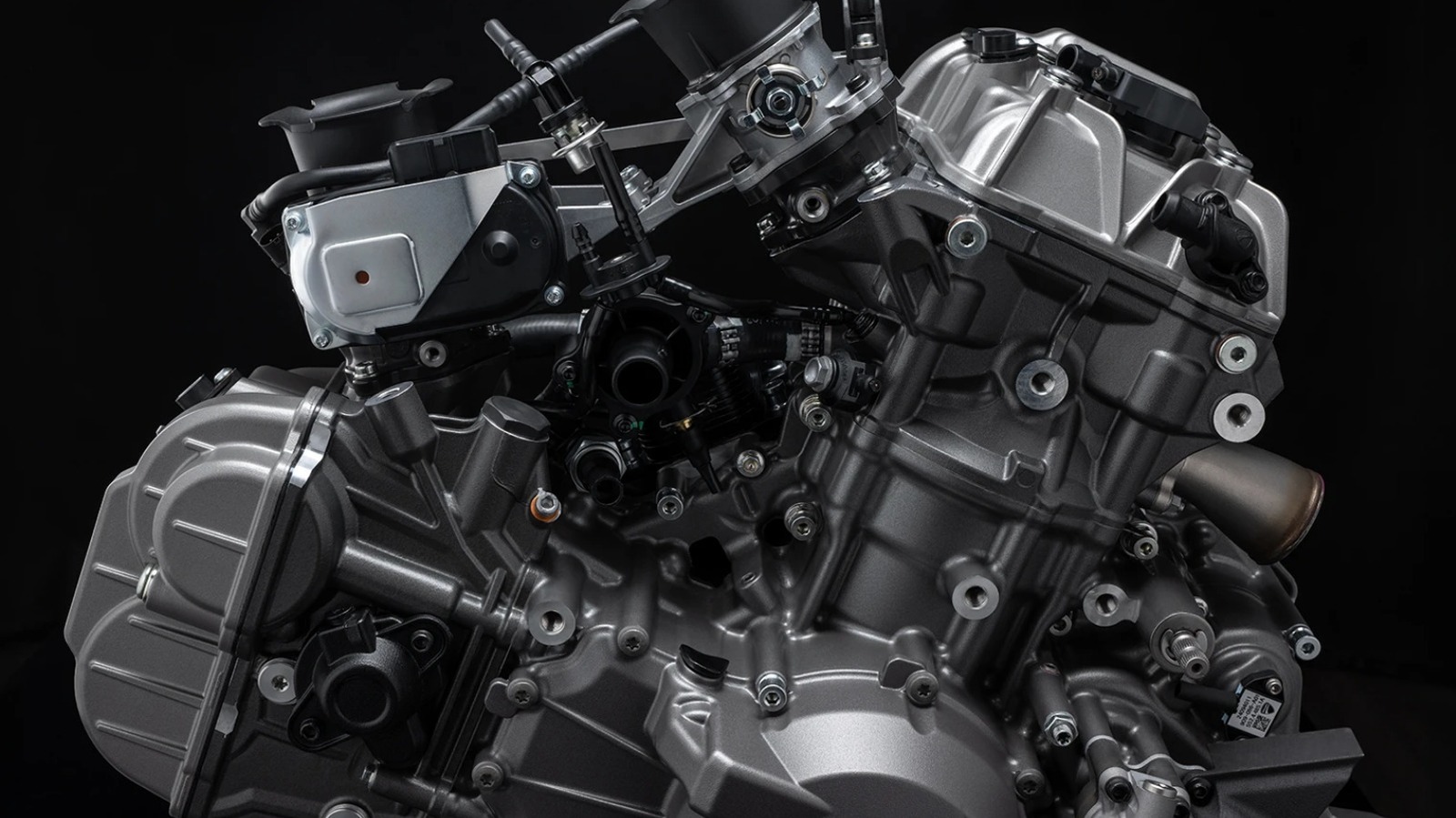
Many different kinds of motorcycle engines exist, and each can dramatically affect how the bike performs. Two of the most important factors to consider when choosing a motorcycle are displacement and compression ratio. These refer to the cumulative amount of fuel and air mixture that moves through all of the engine’s cylinders in a single four-stage combustion cycle and the volume ratio measuring how much that mixture is compressed by the piston before ignition. These both have a direct impact on the amount of torque and power that the engine can produce, but they aren’t the only things to consider.
You’ll also want to take a look at the number of pistons in the engine block and their orientation. Even when you look at two-cylinder bikes, there are many options to choose from, and each of them proffers a range of pros and cons. Most fall into one of three categories: parallel-, boxer-, and V-twin. But even within these broad categories, several sub-designations exist. Take V-twins, for instance. Rather than having their cylinders run in parallel, these engines offset them at an angle. Early V-twins had smaller cylinders and could get away with a much shallower angle, and thus a much narrower footprint. But as the market called for larger displacement, the cylinders grew and were forced farther apart at more extreme angles to allow clearance for the wider bores at the bottom.
This culminated in the L-Twin Engine, developed by Ducati’s famous engineer, Fabio Taglioni, in 1970. He turned the single-cylinder Desmodromic engine into an L-twin, placing the cylinders at a full 90-degree angle.
The L-Twin is a performance powerhouse with character
One of the L-Twin engine’s premier features, and what sets it apart from other V-Twins, is the space it offers for larger cylinders while keeping the overall footprint minimal. Taglioni’s first L-twin Desmodromic engine was a 750 GT, but this was hardly the peak of what the orientation could offer. Ducati has since gone on to develop much larger L-Twin engines, such as the 1,285cc Superquadro, which can generate a colossal 155 horsepower at 10,750 RPM and a maximum torque of 77 lb-ft at 9000 RPM. Those performance numbers are hard to argue with.
This is still a far cry from the largest V-Twin that there is, however. Take a look at some of the biggest motorcycle engines ever made, and you’ll find that models like Harley-Davidson’s 45-degree V-Twin, the 2,212cc Screamin’ Eagle 135 Stage IV, and Kawasaki’s 52-degree V-Twin, the 2,053cc Vulcan 2000, are both significantly larger. It’s worth noting that these are designed for heavy cruisers and touring bikes, though, so there’s more room for a massive engine. This is fundamentally different from the aerodynamic frame of a sport bike, like the ones Ducati uses for its L-Twins.
It isn’t just the raw numbers, though. The 90-degree layout with the shared crankpin means that firing intervals are spaced at the 270-degree and 450-degree rotations of the crankshaft. This uneven firing sequence gives L-Twin engines a distinct, pulsing rhythm that differs sharply from other V-Twins. Like all V-Twins, this gives the L-Twin exceptionally strong low-to-midrange power. It also gives the bike exceptional rear-tire feedback, with the tire establishing firm grip on the asphalt with each pulse.
L-Twin balance and orientation in the frame
Beyond performance, a few other distinctive characteristics set the L-Twin layout apart from its V-Twin siblings. The 90-degree angle makes for an excellent balance between the two moving pistons without the need for power-robbing counterbalancers. The angle itself provides a cancellation of primary force between the two cylinders. These engines typically have a narrower crankshaft as well, which means that they have less gyroscopic mass to throw the bike off balance. This makes it easier to maneuver.
There are a handful of exceptions, but L-Twin engines are typically mounted with both cylinder blocks contained within the frame, one forward and one forward, and one back–not sticking out from either side. This means that they create an incredibly narrow profile, with almost no width extending outside the frame. This allows for a slimmer profile on the motorcycle overall and allows the rider to take aggressive lean angles when cornering. Models that tilt the forward cylinder at a lower angle also create a lower, more forward-oriented center of gravity. This improves stability and traction through turns as well.
The one major downside to this orientation has to do with airflow. With one cylinder block in front and the other trapped deep inside the frame, the rear block is largely obstructed from airflow. What’s more, much of the heat radiating off the forward cylinder can be absorbed into the rear one. Modern water cooling has largely solved this problem, but early air-cooled models struggled with overheating in the early days of the engine configuration’s development.