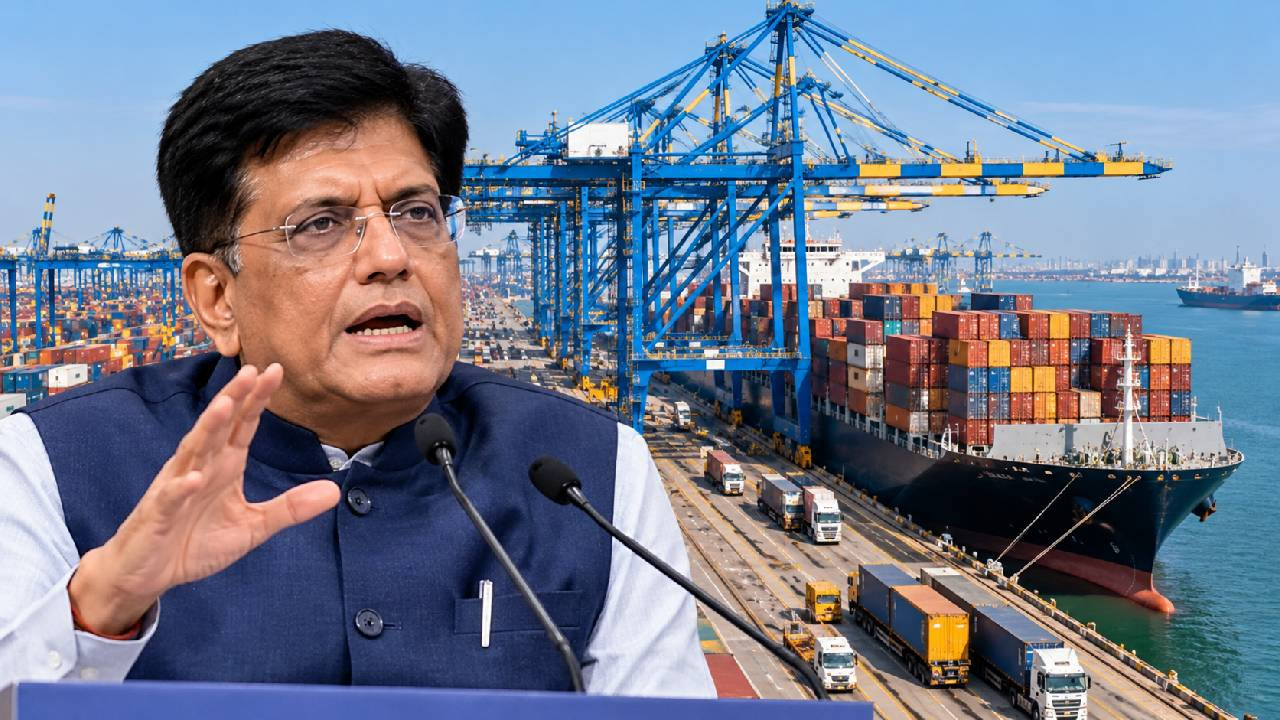
With the expansion of India’s economy and international trade, the freight pressure on ports is also likely to increase. Keeping this need in mind, Union Minister Piyush Goyal has said that India wants to work towards increasing its port capacity to four times the current level by the year 2047. During his visit to Netherlands, he said in Rotterdam that India’s port capacity has doubled in the last decade, but keeping in mind the future economic needs, it is necessary to increase it further. He says the country needs to invest in modern maritime infrastructure to support economic growth and global trade. Increasing port capacity can help handle more cargo, improve transportation systems and strengthen access of Indian products to international markets.
India can benefit from Rotterdam’s experience
Piyush Goyal laid special emphasis on the possibilities of cooperation with the Port of Rotterdam, which is one of the major maritime trade centers of Europe. Rotterdam is an important gateway for goods to reach European markets. The developed port system, goods management and logistics network here play an important role in international trade. According to Goyal, India can learn from Rotterdam’s experience while modernizing its ports. The objective of the collaboration is not only to increase the size of ports but also to improve their operational efficiency.
If the movement of goods, the stopping of ships and the customs process are made more efficient, opportunities may arise for businesses to save time and costs. Exporters are also expected to benefit from the strengthening of trade links between India and Europe.
Emphasis on green energy and carbon capture
Environmental responsibility is also being considered important in the development of the maritime sector. Goyal mentioned possibilities of cooperation in areas like green energy and carbon capture. Port operations can be made more sustainable by increasing the use of green energy and adopting technologies that reduce carbon emissions. Carbon capture technology aims to capture carbon dioxide released from industrial activities and help control its emissions.
India can benefit from exchange of new technologies, investments and expertise in these areas. Additionally, new opportunities may open up for international trade in clean energy related products and services. The importance of such efforts increases because maritime transport is a major part of the global supply chain.
Trust on Sagarmala with ‘Yeh Dil Maange More’
Giving the slogan ‘Yeh Dil Maange More’ in his address, Goyal said that India should not stop being satisfied with its achievements. According to him, the country must continuously raise the standards of quality, productivity and operational efficiency. He also mentioned the Sagarmala initiative of the Central Government, which aims to improve port infrastructure and maritime connectivity. Effectively connecting ports to road, rail and other transport networks can be instrumental in reducing freight costs and increasing the speed of trade.
Improving maritime infrastructure can also stimulate economic activities in coastal areas. However, to achieve the target of 2047, investment, timely completion of projects and adoption of modern technologies will be important.
Planning of Maritime Training Institute in Mumbai
The minister also mentioned the plan to set up a large maritime education and training institute in Mumbai. It aims to produce skilled seafarers and professionals who can meet the needs of the Indian as well as the global shipping industry. The expansion of maritime trade does not depend only on ports and machines; For this, trained human resources are also necessary. Availability of qualified staff in areas such as ship operations, security, technical maintenance and logistics can enhance the efficiency of the industry. In this way, a plan is being made to pursue port expansion and skill development together.
What does this mean for India’s global trade?
The overarching objective of India’s port capacity expansion plan is to make the country more competitive in global trade and logistics. Better port facilities can help exporters ship goods faster, streamline the import process and reduce supply chain bottlenecks. Collaboration with international centers like Rotterdam can provide India an opportunity to gain technical expertise and operational experience.
However, the goal of quadrupling capacity is an ambitious direction in itself; Its real impact will depend on the implementation of projects, financing, environmental standards and coordination of transport networks. If these efforts proceed effectively, India’s maritime economy and international trade could be strengthened in the long term.