ElevenLabs is using its own ElevenAgents platform to automate internal business operations, with the company reporting more than 1,200 working hours saved per month. Its agents also answer over 5,000 questions monthly, build customised customer demonstrations and open more than 150 support and engineering tickets in a month, according to its October 29 account.
The deployment goes beyond retrieving information from Slack. Employees can ask questions, request demos, or report bugs, with agents handling parts of the process through connected tools. The company’s examples cover sales, support, engineering, and product analysis, while its deployment lessons also acknowledge that agents can make mistakes and need reliable information and verification.
Sales Teams Use Agents for Account Questions and Demos
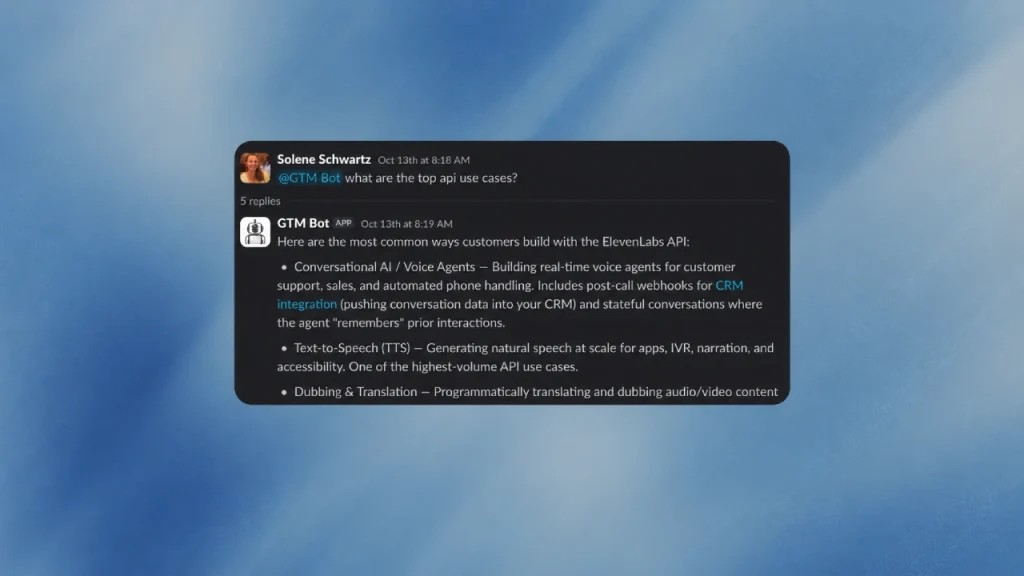
ElevenLabs uses two agents for sales-related work: a go-to-market (GTM) bot for customer and account questions, and a Forward Deployed Engineer (FDE) bot for product questions and demonstrations.
The GTM agent can answer questions such as which customers have logo rights in particular European markets or what the company’s leading API use cases are. This gives sales teams a way to retrieve account and product context directly through internal conversations.
The FDE agent handles product-oriented requests and can build a working customer demo configured for a prospect’s use case. ElevenLabs says it can assemble the demo from a Slack message, reducing the manual preparation involved in creating a tailored example.
These agents support sales and technical teams. Their role is to answer questions and prepare demonstrations that employees can use in customer conversations.
Triage Agent Searches Slack and Creates Linear Tickets
ElevenLabs says its triage agent created more than 150 new tickets in the previous month, covering support and engineering workflows that had previously involved manual work. Before opening a ticket, the agent searches Slack for relevant context and checks existing tickets for duplicates. It also ensures the issue contains enough detail to help diagnose the problem, then creates a Linear ticket with the appropriate priority.
Routing is based on an ownership document uploaded to the agents’ knowledge base. This gives the agent a reference for deciding which team should receive a feature request or bug report.
The workflow connects context gathering, duplicate checking, ticket creation, and team assignment. It does not mean the agent resolves the underlying bug or feature request; support and engineering teams still need to review and act on the ticket.
Product Teams Receive Business Analysis in Slack
Product and product marketing employees can ask data questions in domain-specific Slack channels and receive analysis in the same thread.
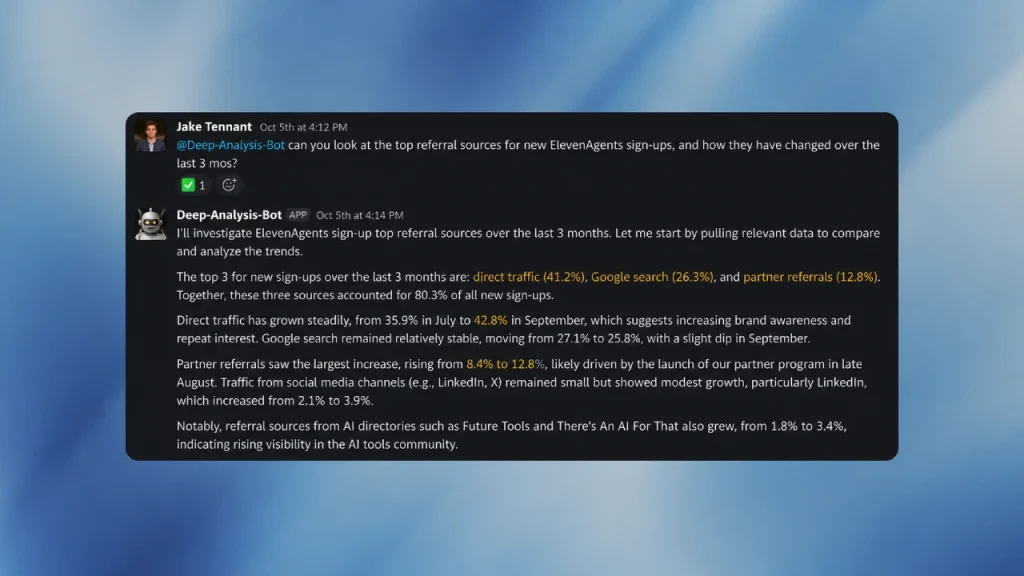
ElevenLabs gives an example involving changes in free-to-paid conversion among ElevenCreative self-serve subscribers in the United States over six months, including a request to identify the main drivers. Employees can follow up in the thread to discuss the results.
The company says answer quality depends on what information the agent can access. That makes data curation a central part of the workflow, particularly when employees are asking questions about business metrics.
What ElevenLabs Learned From Internal Deployment
ElevenLabs says reliability and accuracy are important to adoption: mistakes in shared channels are visible, but successful workflows are visible too. Its deployment experience points to several changes that helped improve agent behaviour.
Schema curation
The company says removing unnecessary fields improved retrieval quality more than prompt tuning in its own experiments. Each additional field gives an agent another place to misinterpret information or make an unsupported guess, so ElevenLabs reduced schemas to the critical data needed for a task.
Valid Salesforce picklist values
Salesforce fields such as deal stage and account type use fixed sets of valid values. ElevenLabs found that an agent could generate a plausible-sounding value that did not exist in Salesforce. The company now fetches valid values at startup and injects them into the MCP tool’s type definitions, limiting the agent to options accepted by the system.
Clearer procedures
As procedures accumulate, some can overlap or conflict. ElevenLabs says its Architect can restructure procedures to clarify when each should run and reduce competing instructions. This matters when different issue types require different handling, such as feature requests and bugs.
Verification after actions
After creating a Linear ticket, the agent checks that its fields are set correctly and that it has been routed to the right team. ElevenLabs says this has helped curb occasional hallucinations and incorrect team selection. The verification step is particularly important because a response claiming that a task is complete does not prove that the connected system was updated correctly.
ElevenLabs’ AI Agents Handle Specific Internal Workflows
ElevenLabs’ reported monthly figures show the scale of its internal use, while its examples explain where the agents fit: answering account questions, building demos, preparing tickets and analysing business data. The company also makes clear that deployment requires ongoing work. Curated schemas, valid Salesforce values, clearer procedures and checks after actions help address errors. The result is an internal automation system designed to take on defined operational tasks while employees continue to review information, handle customer relationships and resolve engineering issues.
(Source)