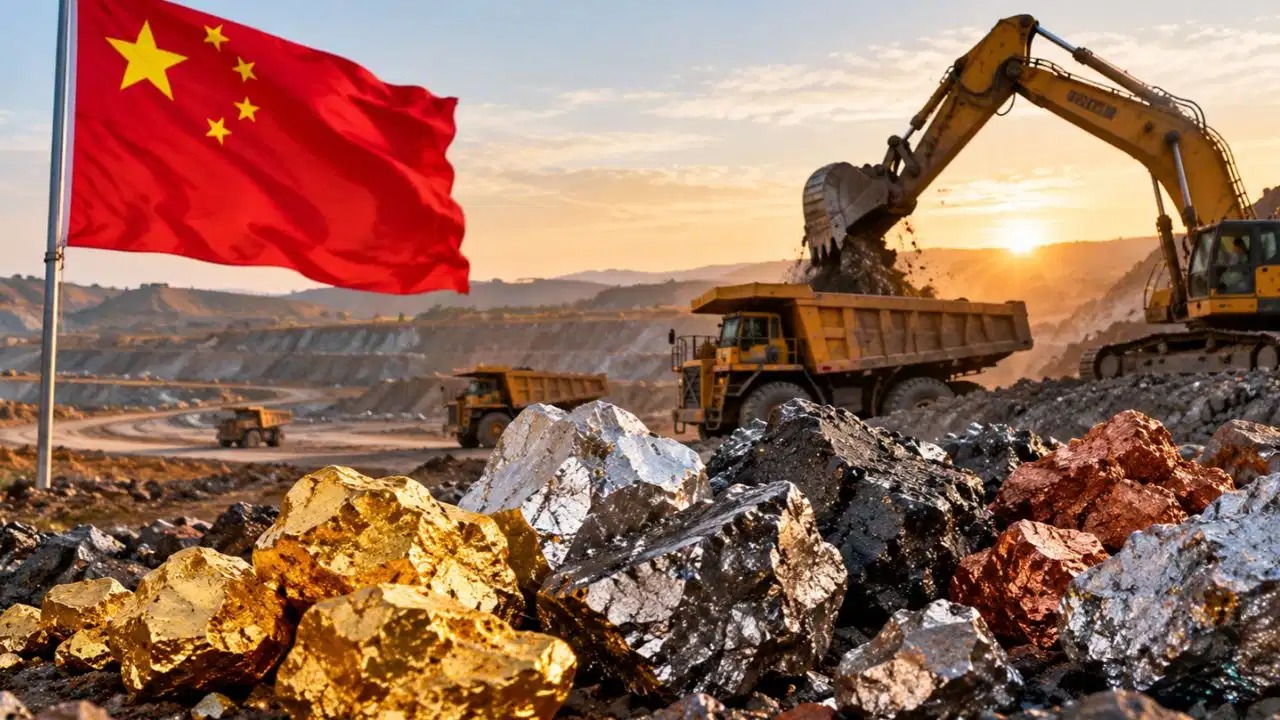
Tezzbuzz Desk– China has achieved great success in terms of natural resources. The country's Ministry of Natural Resources has confirmed a huge increase in the reserves of gold, nickel, rhenium and many other important minerals after re-examining the mineral reserves. Government news agency Xinhua shared information in this regard on Saturday. This new assessment is expected to strengthen the position of China's strategic mineral resources. The special thing is that in this campaign, already existing mines and such mining areas were also re-examined, which were earlier considered to be of low quality or difficult to use. According to the ministry's data, the increase in China's gold reserves is said to be equal to 50 big mines. At the same time, an increase in nickel reserves has been recorded equal to that of 30 big mines. Apart from this, the reserves of minerals like gallium, indium, tantalum and vanadium have also increased. Additional reserves equivalent to 10 large mines have been reported for each of these four minerals. However, these figures reflect increases in reserve estimates and not necessarily the discovery of new mines.
Important information regarding rhenium has also come to light in this campaign. An increase of more than 200 percent has been recorded in China's rhenium reserves. Rhenium is a rare metal that is used to make superalloys that can withstand extreme temperatures. These alloys are used in making important parts of jet engines. Such substances play an important role in the aviation and aerospace industry, as they have to work under extremely high temperatures and pressures. This nationwide campaign lasted for about a year. During this period, special attention was paid to 17 strategic minerals of China. The scope of the investigation included large and medium-sized mining sectors with more than 1,800 operational mines across the country. More than 100 institutions took part in this work. About 2,000 survey workers in 27 provinces, autonomous regions and municipalities of China collected data related to mineral resources. Fresh evaluation of by-products present in old mines was also an important part of this campaign.
Meanwhile, information about the discovery of a new deposit of Zircon in Baicheng in China's Xinjiang region has also come to light. According to Xinhua, the country's first paleofluvial-lacustrine zircon placer deposit has been discovered here. Such deposits are formed by the accumulation of minerals in old river or lake sediments. This discovery is likely to increase the domestic availability of Zircon in China. Zirconium is obtained from Zircon, which is used in making the protective layer of fuel rods in nuclear reactors and in aerospace alloys that can withstand high temperatures. China has long been dependent on imports for its supply of zircon. In such a situation, new reserves can help in strengthening its domestic supply. With the increase in reserves of gold and other strategic minerals, this discovery is also considered important for China's industrial and technological sectors.