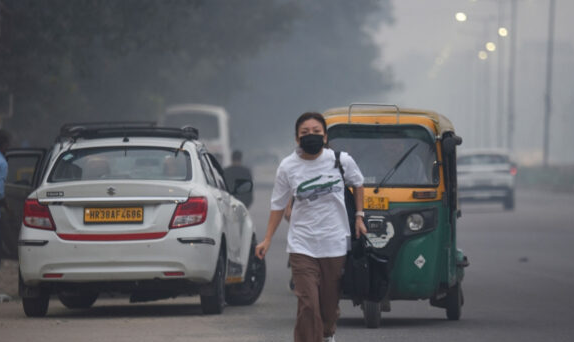
Delhi NCR AQI Report 02 November 2026: There is still one week i.e. 7 days left for Diwali, but already the breathing of 4 crore people of Delhi-NCR is in trouble. On the first day of the week, Monday (October 02, 2026), for the first time this season, Delhi’s air quality has fallen to ‘very poor’ category. The national capital is in the grip of dense smog. There was some relief in the pollution level due to rain last week, but now it has increased rapidly again. This increase in pollution levels has happened a week before Diwali. Firecrackers are usually burnt during Diwali, which further increases the pollution in the air of the capital. The air quality index (AQI) was recorded at 307 at 7:05 am on Monday, while the city’s 24-hour average AQI on Sunday was 261 (‘poor’ category), according to the Central Pollution Control Board (CPCB)’s 4 pm bulletin. A day earlier it was 117 (‘moderate’ category), which means the air quality has deteriorated significantly. Even before this, due to rain on Friday, AQI was 60, as heavy rains had washed away pollution from the air of Delhi. Due to this, the clearest day of October was seen in the last four years. Air pollution will worsen in the coming days. Meteorologist Navdeep Dahiya has warned that the smog season has started. Due to adverse weather conditions, pollution levels may increase further in the coming days. In a post on ‘X’, he said that most of the AQI sensors in Delhi-NCR are now showing AQI level above 300 and at many places it is reaching the range of 400-500 at night. The winds are coming from the north-west direction and the weather is calm. In such a situation, all the particles causing pollution will remain in the environment for a long time. Navdeep Dahiya further said that no improvement in weather conditions is expected for the next 7 to 10 days. He warned that the smog situation in Delhi-NCR and northern plains may worsen. Air quality recorded ‘very poor’ at 36 monitoring stations Of the 59 air quality monitoring stations in Delhi, data was available for 58. Of these, the air quality was recorded as ‘very poor’ at 36 stations. Jahangirpuri was the only station that fell in the ‘severe’ category, where AQI was recorded at 417. The air quality at five stations was ‘moderate’, while the remaining stations were in the ‘poor’ category. What are the rules: According to CPCB, 0-50 AQI is considered good, 51-100 satisfactory, 101-200 moderate, 201-300 poor, 301-400 very poor and 401-500 severe. PM2.5 is the main pollutant As of 6 am on Monday, PM2.5 was the main pollutant at 51 of the 58 reporting stations, while PM10 was the main pollutant at the remaining seven stations, according to the CPCB. At the same time a day earlier, PM2.5 was the main pollutant at 46 out of 57 stations, and PM10 was recorded at 11 stations. The last time Delhi recorded very poor air quality was on February 11, when the 24-hour average AQI was 305. Earlier, on February 4, AQI had reached 339.