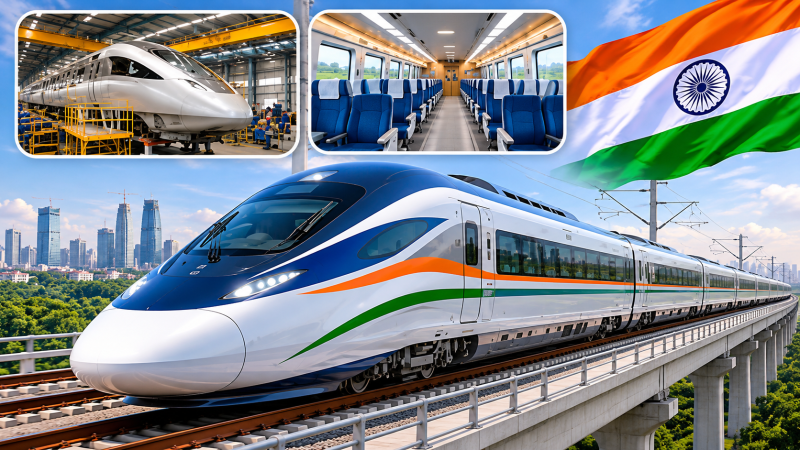
India's first indigenous bullet train is preparing to run on the Mumbai-Ahmedabad high-speed rail corridor. 'Bharat 28' i.e. B-28 trainset will have eight coaches, capacity of 557 passengers, Wi-Fi based entertainment and modern security features. Railways aims to start its commercial operations from August 2027.
Tezzbuzz Desk-An important step is being taken towards developing the high-speed rail network in India. Indigenous trainset 'Bharat 28' (B-28) is being prepared for the proposed bullet train service between Mumbai and Ahmedabad. It is being manufactured at the manufacturing unit of Bharat Earth Movers Limited (BEML) located in Bengaluru. This eight-coach train has been designed keeping in mind modern technology, passenger amenities and energy efficiency. Its operating speed has been set at 249 kilometers per hour and maximum test speed at 280 kilometers per hour.
What happens next after the squeeze test?
Railway Minister Ashwini Vaishnav visited BEML's Aditya Manufacturing Facility in Bengaluru on November 1 and took stock of the manufacturing work of the train. During this time, the squeeze test of the integrated car body of the first coach of the train was in a critical stage. The purpose of this test is to ensure that the structure of the coach is capable of withstanding external pressure and heavy forces. According to the Railway Minister, the squeeze test is in the final stages and is targeted to be completed by next week. After this, propulsion system and other electronic equipment will be installed in the train. Climatic testing will then be conducted to check the performance of the train in different weather conditions. This will take into account conditions like temperatures up to 50 degrees Celsius, extreme cold, dust and heavy rain. BEML is preparing the first two indigenous bullet trains.
Capacity of eight coaches and 557 passengers
The length of 'Bharat 28' trainset will be approximately 202 meters. This will include seven standard class coaches and one executive class coach. Its total passenger capacity has been set at 557. Standard class will have 3×2 seating arrangement, while executive class will have 2×2 seating facility. The train will have four motor cars and four trailer cars. Driver cabs will be made at both its ends. These will have intelligent onboard control system, which will help in coordination with train operations and operation control centre. If needed, a train of 16 coaches can be formed by combining two trainsets of eight coaches each. This will help in increasing the capacity as per the demand of passengers.
Wi-Fi, charging points and modern amenities
Many modern facilities will be provided inside the train for comfortable travel of passengers. It will have comfortable seats, ample legroom, large windows, LED lighting and luggage racks. Separate storage stands will also be provided for larger items. Passengers will get power outlets to charge mobiles and laptops. The train will have a Wi-Fi based infotainment system, through which passengers will be able to enjoy the entertainment content already available. Important information will be shown in Hindi, English and regional languages on the LCD display installed in the coach. Passengers will get updates related to travel through automatic announcement and public address system. Emergency talk-back units will also be installed to contact train staff in case of emergency.
Special arrangements for disabled passengers also
The B-28 train has taken care of the needs of passengers with disabilities and reduced mobility. There will be special space arrangement for two passengers in the train. The floor height corresponding to the platform and the required exit steps on the doors have been designed to facilitate easy boarding and disembarkation of passengers. Additionally, wheelchair-friendly doors, special seats and accessible toilets will be available. Information signs in Braille script will also be installed for the convenience of visually impaired passengers. The train will have bio-digester toilets and heating, ventilation and air-conditioning (HVAC) system, which will help in maintaining a comfortable environment inside the coach in different weather conditions.
Energy saving and aerodynamic design
25 kilovolt AC overhead electrical system will be used in the indigenous bullet train. It will have regenerative braking technology, through which the energy generated during braking can be sent back to the electrical grid. This will help in reducing energy consumption. The body and front part of the train have been given an aerodynamic design. Its purpose is to reduce air resistance, vibration and noise at high speeds. Attention has also been paid to controlling the pressure waves generated while passing through the tunnels. Sound insulation and noise-damping materials will be used in the coaches to provide a relatively quiet environment to the passengers.
When will the bullet train service start?
According to the Railways' plan, the aim is to start trials of the indigenous train on the approximately 100 km long Surat-Vapi section of the Mumbai-Ahmedabad corridor in the first quarter of the financial year 2027-28. It is planned to start commercial operations from August 2027. However, the actual launch will depend on trials and necessary approvals.
The total length of the Mumbai-Ahmedabad high-speed rail corridor is 508 kilometers and is targeted to be completed by December 2030. The 'Bharat 28' project is considered important towards developing indigenous high-speed rail technology in India. Through this, the country is preparing to increase its manufacturing capacity in the field of modern rail transport and provide fast, convenient and technologically advanced travel to the passengers.