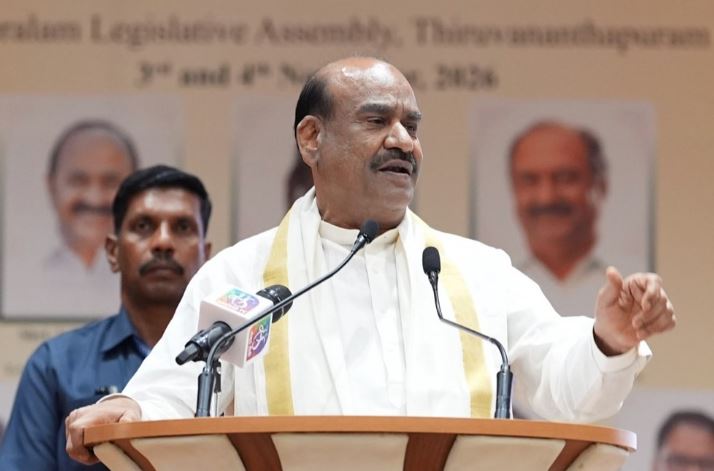
New Delhi, 3 November 2026: Lok Sabha Speaker Om Birla today called on the Public Accounts Committees of Parliament and state legislatures to strengthen their role as guardians of public finances, and stressed that every rupee received from the public treasury should be properly accounted for and fully utilized for the purpose for which it was sanctioned. He said that transparency and accountability are the cornerstones of democracy and the ultimate criterion of public expenditure should be the positive change it brings in the lives of ordinary citizens.
Inaugurating the Conference of Chairpersons of Public Accounts Committees of Parliament and State Legislatures in Thiruvananthapuram, Om Birla said that PAC is an important institution of parliamentary democracy, which has been entrusted with the responsibility of scrutinizing public expenditure, ensuring financial discipline and holding businessmen accountable. He observed that the responsibilities of the committees extend beyond mere examination of accounts and audit findings; They should also evaluate whether public funds have achieved their intended objectives and delivered the outcomes for which they were allocated.
Expressing concern over audit observations remaining undecided for 10, 15 or 20 years, Birla said such long delays raise serious questions on the effectiveness of the system. They called for a concrete, systematic and time-bound action plan to ensure that audit observations and resulting actions are resolved without unnecessary delay. He said the Central and State Governments should work together to strengthen the mechanisms of monitoring, review and follow-up so that accountability is not established merely on paper but translates into timely corrective action.
-
The ability of democratic institutions to rise above political matters
Highlighting the unique democratic tradition of appointing a member of the opposition as the chairperson of the Public Accounts Committee, Birla said that this practice reflects the maturity, inclusiveness and strength of India's parliamentary democracy. Representation from all political parties on the committee ensures that diverse perspectives are brought to the scrutiny of public expenditure. He described this system as an excellent example of the ability of democratic institutions to rise above political matters to achieve common national objectives.
The Speaker of the Lok Sabha noted that members may belong to different political parties, may have different ideologies and may have different views on policies and governance; However, when it comes to safeguarding public money, their responsibilities are joint. PAC should work through dialogue, collaboration, consensus and collective responsibility. Its purpose is not to criticize any individual or the government, but to ensure that public funds are not misused or wasted, that inconsistencies and leakages are stopped and that businesses remain accountable to the public. He emphatically said that the trust of citizens is the foundation of democratic governance. Every rupee of public money represents the aspirations and contribution of the people and hence should be spent with the highest standards of fiscal propriety.
-
evaluation of public expenditure
The Lok Sabha Speaker had emphatically said that evaluation of public expenditure should not be limited to mere figures, allocations and utilization certificates. In case of infrastructure projects, the committees should, where appropriate, visit the project locations and check the quality of work, its timely completion and adherence to prescribed standards. He said such direct evaluation would help establish whether the money spent has resulted in the creation of the desired infrastructure and whether public resources have been used effectively. Similarly, in the case of social welfare schemes, it is necessary to go beyond the amount spent and examine the actual impact of the expenditure. He said that the ultimate objective of public expenditure should be social good and public welfare.