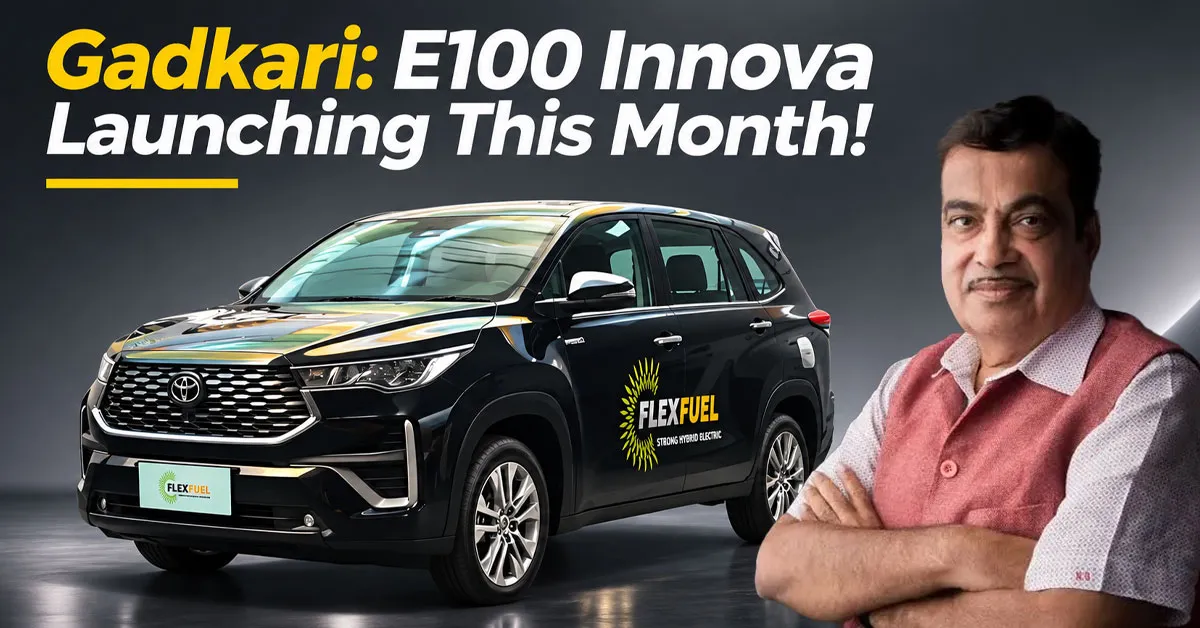
Union Road Transport Minister Nitin Gadkari says he will launch Toyota’s ethanol-powered Innova HyCross in November 2026. The flex-fuel MPV is designed to operate on E100, or fuel made almost entirely from ethanol, as well as compatible petrol-ethanol blends. Gadkari made the announcement at the ENRich 2026 conference in New Delhi on November 2.
The minister said he has been using a Toyota-supplied Innova flex-fuel vehicle for about a year and a half. However, Toyota has not yet announced a showroom launch date, booking amount, price or final production specifications. The distinction matters: a ministerial unveiling is not necessarily the same as customers being able to buy the vehicle immediately.
The technology is not new. Toyota Kirloskar Motor unveiled an Innova HyCross-based electrified flex-fuel prototype in August 2023. It combined a petrol engine modified to use high-ethanol fuels with a strong-hybrid system. At the time, Toyota and the government said further testing, calibration and certification would be required before a commercial version could arrive.
The hybrid arrangement is significant. A conventional flex-fuel engine has to burn the fuel to move the car. Toyota’s system can also use the electric motor and battery at suitable speeds, reducing how often the engine needs to run. That could help compensate for ethanol’s lower energy content, although Toyota has not published certified fuel economy or electric-running figures for the proposed production E100 Innova.
Gadkari had earlier indicated that the Innova would be launched in October. That did not produce a confirmed retail launch, and he has now referred to November instead. Until Toyota releases its own announcement, it is sensible to treat this as an expected unveiling rather than a firm customer delivery schedule.
On October 26, the Ministry of Road Transport and Highways amended the Central Motor Vehicles Rules to include E100 in the certification framework for flex-fuel vehicles. Earlier provisions covered E85. The change gives manufacturers a clearer route to homologate vehicles designed for very high ethanol content.
It does not mean existing petrol cars can suddenly run on pure ethanol. Fuel pipes, seals, engine controls and other components must be suitable for the approved fuel. Most cars sold today are designed for lower blends such as E20. Owners should use only the fuel specified in the vehicle’s manual and compatibility label.
Gadkari also named Tata Motors, Mahindra, Suzuki and Hyundai among manufacturers working on ethanol-compatible vehicles. Maruti Suzuki has already introduced the WagonR Bioflex, although Business Today reports only 20 registrations since its June 2026 launch. That small figure illustrates how early the market remains.
The more difficult question is fuel availability. E20 petrol is widely supplied, but there is no comparable nationwide network of E100 pumps. A flexible-fuel vehicle can use other approved blends, which helps, but the case for paying extra for E100 capability becomes weaker if pure ethanol is not available near the owner.
Gadkari cited ethanol at about Rs 75 per litre against petrol at roughly Rs 120. Those were figures he used in his remarks, not a confirmed nationwide retail price for E100. Ethanol also contains less energy per litre than petrol, so its lower price does not automatically produce equally large savings per kilometre. Actual fuel economy and pump prices are needed to make that calculation.