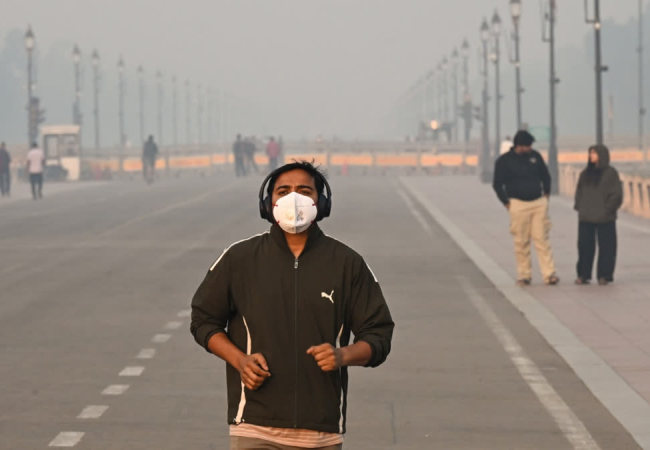
New Delhi. Even before Diwali, the effects of air pollution have started becoming visible in Delhi-NCR. The increasing level of pollution is also increasing the concern for people's health. Health experts have been continuously alerting that toxic smoke, dust and fine pollution particles dissolved in the air can reach inside the body with breath and cause damage to everything from lungs to heart and brain.
Read :- Lahore AQI: Lahore becomes the most polluted city in the world, know which city is at second and third place.
Dangerous levels of pollution were seen in many parts of Delhi-NCR on Wednesday. In most places the Air Quality Index (AQI) was recorded between 350-400. This level of AQI is considered severe and dangerous. According to the data of Central Pollution Control Board (CPCB) at 8 am, AQI of Delhi was recorded at 377, Noida at 314, Greater Noida at 266, Ghaziabad at 236, Gurugram at 324. In areas like Dwarka-Mundka and Jahangirpuri of Delhi, AQI has reached close to 450. 426 AQI was recorded in Noida Sector 62. Along with air pollution, alert is also being raised about the increasing amount of black carbon in the air of Delhi-NCR.
First know how dangerous is crossing AQI 400?
The air quality in Delhi-NCR is reaching very poor condition. On Tuesday, AQI remained beyond 400 in most parts of Delhi-NCR, more or less the same situation was seen on Wednesday. Air Quality Index tells the level of pollution present in the air. Levels between 401-500 on the AQI scale are considered severe. Pollutants in the air can affect even healthy people. At the same time, the risk increases for people already suffering from asthma, respiratory disease, heart disease and lung problems. Due to exposure to such air, problems like cough, sore throat, burning sensation in the eyes, shortness of breath and heaviness in the chest can occur.
What are the problems caused by black carbon?
Read :- 'What is the relation of firecrackers with religion?' Important comment of Supreme Court on ban in Delhi-NCR
Black Carbon is called soot in common language. Black carbon is released from the smoke of diesel vehicles, burning of coal, wood or other organic fuels. Burning of stubble increases its risk significantly. According to the World Health Organization (WHO), black carbon is also a part of PM2.5 particles. These are so small that they can reach inside the lungs with the breath.
The particles of black carbon are very small. By breathing polluted air, these particles can reach inside the lungs. Constant exposure to these increases the risk of swelling in the body and respiratory problems. In asthma patients, these can increase breathing problems and asthma attacks. The risk of problems related to heart and blood vessels has also been seen to increase due to exposure to black carbon.
What to do to avoid pollution?
The AQI in Delhi-NCR has already crossed 400, experts have feared that the situation may become more dangerous in the coming days. In such a situation, everyone should keep taking preventive measures.
Avoid walking or running outside in the morning and evening. Instead of exercising outdoors, do light exercise indoors. Wear a well-fitting mask when going out. Keep the windows and doors of the house closed. If the level of pollution outside is high, take more precautions. Children, elderly, pregnant women and asthma and heart patients should take special caution. If you have trouble breathing, chest pain or persistent cough, contact your doctor.