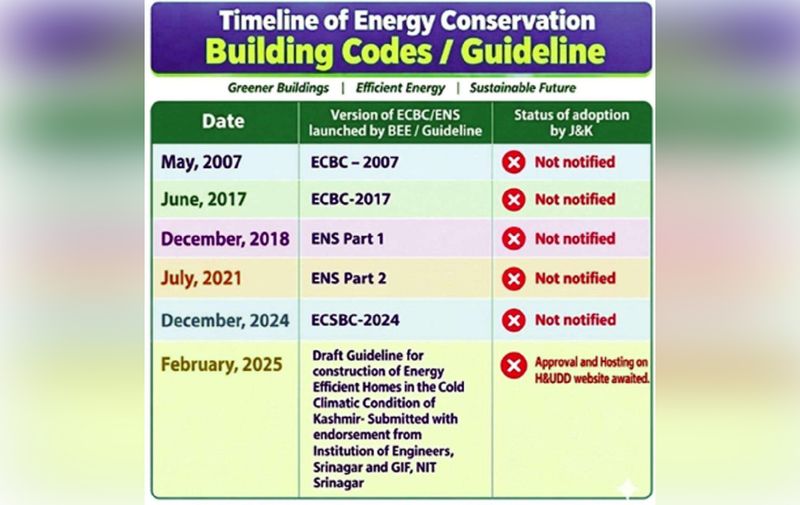
Due to harsh climatic conditions and lossy design, buildings in J&K consume nearly 50% of the total energy, compared with around 35% at the national level. However, energy efficiency in buildings remains largely an unknown concept in J&K. People are familiar with star ratings for water heaters, air conditioners, refrigerators, washing machines and other appliances, but the concept of star-rated buildings is virtually unknown here, even among town planners, development agencies, architects and engineers, let alone the general public.
One of the reasons for this lack of awareness and implementation is that J&K is yet to adopt the Energy Conservation Building Code (ECBC) and Eco-Niwas Samhita – ENS (Energy Conservation Building Code for Residential Buildings). Bureau of Energy Efficiency (BEE) established under the Energy Conservation Act, 2001, introduced the ECBC for commercial buildings in 2007 and updated it in 2017. Jammu & Kashmir has not yet adopted the code despite submitting amendments for approval in 2022. BEE also launched the updated Energy Conservation and Sustainable Building Code for commercial buildings (ECSBC-2024), along with the Energy Conservation and Sustainable Building Code for Residential Buildings (Eco Niwas Samhita ENS – 2024), neither of which J&K has adopted till date. J&K is therefore 19 years behind in this regard.
For the ECSBC, formerly known as ECBC, to become legally binding and enforceable within UT, a two-step statutory process must be completed: 1. UT Gazette Notification: Under Section 15(a) of the Energy Conservation Act, 2001, the UT Government must first formally amend the central code to suit local climatic conditions and notify the State ECSBC Rules in its official government gazette. 2. Incorporation into Building Bye-laws. Following notification, the code must be integrated into the local municipal or development authority building bye-laws to operationalize the sanctioning and approval process. Merely incorporating few clauses into the local building bye-laws is not sufficient under the legal framework of the Energy Conservation Act. This is precisely what the Housing and Urban Development Department (H&UDD) has done, it has undertaken only Step 2 only, which is not sufficient for effective implementation of the code.
The ECBC was accordingly amended by Power Development Department with the assistance of a consultant appointed by BEE and the ECBC/ENS committee in a meeting chaired by Administrative Secretary, H&UDD in July 2022, cleared the code and submitted same for notification by the government, which is still awaited.
Kashmir Valley and the upper reaches of Jammu have temperate climatic conditions, whereas the remaining areas of the UT are predominantly tropical. Accordingly, the ECBC was suitably amended to reflect the local climatic conditions. The threshold load for large commercial buildings was also reduced from 100 kW to 50 kW, thereby bringing a larger number of commercial buildings within the ambit of the code.
There are no comprehensive guidelines available for the common masses in J&K who intend to construct new houses or renovate existing ones. One such guideline titled “Guideline for Construction of Energy-Efficient Homes in the Cold Climatic Conditions of Kashmir” was prepared to help make homes more comfortable and energy-efficient. The guideline was examined by the Institution of Engineers and GIF, NIT Srinagar and subsequently endorsed to the H&UDD in February, 2025 for hosting it on its website. However, the same is also still awaited. Similar Guideline is required to be prepared for the tropical climatic conditions of Jammu Region.
The energy costs of lossy houses in Kashmir for space and water heating are extremely high. To illustrate with an example, underfloor heating (Electrical Hamam) in Kashmir is generally designed for such houses at around 20 watts per sq. ft. of floor area. In Germany, however, underfloor heating in houses constructed on Energy Efficient Passive House principles is designed at around 1 watt per sq. ft., despite minimum temperatures of Germany falling below the temperature of Kashmir during winters. Similarly the cooling costs of houses in Jammu Region, not constructed on energy efficient principles are also extremely high during summer season.
It is ironic that people invest their lifetime savings in constructing new houses, only to end up with structures that are not adequately suited for living in extreme climatic conditions due to poor thermal comfort. The energy costs of these houses are also extremely high. The roof designs of most of new houses are neither suitable for rooftop solar installations and solar water heaters nor conducive to rainwater harvesting. Similarly, large south-facing windows, which are important for harnessing solar radiation during winter, are missing in most of the homes.
With proper orientation and tilt angle, the roof of a building can be designed to optimally accommodate a rooftop solar PV system capable of generating the building’s entire annual energy requirement. A building designed to achieve such a balance between energy consumption and on-site renewable energy generation is termed a Net-Zero Energy Building. Such a building can effectively eliminate the net carbon emissions associated with its energy consumption, particularly those arising from thermal power generation. About 53% of J&K’s electricity requirement is still met through thermal power, resulting in approximately 8 million tons of CO? emissions annually. Improving energy efficiency and expanding renewable energy generation through energy-efficient green building design can substantially reduce these emissions.
Experience among local architects and engineers in J&K regarding other measures for enhancing comfort and energy efficiency in buildings, such as the use of green building materials, insulation, high-performance windows, thermal-bridge-free design, and mechanical ventilation, is also largely lacking.
The Indian climate is predominantly tropical, whereas Kashmir and the upper reaches of Jammu have a temperate and cold climate, with winter temperatures falling below 0°C. Therefore, it may not be appropriate to simply adopt the construction practices applicable to the rest of the country for ensuring the thermal efficiency of buildings in J&K.
Implementing energy-efficiency and green-building principles in Jammu and Kashmir will not only promote environmental sustainability and improve the quality of life of residents but also create significant business opportunities for emerging startups. Encouraging the adoption of clean and efficient energy practices can foster green innovation and entrepreneurship across the region.
Furthermore, these initiatives represent a proactive approach to addressing global warming, an urgent challenge already affecting Jammu and Kashmir and other Himalayan regions through erratic weather patterns, shrinking glaciers, flash floods and ecological imbalances. Adopting such measures will help safeguard the region’s natural resources, stimulate economic growth, strengthen energy resilience, and, at the same time, provide greater thermal comfort to residents during harsh winters.