
Speaking at the Fortune Southeast Asia 500 Summit in HCMC on Nov. 3, Ashley Zhang, Asia-Pacific regional head at the Institute of International Finance (IIF), said an international financial center should perform three core functions: attract global capital, strengthen regional connectivity, and address gaps in currency-related financial services.
Financial centers cannot operate in isolation but must function as part of an interconnected network, she said.
“This is precisely the connectivity function. Rather than becoming a standalone center trying to attract all resources to itself, Vietnam International Financial Center-HCMC should help make capital more accessible across the region,” she said.
The center should also support multicurrency structures, payment infrastructure and risk-hedging mechanisms rather than rely on a single currency.
The IIF represents around 400 members in more than 60 countries, including commercial and investment banks, funds, asset managers and other financial institutions.
|
Ashley Zhang, Asia-Pacific regional head at the Institute of International Finance, speaks at Fortune Southeast Asia 500 Summit in HCMC on Nov. 3, 2026. Photo courtesy of Fortune |
HCMC recently rose 17 places to 67th in the Global Financial Centers Index, compiled by British consultancy Z/Yen Partners and the China Development Institute, according to background information on VIFC-HCMC.
The city is one of two locations designated to host Vietnam’s international financial center under a single-center, two-location model.
VIFC-HCMC has attracted 10 members and plans to introduce procedures and regulations this month for admitting investment funds.
Richard D. McClellan, CEO of VIFC-HCMC, said the center aims to bridge domestic regulations and international standards, removing barriers that could hinder capital flows into Vietnamese projects.
It will gradually open sectors and services as their legal frameworks are completed, with further regulations expected to be approved in the coming weeks.
“Over the next five to 10 years, we aim to develop the financial infrastructure needed to coordinate and process capital flows worth hundreds of billions of U.S. dollars,” he said.
Governance and transparency key to attracting capital
Experts at the summit said Vietnam has significant potential to attract international investment through its financial center but must strengthen its institutional framework to meet investor expectations.
Warrick Cleine MBE, chairman and CEO of KPMG Vietnam and Cambodia, said Vietnam had recorded strong economic growth over the past three decades, improving prosperity across generations. He believes the trend could continue, but the economy’s growing complexity requires new channels to attract foreign capital.
VIFC could help remove regulatory and institutional barriers that discourage international investors, he said.
“But when capital arrives, companies need to improve their governance, transparency, and disclosure standards,” he said.
Pham Hong Hai, deputy CEO of UOB Vietnam, cited Vietnam’s strong economic growth, robust consumption and deeper integration into global supply chains. The country’s stock market upgrade also creates opportunities to attract foreign investment, he said.
However, financial infrastructure and regulations still need to be developed to meet international standards. Unresolved issues include capital controls and the registration of ownership rights for foreign investors.
“The direction is clear. What remains is implementation,” he said.
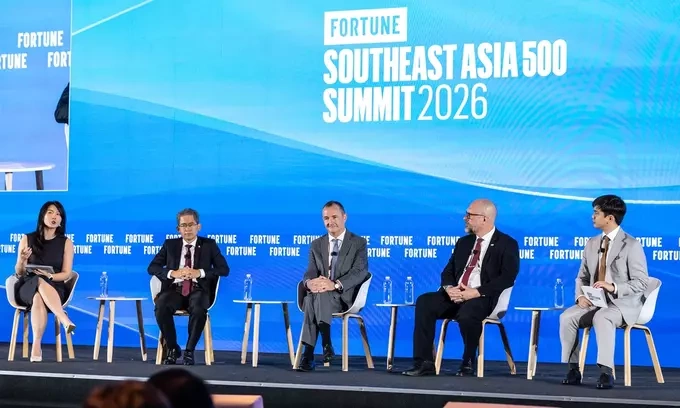 |
|
Experts discuss the development of Vietnam’s international financial center at the Fortune Southeast Asia 500 Summit on Nov. 3, 2026. Photo courtesy of Fortune |
Deputy Minister of Finance Le Tan Can said Vietnam is developing an integrated economic ecosystem connecting domestic and foreign businesses. Priorities include logistics infrastructure, data systems, clean energy and a skilled workforce.
The country is also seeking to harness new growth drivers, particularly capital markets, free trade zones and international financial centers. Financial institutions, investment funds and fintech companies are expected to participate in developing the center.
Zhang also pointed to a broader challenge facing Southeast Asia: despite improving profitability, international investors remain cautious because of limited policy predictability and inconsistent implementation.
Addressing these concerns will be essential for Vietnam and other regional economies seeking to attract and retain international capital.