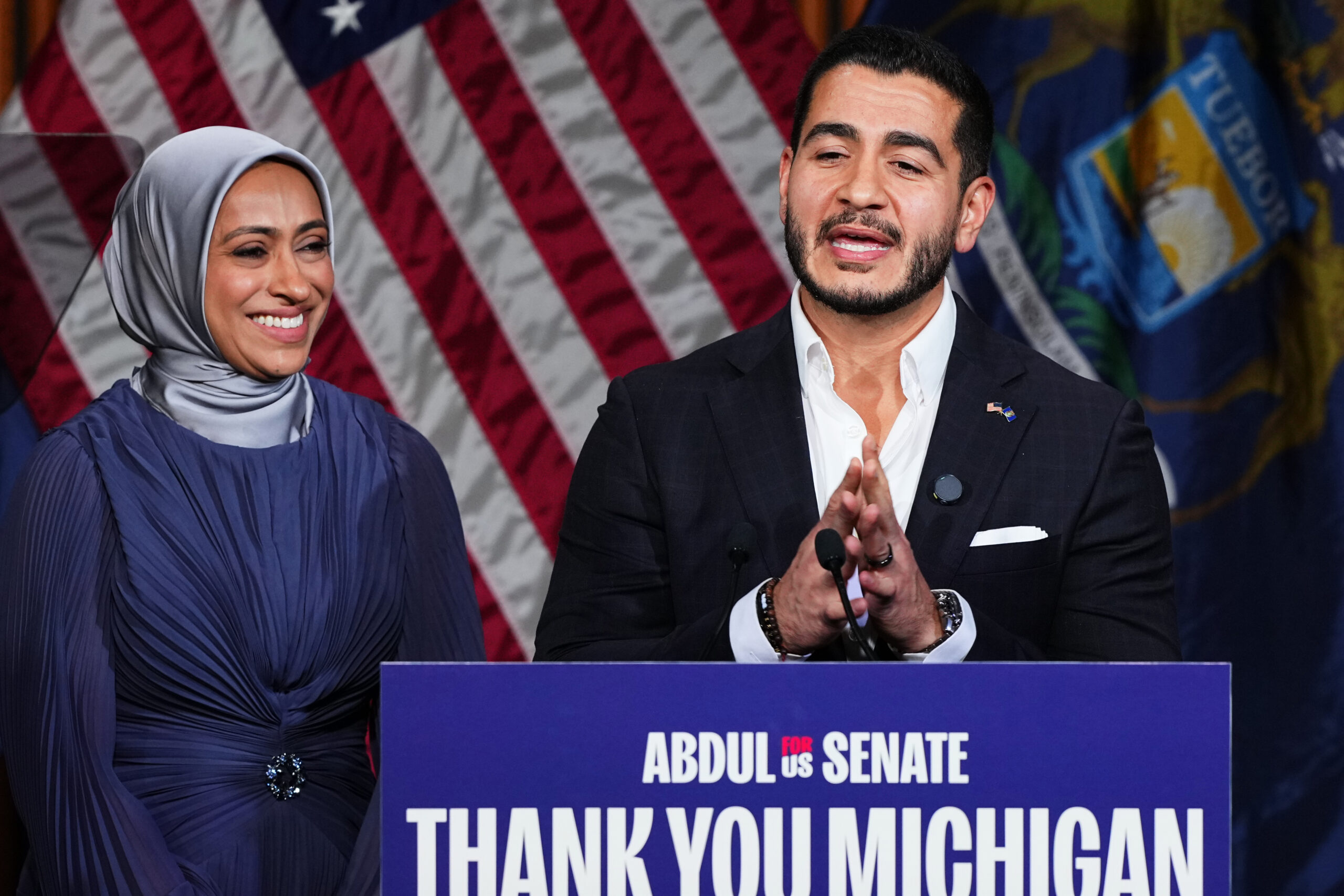
‘A Beautifully American Story’: Muslim Americans Celebrate El-Sayed’s Win/ NEWSLOOKS/ WASHINGTON/ J. Mansour/ Abdul El-Sayed’s election as the nation’s first Muslim senator sparked celebrations among Muslim Americans after a campaign marked by anti-Muslim attacks. Supporters described his Michigan victory as a milestone for representation, while emphasizing the policies and coalition-building behind his success. El-Sayed said the result demonstrated that Americans of different backgrounds belong in the country’s political life.


Quick Look
- Historic election: El-Sayed defeated Republican Mike Rogers to become the first Muslim elected to the U.S. Senate.
- Campaign backlash: Muslim American leaders celebrated the result as a rejection of anti-Muslim rhetoric.
- Dearborn enthusiasm: Mayor Abdullah Hammoud credited both strong participation and El-Sayed’s policy platform.
- Identity and representation: Supporters highlighted the significance of hearing El-Sayed use his full name in his victory speech.
- Broader message: El-Sayed said his election represented people who feel excluded from government.
- Religious freedom debate: Muslim leaders challenged Republican portrayals of Sharia as a constitutional threat.
- Future generations: Advocates said the victory could encourage more Muslim Americans to seek office.


Deep Look
El-Sayed’s Victory Carries Meaning Beyond Michigan
DEARBORN, Mich. — Abdul El-Sayed campaigned to represent Michigan rather than emphasizing the possibility of becoming the nation’s first Muslim senator. After winning, however, he embraced the significance of a result that resonated with Muslim Americans across the country.
His defeat of Republican Mike Rogers, confirmed early Wednesday, followed a campaign in which President Donald Trump and other Republicans targeted his religion and questioned his loyalties.
“They tried to demonize people because of how they pray,” El-Sayed told The Associated Press on Wednesday. “And Michigan — the whole Michigan — clapped back. People don’t want that. They’re sick of it.”
During his victory speech, he introduced himself with a declaration that carried particular meaning for many supporters:
“My name is Abdulrahman Mohamed El-Sayed.”
For Muslim Americans who grew up amid the suspicion and hostility that followed the Sept. 11 attacks, the moment offered a powerful expression of belonging.
Muslim Leaders Describe a Rejection of Anti-Muslim Politics
El-Sayed’s campaign unfolded amid heightened anti-Muslim rhetoric following Zohran Mamdani’s election as New York City mayor a year earlier.
Trump called El-Sayed a “jihadist” who was “on the side of the terrorists.” Those attacks sought to associate the candidate with extremism without substantiating such ties.
Meanwhile, dozens of congressional Republicans formed a Sharia-Free America Caucus, portraying Islam’s religious code as a danger to the Constitution.
Nihad Awad, national executive director of the Council on American-Islamic Relations, described El-Sayed’s victory as a broader political milestone.
The outcome “represents a historic turning point for American Muslim political engagement and a historic defeat for the politics of hate,” Awad said.
“Anti-Muslim extremists, Israel lobby groups and even the president of the United States used every smear in the book to paint Dr. El-Sayed as a Muslim boogeyman,” he added. “None of it was true, and none of it worked. Anti-Muslim hate was on the ballot, and it failed.”
Dearborn Celebrates “A Beautifully American Story”
In Dearborn, home to a substantial Arab American population, Mayor Abdullah Hammoud said residents turned out in large numbers.
“What a beautifully American story,” Hammoud said. “One of our brightest and best earned the support of the majority of Michiganders who participated in yesterday’s election. And regardless of the direction in which he prays, they’re sending him to the U.S. Senate.”
Hammoud, who has known El-Sayed for more than a decade, said shared identity alone did not explain his appeal.
He pointed to Dearborn’s support for Bernie Sanders’ 2016 presidential campaign as evidence that progressive policies and authentic engagement mattered to the community. Sanders is Jewish and serves as an independent senator who caucuses with Democrats.
In El-Sayed, Dearborn residents “finally saw themselves and a candidate who appealed to them, but it had to do with far more than just his ethnicity or his religion,” Hammoud said.
“It was honestly because of the policies and building a coalition with this community in an honest way.”
Supporters Find Pride in His Name and Heritage
Zaynah Jadallah, 26, said canvassing in Dearborn frequently meant meeting residents who already intended to support El-Sayed and then offered her food or water.
She attributed that familiarity to his grassroots campaign and openness about his Egyptian heritage.
“He’s always been proud of his identity. He never shied away from it or from saying his name,” Jadallah said.
Yasmin El-Sayed, who is not related to the senator-elect, traveled from New York with her two daughters to attend the Detroit election watch party. His victory speech brought her to tears.
“Having grown up in a post-9/11 world, being Muslim, being Arab myself, never in a million years did I think we would see what we saw today,” she said.
Senator-Elect Offers a Broader Message of Belonging
El-Sayed said the result belonged to people who have struggled to see themselves represented in government.
He described it as a victory for those “who don’t see themselves reflected in our government or who’ve been told that they don’t belong for some reason or another — not just how they pray but who they love, how they identify, the color of their skin, where they grew up.”
“I didn’t run to be the first Muslim senator. I ran to be the next senator of the state of Michigan who happens to be Muslim,” he said. “But I also know that democracy is constantly about the conversation about who we are, who we want to be.”
He argued that Michigan voters had rejected a campaign focused on his identity rather than their concerns.
“Michigan proved just how big we are. Rejected a hateful, spiteful campaign that had nothing to say about the issues and only wanted to point to my name and my face,” he said.
“I want all of those folks out there who have been told that America’s not big enough for them to reflect on that. America really is big enough for all of us.”
Advocates See Possibilities for Future Generations
Mohamed Gula, CEO of Emgage Action, said the victory followed a year of “extremely Islamophobic and disgusting rhetoric being used as a campaign strategy.”
“For Abdul to come out last night and use his full name meant the world to someone who grew up in post-9/11 America, where the Muslim American community was seen through a national security lens,” Gula said.
“Our children, years from now, will be able to run for office,” he added, “to be seen as who they are.”
For advocates, the significance extended beyond electing one candidate to challenging assumptions about whether visible Muslim identity prevents success in competitive elections.
Sharia Debate Highlights Disputes Over Religious Freedom
The campaign also intensified arguments over Shariawhich provides Muslims with religious guidance on living righteous lives.
At the Republican midterm convention in Dallas, Texas Sen. Ted Cruz drew loud applause when he declared: “Sharia law has no place in America.”
Muslim civic leaders and scholars challenged portrayals of ordinary religious practice as a threat to American law.
They described Sharia as practiced by Muslims in the United States as guidance sharing features with other faith traditions, including the Ten Commandments and Jewish religious law derived from the Torah. They rejected claims that those practices inherently threaten the Constitution or judicial system.
Gula noted that Texas Gov. Greg Abbott and Attorney General Ken Paxtonboth prominent participants in the anti-Sharia campaign, lost their elections Tuesday. Democrat Gina Hinojosa defeated Abbottwhile Democrat James Talarico beat Paxton in the Senate race.
“I saw this as not just Muslims standing against Islamophobia as never before,” Gula said. “I saw Americans saying hate will not be used as a campaign issue … we are not going to accept hate.”
Victory Offers Hope Without Ending Prejudice
Asma Uddin, a professor at Michigan State University’s College of Law, said politicians have increasingly depicted Muslim prayer, clothing choices, family counseling and mosque attendance as signs of political danger.
El-Sayed’s election offered a counterpoint to that rhetoric.
“What I find especially exciting is that El-Sayed won in a political climate where being visibly Muslim can still be a liability,” Uddin said.
His victory “gives us real reason for optimism. It suggests that anti-Muslim attacks don’t necessarily carry the political weight that those deploying them assume they do.”
More on US News