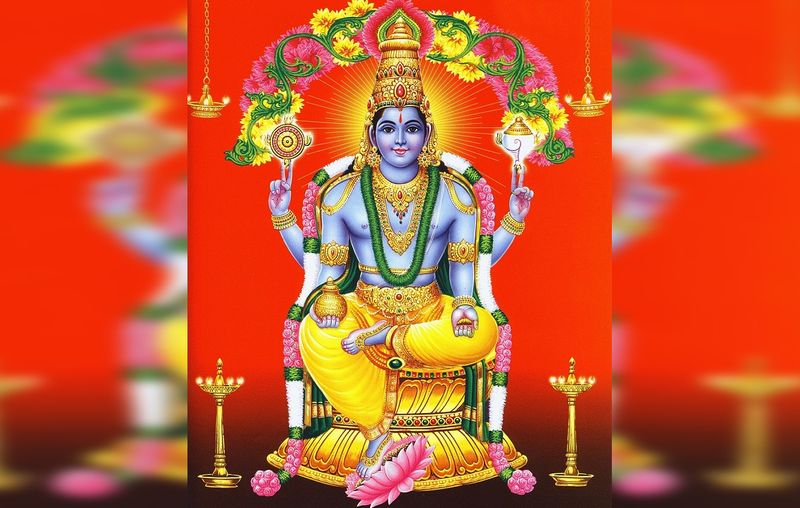
During Dhanteras, millions worship Lord Dhanvantari, the supreme incarnation of Lord Vishnu who emerged from the Samudra Manthan (cosmic ocean) as the father of Ayurveda.
Holding the Amrit Kalash (pot of immortality), the Shanka (conch), the Chakra (discus), and life-saving medicinal herbs, he stands as the ultimate protector against disease and mortality. While Puranic texts locate his earthly kingdom in Kashi, the profound symbols of Dhanvantari’s divine anatomy, his weapons, and his healing nectar find their most vivid earthly reflection in the legacy of ancient Kashmir.
The Divine Herb-Bearer and the Valley of Nectar
In traditional iconography, Lord Dhanvantari’s four arms represent the dynamic expansion of life force. In one hand, he holds the fresh, life-giving Oushadhi (herbs). For millennia, the alpine meadows and glacial slopes of Kashmir served as the physical manifestation of Dhanvantari’s hand.
Kashmir was globally revered as the ultimate Oushadhi Bhumi (land of medicinal herbs). The region’s unique climate nurtured highly potent, rare botanical treasures like Kuth (Saussurea costus) and Mushkbala, which became foundational to ancient Ayurvedic pharmacopoeia. Early scholars believed that the high-altitude Himalayan flora of Kashmir possessed unparalleled healing potency because the soil itself had been sanctified by the overflowing drops of the Amrit Kalash carried by Lord Dhanvantari.
The Conch of Knowledge and Kashmir’s Sharda Legacy
Lord Dhanvantari holds the Shanka (conch shell), symbolizing the cosmic vibration that drives away the darkness of ignorance and disease. He is the master of Ashtanga Ayurveda (the eight branches of medicine), including complex ancient surgery (Shalya Chikitsa).
This divine aspect of Dhanvantari as the ultimate repository of structured medical knowledge resonated perfectly with Kashmir’s identity as Sharda Peeth-the cradle of learning. Kashmiri polymaths adopted Dhanvantari’s analytical scientific temperament. It was in this intellectual sanctuary of Kashmir that foundational Ayurvedic texts were preserved, deeply studied, and updated. The region transformed Dhanvantari’s cosmic medical blueprints into structured, practical systems of daily community health.
The Discus of Protection and the Concept of Prana
The Chakra (discus) in Lord Dhanvantari’s hand represents his power to cut through the core roots of disease and restore cosmic order (Dharma) within the human body. He taught that the body is a universe in miniature, governed by Prana (life energy).
This exact cosmic philosophy anchors Kashmir Shaivism. The great sages of Kashmir mirrored Dhanvantari’s teachings by declaring that spiritual enlightenment is impossible without a purified, healthy physical body . The Chakra of Dhanvantari represents the internal cleansing of the body’s energy centres, a concept that Kashmiri mystics integrated into their daily spiritual practices.
A Living Tribute to the Lord of Healing
By viewing Kashmir through the lens of Lord Dhanvantari, we see that the Valley is not just a geographical paradise, but a sacred landscape engineered for human wellness. Celebrating Dhanvantari Jayanti with a focus on Kashmir is a powerful reminder of our duty to protect this fragile Himalayan ecosystem. Safeguarding Kashmir’s unique medicinal wealth is the truest way to honour the eternal, life-preserving legacy of the Divine Physician.