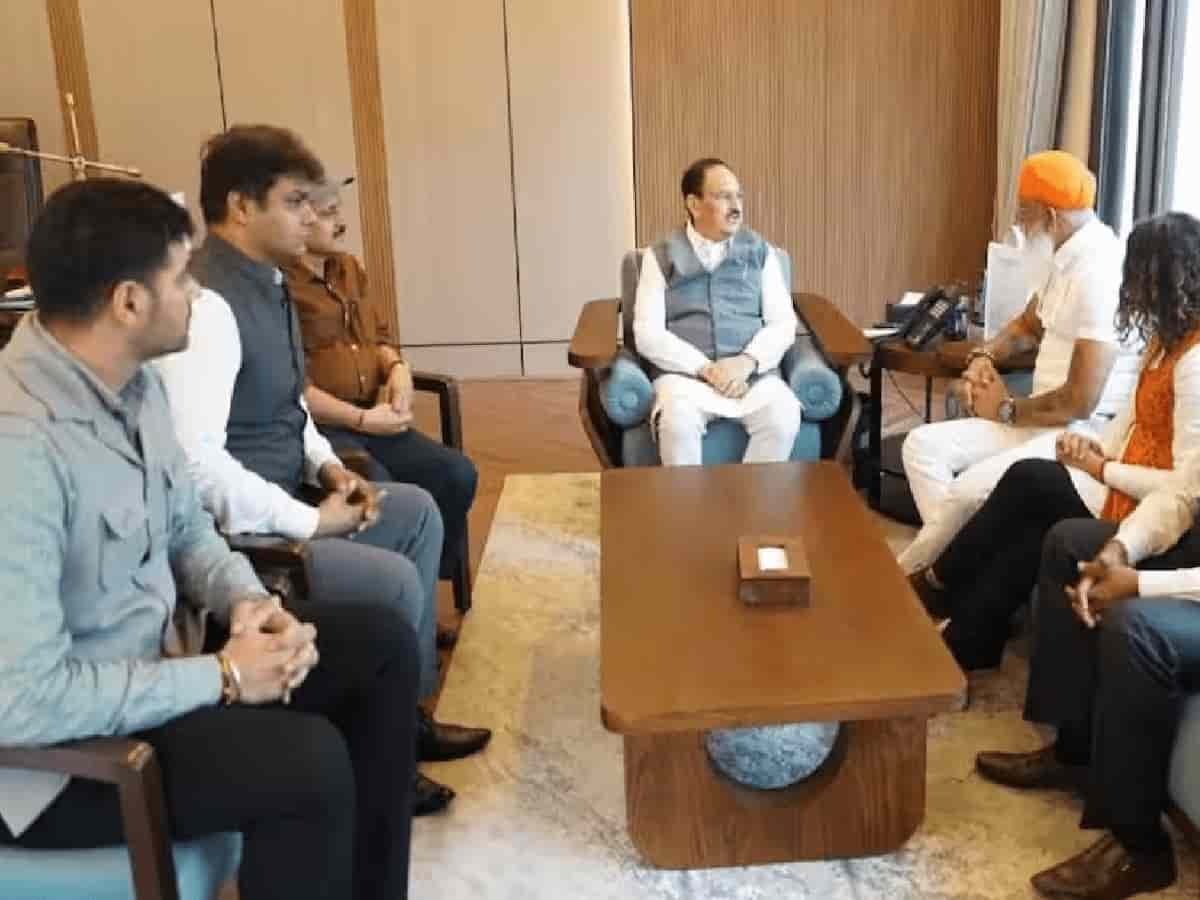
In a major political and administrative development surrounding higher education governance, the central government has assured community representatives that the controversial University Grants Commission (UGC) Guidelines 2026 will not be enforced in their existing draft framework. The development emerged following the conclusion of the second round of high-level consultations between a delegation of the Upper Caste Mahapanchayat Committee and Union Minister Jagat Prakash Nadda in the national capital. Addressing the media and releasing a public statement after the dialogue, Kshatriya Karni Sena National President Dr. Raj Shekhawat termed the administration’s formal commitment a significant triumph of collective representation, democratic engagement, and sustained dialogue. The Centre has signaled the establishment of a specialized review committee tasked with re-evaluating the regulatory provisions, ensuring that constitutional protections, statutory equity, and the rights of general category students remain safeguarded.
Consensus Reached in Round Two: Government Pauses Current Implementation
The contentious regulations notified under the proposed UGC Guidelines 2026 had triggered vocal resistance across multiple student bodies, legal scholars, and community associations over past months. Critics had argued that several ambiguous clauses governing equity, campus grievance mechanisms, and institutional classifications risked administrative subjectivity, potentially alienating general category candidates and creating friction across university campuses.
Taking to social media platform X following the discussions with Union Minister J.P. Nadda, Dr. Raj Shekhawat disclosed the substantive outcomes of the closed-door dialogue. He affirmed that the ministerial delegation had categorically clarified that the UGC Guidelines 2026 would not proceed in their present iteration. According to Shekhawat, the government reiterated its intention to set up an expert review committee to carry out a comprehensive re-examination of the regulatory language. The primary mandate of this panel will be to formulate amendments that align with principles of universal parity, constitutional guarantees, and binding jurisprudence previously articulated by the Supreme Court of India.
Supreme Court Interventions: Centre’s Pledges on Record Before the Apex Court
The political assurances extended to the Mahapanchayat delegation mirror the legal stance formally communicated by the Union of India before the highest judicial forum. On Thursday, November 5, 2026, a Supreme Court bench headed by Chief Justice of India Surya Kant took up a batch of writ petitions challenging the constitutional validity and equity provisions of the proposed UGC regulatory framework.
During the court proceedings, Solicitor General Tushar Mehta, representing the central government, informed the apex bench that the Union administration was actively considering the appointment of a specialized committee to revisit and overhaul the contentious regulations. The Solicitor General assured the bench that the government was approaching the matter with sensitivity to ensure that no student segment felt marginalized, insecure, or dissatisfied. The Supreme Court, while deferring the hearing, observed that protecting the welfare and mental security of every single student is paramount, remarking that regulatory bodies must take into account the genuine sentiments and future aspirations of the nation’s youth when framing institutional rules.
Karni Sena and Mahapanchayat Stance: A Broader Movement for General Category Equity
Reflecting on the timeline of the agitation, Dr. Raj Shekhawat highlighted that the Centre’s latest undertaking aligns with the preliminary commitments made during back-channel discussions on September 20, which culminated in the government’s formal undertakings to the Supreme Court. Emphasizing the collective nature of the demonstration, Shekhawat noted that the movement’s progress was not the achievement of any single entity or community front, but a victory for civil voices advocating an equitable educational framework.
The Upper Caste Mahapanchayat Committee and community leadership have maintained that affirmative campus regulations should prevent unfair discrimination without creating institutional imbalances that disadvantage meritorious students. The leadership reaffirmed that they will closely monitor the formal notification establishing the review committee, the composition of its members, and the transparent release of revised draft recommendations before finalizing their future course of action.
Institutional Balancing Act: University Campuses Await Policy Redraft
The Ministry of Education and the University Grants Commission now face the complex task of harmonizing institutional reform with campus harmony. Creating robust anti-discrimination mechanisms that prevent harassment across all social segments while addressing legitimate anxieties regarding reverse discrimination requires nuanced administrative drafting.
Academic administrators and student welfare bodies have welcomed the consultative pause, noting that hasty implementation of sensitive campus mandates often leads to protracted litigation and campus polarization. By deferring the current guidelines and engaging with diverse stakeholders—including legal experts, university vice-chancellors, student representatives, and civil rights advocates—the Centre aims to establish a balanced regulatory framework that strengthens higher education governance while preserving constitutional fairness for all students nationwide.