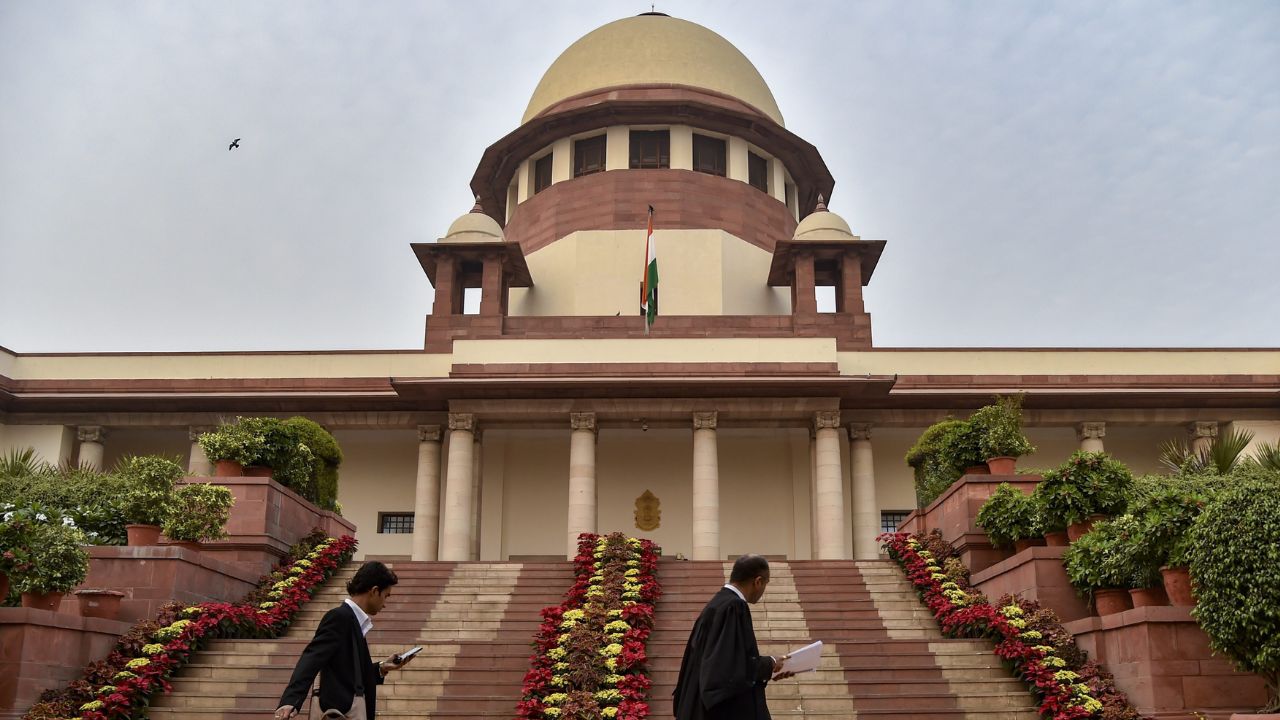
The Supreme Court rejected a public interest litigation (PIL) seeking guidelines for the appointment of ministers and public representatives facing criminal charges. The petition demanded that people facing criminal charges be barred from making ministers or giving important portfolios. It was said in the petition that the criminal background of MLAs and MPs should be kept in mind while making Prime Minister and Chief Minister ministers and while allocating departments.
The case was heard by a bench of Chief Justice (CJI) Surya Kant, Justice Joymalya Bagchi and Justice V Mohana. The petitioner made it clear that he did not want to add any new disqualification under Articles 75 and 164 of the Constitution. These articles relate to the appointment of central and state ministers respectively. Petitioner Dilip Kumar Sharma said that the discretion to choose ministers and allot departments should be used on the basis of some prudential standards.
Also read: 'Poor people do not spread pollution…', Supreme Court's comment on firecrackers
Why did the Supreme Court reject the petition?
Justice Joymalya Bagchi said that the petitioner's argument is based on constitutional morality and is not binding. He also questioned the practicality of making such guidelines. He said the criminal law continues to be misused against people participating in the democratic process, often by their political opponents. In such a situation, why should it not be left to the discretion of the Chief Minister to decide whether a matter is so shameful for the government or not that that person should be kept out of the cabinet.
Justice Joymalya Bagchi:-
What you are arguing is constitutional morality. It is not binding. Criminal laws are used as a weapon against people participating in the democratic process, sometimes by their political opponents. In such a situation, should it not be left to the discretion of the Chief Minister to decide whether a criminal case is so embarrassing to the government that the person should be kept out of the Cabinet?
Also read: Number 1 in population, yet why is the Supreme Court afraid of population?
What arguments were given by the petitioner?
Petitioner's lawyer Nisha Tiwari told the bench that it was not their intention to challenge the constitutional powers of the executive. He said that the use of discretion should be appropriate and some criteria should be set for it. Justice Joymala Bagchi replied that making such guidelines would put the Supreme Court in difficult territory. He said that after the change of power, criminal cases can be initiated and the court is conscious of this fact.
The petitioner cited the analysis of the Association for Democratic Reforms (ADR). ADR's 2025 analysis included 4,092 MLAs from state assemblies and union territories. Of these, 1,861 or 45 percent had declared criminal cases against themselves. 1,205 or 29 percent had declared serious criminal cases.
Nisha Tiwari also argued that the Supreme Court had recognized this problem more than a decade ago, but the Parliament did not take adequate steps. He said that while voting, voters do not give their consent that a person with criminal background should become a cabinet minister. Even after this the court rejected the petition.
Also read: BMC Commissioner could not get the encroachment removed, Supreme Court stopped her salary for one month
What improvements could have been made if this petition was accepted?
Advocate Nisha Tiwari, appearing for the petitioner in the Supreme Court, said in a conversation with Khabargaon, 'If the Supreme Court had accepted this petition, the biggest reform would have been that politicians facing murder, rape, kidnapping or corruption would have been banned from getting sensitive ministries like Home or Finance. This would have eliminated direct confrontation by ministers exercising administrative influence over police or prosecution agencies investigating their own cases. As an interim arrangement, transfer or control of policemen and government lawyers involved in such cases could have been brought under the ambit of the judiciary and fair investigation and hearing could have been decided.
Advocate Nisha Tiwari said, 'It would improve transparency and accountability of appointments in the Council of Ministers. It would have been mandatory for the Prime Minister and Chief Ministers to make public a 'Suitability Memorandum' giving reasons to the public while appointing such tainted MLAs as ministers, which would have strengthened the right to information of the citizens. The rules would have been decided based on merit and loyalty rather than just electoral popularity, celebrity influence or family influence. The President or Governors would also have got the clear right to advise for reconsideration of the names of persons facing serious allegations.