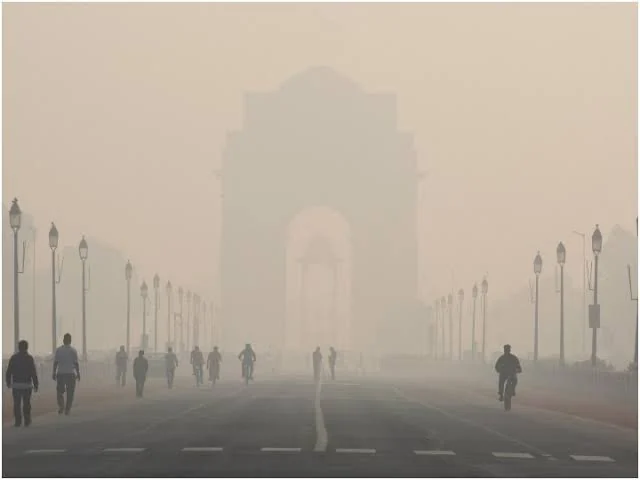
On Saturday, just a day before Diwali, Delhi's air once again reached the very poor category. The rapidly increasing air pollution in the capital has raised concerns from the government to environmental experts. According to Central Pollution Control Board (CPCB) data, Delhi's average air quality index (AQI) was recorded at 364 at 9 am on Saturday, which falls in the very poor category. At the same time, according to the live ranking of Swiss group IQAir, Delhi remained the most polluted major city in the world on Saturday morning. In view of the increasing level of pollution before Diwali, the situation is expected to worsen in the coming days.
Concern about pollution increased before Diwali
The deterioration in Delhi's air quality ahead of the festival has raised health concerns. Poor air quality can especially affect children, the elderly and people suffering from respiratory diseases. Measures for the third phase of the Graded Response Action Plan (GRAP) have been implemented to control pollution in Delhi-NCR. Under this, many restrictions have been imposed on construction activities, vehicles and schools. The system of hybrid education has also been implemented for students up to class five.
According to the Central Pollution Control Board (CPCB), Delhi's average air quality index (AQI) was recorded at 363 at 10 am on Saturday, which falls in the very poor category. At the same time, in the live ranking of Swiss air quality monitoring organization IQAir at 10:35 am on Saturday, Delhi stood first among the major polluted cities of the world. Delhi's reading on IQAir's American AQI scale was recorded at 581, while in Pakistan's Lahore it was 285.
Why is there a difference between the figures of IQAir and CPCB?
There is a difference in the data of IQAir and CPCB regarding Delhi's pollution. The reason for this is the measurement method of both the institutions and the different scale of AQI. IQAir's readings are based on the amount of pollutants in the air and the US Air Quality Index. At the same time, India's CPCB calculates AQI using its own scale and prescribed method. Therefore, it would not be correct to directly compare the figures of both.
Pollution may increase due to firecrackers on Diwali
Delhi's air quality is likely to deteriorate further due to large-scale burning of firecrackers during Diwali. In the capital already suffering from pollution, fireworks may increase the amount of particulate matter and other pollutants in the air. In view of the pollution situation, the system of hybrid education has been implemented in the schools of Delhi-NCR till class five. Under this, students have been given the option of studying through both online and offline mediums. Apart from this, people are also being encouraged to adopt work from home.
Worst air in 8 years before Diwali
Local media reports quoting official data said that Delhi's air quality on Friday was recorded as the worst before Diwali in the last eight years. Due to this, the fear of increase in pollution during the festival has deepened.
Why does pollution in Delhi-NCR increase in winter?
Air pollution becomes a major seasonal problem with the onset of winter in North India. During this time, due to cold and heavy air, the pollutants remain trapped in the atmosphere for a long time and are not able to spread easily. Smoke from vehicles, dust from construction works and smoke generated from burning of crop residues in nearby states further increase pollution. When the wind speed is low, the effect of these pollutants persists for a longer time.
GRAP-3 restrictions implemented in Delhi-NCR, ban on old vehicles
In view of the increasing air pollution in Delhi-NCR, the Commission for Air Quality Management (CAQM) has implemented restrictions in the third phase of the Graded Response Action Plan (GRAP). Giving this information on Friday, Delhi Environment Minister Manjinder Singh Sirsa said that with the implementation of GRAP-3, a ban has been imposed on the operation of vehicles with old emission standards. Under this, diesel vehicles of BS-IV and below standards and petrol vehicles of BS-III and below standards will not be able to run. This ban will be applicable to the concerned vehicles registered in Delhi as well as other states. The minister said diesel-powered heavy vehicles and light commercial vehicles (LCVs) with emission standards BS-IV and below will also be banned. Apart from Delhi, these restrictions will also be applicable in Noida, Ghaziabad, Faridabad, Gurugram and Sonipat.
Hybrid education mandatory in schools up to class five
Under GRAP-3, it has been made mandatory to operate all schools up to class five in Delhi-NCR in hybrid mode. Under this, students will have to be given the option of studying through both online and offline mediums. Parents and students will be able to choose any one of these mediums as per their convenience.
Wind speed likely to be almost zero, AQI may increase
Environment Minister Manjinder Singh Sirsa, citing the forecast of the Meteorological Department, said that the weather conditions may become more adverse from Saturday. The wind speed is expected to reach almost zero. Due to this, the pollutants present in the atmosphere can remain accumulated for a long time and the Air Quality Index (AQI) can increase further. Stagnation of air can make the pollution situation more serious. In such a situation, the smoke emanating from firecrackers during Diwali can also affect the air quality of Delhi.
Government appealed to people for cooperation
The Environment Minister has appealed to Delhiites to follow the restrictions imposed under GRAP-3 and cooperate in pollution control efforts. He clarified that all these restrictions will remain in effect as long as the third phase of GRAP remains in force. The Minister said that along with government efforts, participation of common citizens is also necessary to deal with pollution. People need to follow the rules and play their responsibility in reducing pollution.
Follow the LALLURAM.COM MP channel on WhatsApp