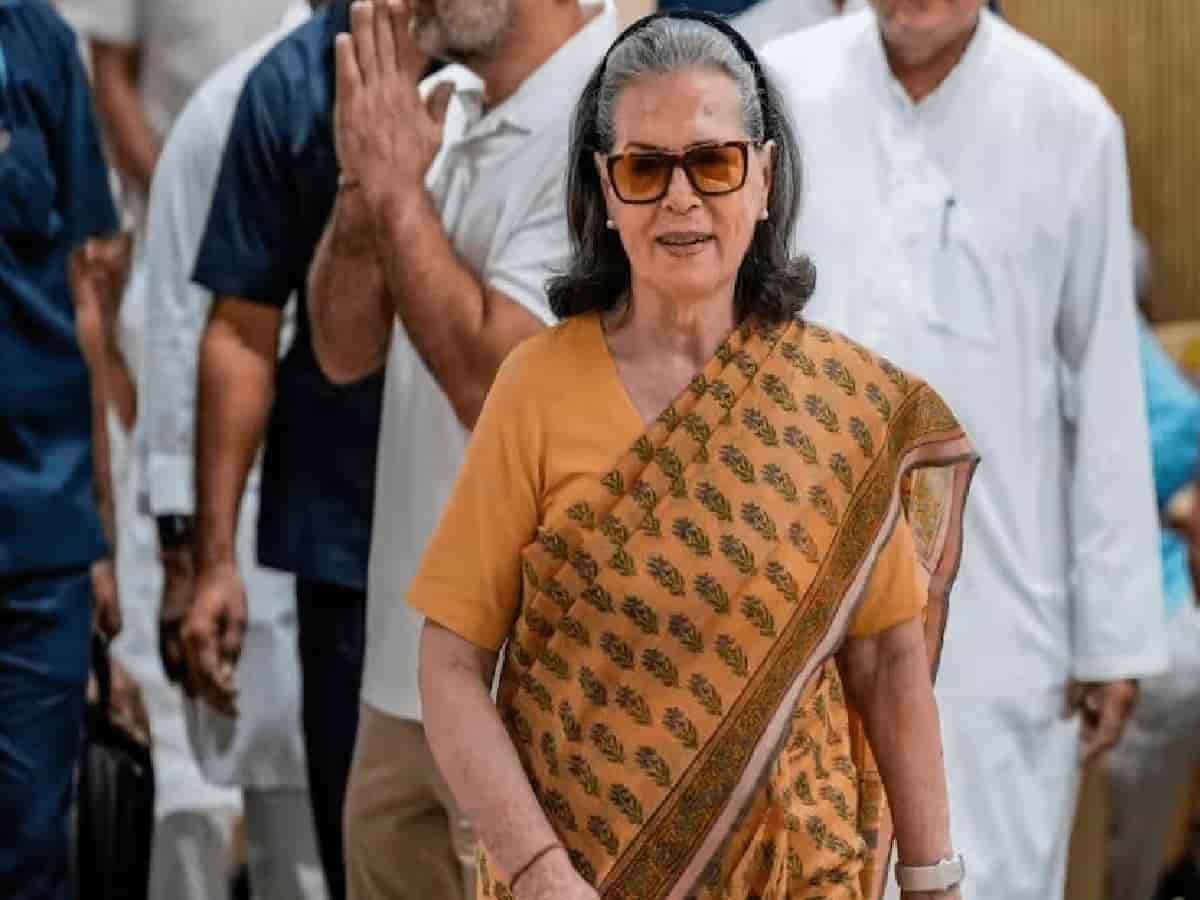
Sonia Gandhi, one of the top leaders of the country's politics and a senior leader of the Congress Parliamentary Party, has made a very sharp and ideological attack on the working style of the Bharatiya Janata Party government which is in power at the Centre. He has said in clear words that during the last 12 years of rule, such a deep injury has been caused to the country's democratic structure, autonomous institutions and social fabric, which will be extremely challenging to compensate for a long time to come. In an exclusive and frank interview given to the English daily 'The Hindu', Sonia Gandhi said that now the common people of India have started realizing this planned loss on the ground. Uneasiness and dissatisfaction with the current governance system and system is clearly being felt among the citizens in different parts of the country. He underlined that when democratic traditions are weakened, it has a direct impact on the unity of the society and civil rights. Sonia Gandhi expressed hope that in the future, when the government will be changed with the public mandate, a transparent and sensitive good governance will be reestablished in the country. However, he also gave a realistic warning that merely changing the government will not be enough to make the constitutional pillars which have been hollowed out in the last decade as independent and strong as before, but for this, all the responsible political parties of the country will have to work together and make honest efforts for a long time. Despite these difficult circumstances, he made it clear that he is completely optimistic about the country's inherent strength and the future of democracy. This much talked about and detailed interview of Sonia Gandhi has come just before the global publication of her much awaited autobiographical book 'Belonging: A Journey of Love'. This book, being published by HarperCollins India, is going to be formally released before the readers on November 10. In this book, he has written down in detail every untouched and sensitive aspect of his life, which ranges from his childhood in Italy to his historic political journey in India. In the book, she has shared in a very emotional and fearless manner her spiritual connection with the soil of India, her entry into the Gandhi family as a daughter-in-law, the precious moments of happiness and sorrow spent with Rajiv Gandhi, taking over the reins of the Indian National Congress after tragedies and her inner thoughts on today's contemporary political scenario. During the interview, he told that this book is an authentic story of his life experiences, moral struggles and his loyalty towards India, rather than a political manifesto, which also tries to look at the country's current political crisis from a broader human and constitutional perspective. Talking about the organizational situation of Congress and the electoral challenges, Sonia Gandhi completely rejected any kind of disappointment. He bluntly alleged that in the present times the electoral field for the opposition is no longer fair and level. The ruling party has established its undeclared control over almost all the autonomous regulatory bodies, especially the Election Commission, disregarding constitutional limits. Apart from this, a large part of the mainstream media of the country is working under the direct influence of the government, due to which the real issues of public concern are suppressed and only one-sided narrative is put forward. He also underlined that the fairness of a healthy democratic contest has been seriously damaged by the unaccounted black money and blatant emotional use of religion in politics. Sonia Gandhi said that despite all these adverse circumstances, constant pressure and harassment from the investigating agencies, the morale of Congress workers and grassroots leaders has not broken. From booth level to district and national level, Congress workers are standing firm to protect the values of the Constitution and democracy. Referring to the administrative irregularities and lack of transparency in the voting process in the recent elections, he said that these incidents have forced the conscious voters of the country to think about how to protect the real power of their franchise. Discussing the future prospects of the opposition alliance and the unity of the opposition parties at the national level, Sonia Gandhi said that the Congress is continuously working in coordination with like-minded political parties. The way Congress has positioned itself as a national alternative amidst all the crises along with the ground reality, is the biggest proof of its ideological strength and internal strength. He said that the possibilities of alliance at the national level are becoming more mature and stronger day by day. Recognizing the complexities of alliance in practical politics, he said that in the larger public interest, sometimes one has to agree on a minimum common program even with parties whose core ideology does not completely match that of the Congress. However, he also admitted that such compromises never felt very comfortable to his personal nature. But at the same time, he firmly clarified that Congress has never made any ideological compromise with the divisive and communal ideas of Bharatiya Janata Party and Rashtriya Swayamsevak Sangh (RSS), nor is any such compromise possible in the future. Clarifying the party's position on secularism, he said that even though the personal opinions of some party leaders may have been different, the official and basic resolution of the Congress has been that every citizen should have the full constitutional right to practice his or her religion, faith and belief without any fear. Talking about her much talked about decision of not accepting the post of Prime Minister after Congress' historic election victory in 2004, Sonia Gandhi made it clear that she never had any regrets or regrets on that decision. During that period, Dr. Manmohan Singh, as the Prime Minister of the country, led the government very efficiently, dignified and historically, while he himself took the responsibility of the organization and party workers. Respecting each other's work, both of them worked like a strong and trustworthy team, which gave many historic schemes of development and social security to the country. Giving credit to his personal and political values, he said that after coming to India, the company of late Indira Gandhi and Rajiv Gandhi completely shaped his personality. The indomitable courage of both the leaders, unwavering loyalty towards secular India, sensitivity towards the weaker sections of the society and the feeling of keeping service to the nation supreme remained the permanent guidance of their lives. He also shared that the moral values of family, loyalty and responsibility that he received from his childhood upbringing in Italy are still an integral part of his life. Adopting a very mature stance on the controversial period in the history of independent India, Sonia Gandhi termed the Emergency as a dark chapter in the country's democratic history. He reminded that at that time civil liberties and the rights of habeas corpus were suspended, but Indira Gandhi herself later, understanding the public sentiments, took a bold decision to hold free elections in March 1977 and publicly expressed regret for the administrative excesses committed during that period and also apologized to the country, which shows her dedication to democratic values.