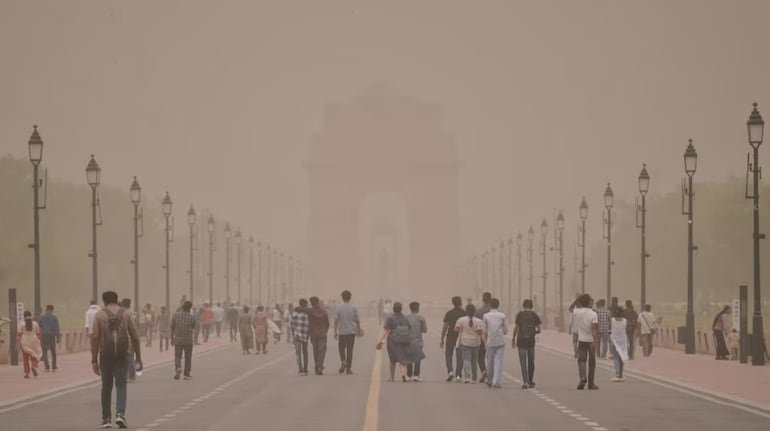
Just before the holy festival of Diwali, the air crisis has once again become acute for crores of residents of the National Capital Region (Delhi-NCR). Due to increasing incidents of stubble burning in Punjab and Haryana, seasonal changes, slow wind speed and local pollution, the climate of Delhi has moved from 'very bad' to 'severe' category. After the Air Quality Index (AQI) reached close to 380 to 400 on an average and crossed the 450 mark at many monitoring stations, the Commission for Air Quality Management (CAQM) has implemented the third phase of the Graded Response Action Plan i.e. GRAP-III (GRAP-III) in the entire NCR with immediate effect. After this decision, emergency level restrictions have been activated in the capital to curb pollution, which has a direct impact on the classes of school children, movement of private vehicles and real estate and construction work. Hybrid classes for children up to 5th: Both online and offline options. A major change has been made in the primary education system to protect the lungs of innocent children from the most lethal effects of microscopic and toxic pollutant particles (PM2.5 and PM10) dissolved in the air. Under the guidelines of CAQM, an order has been issued to mandatorily operate all primary schools up to class 5th in major districts of Delhi and NCR (Gurugram, Faridabad, Ghaziabad, Gautam Buddha Nagar and Sonipat) on 'Hybrid Mode'. This simply means that schools will have to conduct online classes along with physical classes. Parents and guardians have been given complete freedom that they can choose to educate their children online from home instead of sending them to school. Apart from this, small children of nursery and KG have been advised to stay at home preferably to avoid going out in the morning during peak levels of pollution. Complete ban on running of these vehicles: Provision of challan of ₹ 20,000 As soon as the implementation of GRAP-3, the harshest whip has been imposed on the polluting vehicles running on the roads. The Transport Department and Delhi Police have started a special checking campaign with a heavy fine of ₹ 20,000 on violation of rules: BS-3 petrol and BS-4 diesel cars: There is a complete ban on the operation of BS-3 standard petrol and BS-4 standard diesel light motor vehicles (LMV/Cars) in Delhi including Gurugram, Faridabad, Ghaziabad, Gautam Buddha Nagar and Sonipat. Only vehicles connected to emergency, police and health services will be exempted from this. Commercial vehicles registered outside Delhi: Diesel-powered medium goods vehicles (MGV) and light goods vehicles (LGV – BS-3 and below) registered outside Delhi have been completely banned from entering the capital. Only vehicles supplying essential commodities (fruits, vegetables, milk, medicines) and CNG and electric commercial vehicles will be allowed to enter Delhi. Diesel commercial vehicles registered in Delhi: Restrictions will also be applicable on operation of diesel medium goods vehicles of BS-4 and below registered in Delhi. Complete ban on construction and demolition activities A complete ban has been imposed on all construction and demolition works in NCR to prevent dust and particulate matter. The works of digging soil, boring, drilling, piling and laying pipelines in open trenches have been banned. Orders have been given to stop the operation of concrete batching plants (RMC Plants), brick kilns, major welding, gas cutting and stone crusher machines with immediate effect. There will also be a ban on gravel crushing, painting, polishing and major road construction on the roads. However, essential public infrastructure projects like national security, defence, railways, metro rail, airports, hospitals, sewage treatment plants and national highways have been exempted with adherence to strict dust control standards. Preparation to promote 50% work from home and public transport: To reduce traffic jams on roads and smoke from vehicles, state governments (Delhi, Haryana, Uttar Pradesh) have been given the right to decide to send 50 percent of employees in government, municipal corporation and private corporate offices on work from home (WFH). Along with this, daily commuters are being motivated to use public transport instead of private vehicles. Delhi Metro Rail Corporation (DMRC) has added more than 20 additional daily trips (trips) to its network to handle the rush of passengers, while trips of DTC and cluster buses have also been increased. Health experts' warning: Take these important precautions before Diwali. At the beginning of winter, when the air becomes heavy and settles close to the ground, the pollutants form a 'smog chamber'. Doctors and pulmonologists have advised the elderly, children and people suffering from respiratory diseases (asthma, bronchitis) to completely avoid early morning and late evening morning walks. If going out is unavoidable, use a certified N95 mask instead of a normal cloth mask. Run air purifiers in homes and keep windows and doors closed in the morning. An appeal is being made to strictly follow the ban on firecrackers during the festival of Diwali and not to burn garbage or leaves at the local level, so that the situation does not reach the emergency level i.e. Grape-4.