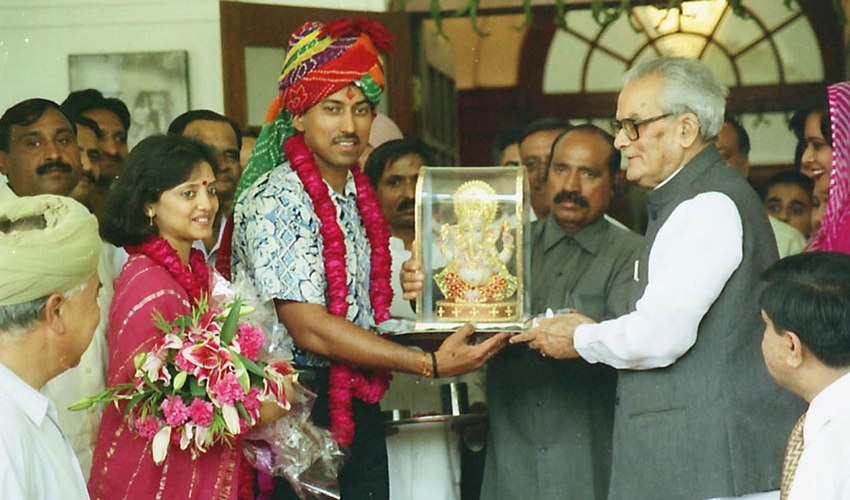
On 17 August 2004, at the shooting range in Markopoulo outside Athens, an Indian Army major named Rajyavardhan Singh Rathore stood on the second step of the Olympic podium. His double trap silver was India’s first individual Olympic silver medal, and it changed how the country thought about shooting.
Name: Rajyavardhan Singh Rathore Born: 29 January 1970, Jaisalmer, Rajasthan | Sport: Shooting | Event: Double trap
An army family in Rajasthan
Rathore was born in Jaisalmer into a military household. His father, Colonel Lakshman Singh Rathore, served in the army, and his mother worked as a teacher. Uniforms and discipline were part of daily life long before sport entered the picture.
He followed his father into the forces. He passed out of the National Defence Academy in Pune as part of its 77th course and then went to the Indian Military Academy in Dehradun, where he won the Sword of Honour, the award given to the best all-round cadet of a course. He was commissioned in 1990 and went on to serve with the Grenadiers. His service included counter-terrorist operations in Jammu and Kashmir and duty during the Kargil conflict.
A late start with a shotgun
Unlike most elite shooters, Rathore did not grow up on a range. He came to competitive shooting in his late twenties, through the army, and chose double trap, a discipline in which two clay targets are released at once and the shooter has to break both with two quick shots. It rewards fast reactions and calm nerves in equal measure, and the army’s marksmanship unit gave him the support to learn it properly.
His progress was quick. Within a few years of taking up the event he was beating the best in the Commonwealth and moving up the world rankings.
Manchester 2002 and the first big titles
The 2002 Commonwealth Games in Manchester announced him to a wider audience. Rathore won the individual double trap gold with 192 out of 200, a Games record, and added the pairs gold with Moraad Ali Khan.
The following seasons brought steady international results. He won a medal at the 2003 World Championships in Cyprus, collected Asian Clay Target Championship titles and picked up ISSF World Cup gold medals in the middle of the decade. By 2004 he was among the leading names in the event and arrived in Athens as a genuine contender.
Silver in Athens
Qualification in Athens was not smooth. Rathore scored 135 and squeezed into the six-man final in fifth place. The final was a different story. He shot 44 out of 50 to finish on 179 and climb to second place, behind Sheikh Ahmed Al Maktoum of the United Arab Emirates, who won with 189. China’s Wang Zheng took bronze, one point behind Rathore.
India had won individual Olympic medals before, but never a silver. The result made him a household name almost overnight. It also gave Indian shooting a new sense of what was possible, four years before Abhinav Bindra won the country’s first individual Olympic gold in Beijing.
Melbourne, Doha and Beijing
Rathore stayed at the top for several more years. He carried the Indian flag at the opening ceremony of the 2006 Commonwealth Games in Melbourne and then defended his individual double trap title. He also won pairs silver with Vikram Bhatnagar. At the Asian Games in Doha later that year he took individual bronze and team silver.
He was India’s flag bearer at the Beijing Olympics in 2008, but he did not repeat his Athens form and missed out on the final. It was the last Olympics of his shooting career. He was promoted to colonel in 2009 and continued to serve before retiring from the army in 2013.
From the range to public office
Rathore joined the Bharatiya Janata Party in 2013 and won the Jaipur Rural seat in the Lok Sabha in 2014, holding it again in 2019. In the Union government he served as minister of state for information and broadcasting from 2014 and held independent charge of the youth affairs and sports ministry from 2017 to 2019, making him one of the few Olympic medallists to run the country’s sports ministry.
In 2023 he moved to state politics, winning the Jhotwara assembly seat in Rajasthan and joining the state cabinet under Chief Minister Bhajan Lal Sharma. He remains a cabinet minister in Rajasthan, with portfolios that include industry and commerce and youth affairs and sports.
Career record and honours
- Olympic Games: silver medal, men’s double trap, Athens 2004 (179 points); India’s flag bearer at Beijing 2008
- Commonwealth Games 2002, Manchester: gold in individual double trap (Games record 192/200) and gold in pairs with Moraad Ali Khan
- Commonwealth Games 2006, Melbourne: gold in individual double trap and silver in pairs with Vikram Bhatnagar
- Asian Games 2006, Doha: bronze in individual double trap and silver in the team event
- Medal at the 2003 World Championships in Cyprus; ISSF World Cup gold medals in the mid-2000s
- Asian Clay Target Championship titles across several seasons
- Arjuna Award (2003-04)
- Rajiv Gandhi Khel Ratna, now the Major Dhyan Chand Khel Ratna (2004-05)
- Padma Shri (2005)
- Ati Vishisht Seva Medal; Sword of Honour, Indian Military Academy
- Member of Parliament, Jaipur Rural (2014, 2019); Union minister of state for youth affairs and sports, independent charge (2017-2019)
- Member of the Rajasthan Legislative Assembly for Jhotwara and Rajasthan cabinet minister (from December 2023)