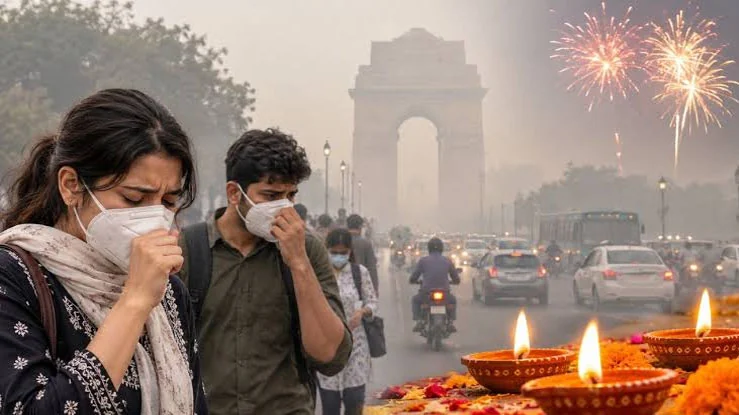
The situation of air pollution in the capital Delhi just before Diwali and during the festival has become extremely worrying. The air of the capital has become more poisonous due to slow wind speed and fireworks being carried out despite restrictions. In 23 areas of Delhi, the Air Quality Index (AQI) has crossed 400, which falls in the serious category. As per available data, the average AQI of Delhi was recorded at 384 as of 7:05 am on November 8, 2026. This falls in the very bad category. At the same time, people's health concerns have increased as pollution levels have crossed 400 in many areas.
Jahangirpuri has recorded the highest AQI of 450. At the same time, the air quality in many areas including Punjabi Bagh, RK Puram, Rohini and Bawana also remains in the severe category. According to the pollution data, 448 AQI has been recorded in RK Puram, 449 in Punjabi Bagh, 445 in Rohini, 445 in IIT Delhi, 446 in Bawana and 441 in NSIT Dwarka. The level of pollution in these areas remains very worrying.
AQI of major polluted areas of Delhi
Area/Monitoring Center AQI Category
Jahangirpuri 450 Gambhir
Punjabi Bagh 449 Gambhir
RK Puram 448 Gambhir
Bawana 446 Gambhir
Rohini 445 Gambhir
IIT Delhi 445 Gambhir
NSIT Dwarka 441 Gambhir
Burari Crossing 414 Gambhir
Alipore 413 Gambhir
Subhash Nagar/Rajouri Garden 384 Very bad
burari 370 very bad
aya nagar 365 very bad
badarpur 349 very bad
anand vihar 344 very bad
Ashok Vihar 323 very bad
The temperature will also drop
Along with pollution, changes are also being seen in the weather of Delhi. The day temperature is likely to drop gradually. The maximum temperature in the next three days is expected to be between 26 to 28 degrees Celsius. On Saturday, the maximum temperature in the capital was recorded at 30.5 degrees Celsius, which was one degree above normal. At the same time, the minimum temperature was recorded at 16.2 degrees Celsius.
Permission to burn crackers only for two hours
According to the prescribed rules, firecrackers can be burst only from 6 to 7 in the morning and 8 to 10 in the night on November 8. Apart from this, fireworks will not be allowed at other times. There is a complete ban on burning of firecrackers within 300 meters of hospitals, health centres, old age homes and educational institutions. These areas have been determined as silence zones.
Ban on barium and traditional firecrackers
To control pollution, a strict ban has been imposed on barium-containing firecrackers, traditional firecrackers and burning of string. People are allowed to use only certified green crackers as per the prescribed standards. The administration has made it clear that strict action will be taken against those who violate the rules. Under this, firecrackers will be confiscated, licenses of vendors can be canceled and police will register FIR and take prosecution action. At the same time, according to the order of the Supreme Court, the complete ban on firecrackers will be implemented again from November 9.
Administration alert to stop pollution
The air quality in Delhi is already in the very poor to severe category. In such a situation, the purpose of strictness on the use of firecrackers is to prevent the level of pollution from increasing further. The administration has appealed to the people to follow the prescribed rules and cooperate in protecting the environment and health.
Follow the LALLURAM.COM MP channel on WhatsApp