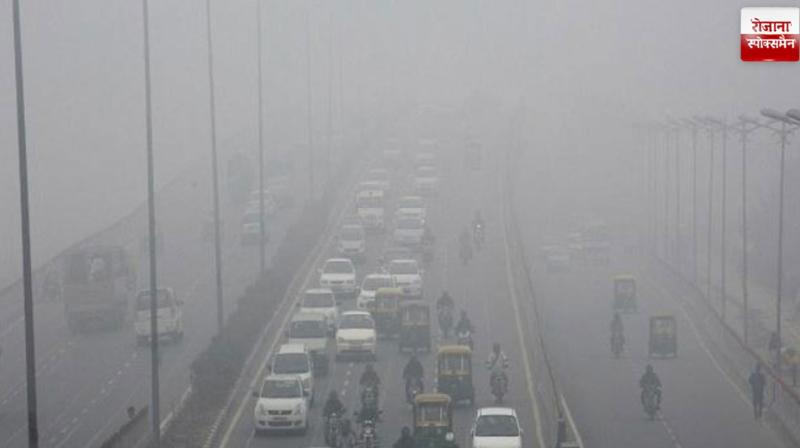
Worst air quality recorded at monitoring stations at Delhi Technological University (DTU) and Burari Crossing
New Delhi. Due to burning of firecrackers at various places in the capital long after the deadline for Diwali, the level of pollution in Delhi's air increased alarmingly on Monday and when people opened their eyes in the morning, the sky of the city was found covered with dense gray smog. Visibility on the roads reduced and people started feeling burning sensation in their eyes and throat again. The air quality index (AQI) of the national capital was recorded at 370, which falls in the 'very poor' category. There is a possibility that the pollution level will increase further during the day and the air quality will reach 'severe' category.
The worst air quality was recorded at monitoring stations at Delhi Technological University (DTU) and Burari crossing. The AQI here was 437-437. The air quality at four other monitoring centers remained in the 'poor' category, while at the remaining centers it was recorded in the 'very poor' category. According to data from Switzerland's air quality monitoring platform 'IQAir', PM2.5 levels in Delhi were recorded at 170 micrograms per cubic metre. This is about 34 times more than the limit set in the annual guidelines of the World Health Organization (WHO). 'PM2.5' are microscopic particles present in the air, which are capable of reaching deep into the lungs and entering the bloodstream. Due to their adverse effects on health, they are included among the major pollutants.
AQI reached 450 in Jahangirpuri on Diwali night.
Despite restrictions, firecrackers were burnt at many places in the capital on Diwali night. During this period, air quality was recorded in severe category at 20 monitoring centres. The highest AQI was recorded at 463 in Sonia Vihar, while it was 450 in Jahangirpuri. The average AQI of Delhi was recorded at 376 on Sunday. Of the 59 monitoring stations that recorded data till 10 pm on Diwali night, air quality was in the severe category at 20, six in the poor category and the remaining 33 in the very poor category.
People had trouble breathing
The process of burning firecrackers intensified between five and six o'clock on Sunday evening. There were also massive fireworks in Pitampura, Burari, Mayur Vihar and some parts of Lutyens Delhi. As the celebrations increased in the evening, a layer of smoke started accumulating on the roads and residential areas. Residents of many areas complained of strong smell of burning firecrackers, reduced visibility and difficulty in breathing. People had to face these problems as the fireworks continued throughout the night.