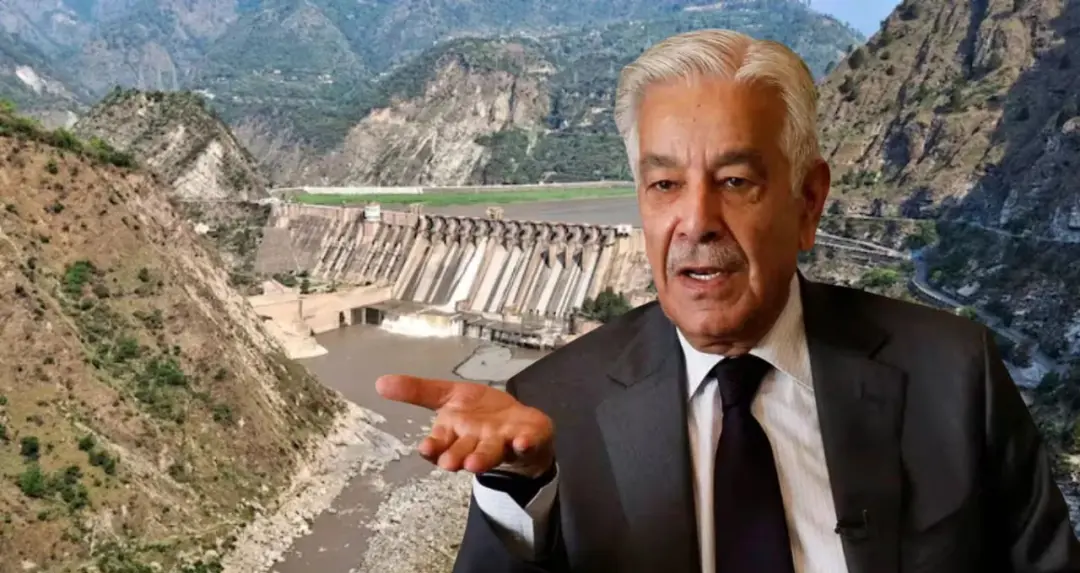
Tension continues between India and Pakistan regarding the Indus Water Treaty. Pakistani Defense Minister Khawaja Asif said that his government is considering all options. However, he has not clearly announced any military action against India.
Islamabad: Pakistan has once again warned India regarding the Indus Water Treaty. Pakistan's Defense Minister Khawaja Asif has said that his government is constantly monitoring the situation arising after India's decision. What further steps should be taken, if necessary, will be decided at the top level of the government. After his statement, the ongoing dispute regarding water sharing between the two countries has again come into discussion.
What did Khawaja Asif say to India regarding Indus Water Treaty?
Pakistan's Defense Minister Khawaja Asif has once again given a statement on the ongoing dispute between India and Pakistan regarding the Indus Water Treaty. In an interview he was asked what Pakistan was going to do next in this matter. Will he express his views only through court and negotiations or will he adopt some other route also?
On this, Khawaja Asif said that the Pakistan government is constantly monitoring the situation. Keeping in view the current situation, further decision will be taken. If necessary, senior leaders of the government will sit together and discuss and decide what should be the next step. Asif also indicated that Pakistan would not keep waiting like this forever. If necessary, other routes can also be considered. However, he did not clarify what further steps Pakistan would take.
Why did India suspend the Indus Water Treaty?
The Indus Water Treaty between India and Pakistan was signed in the year 1960. Under this agreement brokered by the World Bank, arrangements for the use of water of six rivers between the two countries were decided. According to the agreement, India mainly gets the water of Ravi, Beas and Sutlej. At the same time, the main right to use the waters of Indus, Jhelum and Chenab has been given to Pakistan. However, India can undertake hydropower projects and certain other activities on these western rivers under prescribed conditions.
This agreement remained in force despite tensions and wars between the two countries for several decades. But the circumstances changed after the terrorist attack in Pahalgam, Jammu and Kashmir on 22 April 2025. 26 people lost their lives in this attack. The next day, on 23 April, the Government of India decided to suspend the Indus Water Treaty with immediate effect. India alleges that Pakistan supports cross-border terrorism. Pakistan has been denying these allegations.
What condition has India set for restarting the Indus Water Treaty?
India has made it clear that at present the Indus Water Treaty with Pakistan will not start as before. India says that no changes will be made to this agreement until Pakistan stops supporting cross-border terrorism. External Affairs Ministry spokesperson Randhir Jaiswal had said the same thing on July 3, 2026. He had said that to stop terrorism, Pakistan will have to take such steps which can be trusted. Just talking or giving assurance will not work.
In fact, after the terrorist attack in Pahalgam, Jammu and Kashmir in April 2025, India had decided to put the Indus Water Treaty on hold. Since then there is a dispute going on between the two countries regarding water. At the same time, Pakistan is opposing this decision of India. Pakistan says that this is an international agreement between the two countries, hence India cannot stop it alone.
The water of Indus River and other rivers related to it is very important for agriculture in Pakistan. A large number of farmers irrigate their fields with this water. The water needs of common people are also fulfilled by these rivers. This is the reason why Pakistan is looking at this matter by linking it with its agriculture, economy and country's security.
What decision did the Hague court give on the Indus Water Treaty?
The ongoing dispute between India and Pakistan over the water of Indus River has reached the International Arbitration Tribunal based in Hague, Netherlands. In its decision dated 31 August 2026, the tribunal said that the Indus Water Treaty is still in force. According to the tribunal, there is no such rule in this agreement on the basis of which India or Pakistan alone can stop or end it.
In this case, hearing was also held on Ratle Hydroelectric Project of Jammu and Kashmir. The tribunal ordered a temporary halt on some construction work on the project. The order said that concrete work should not be done above the prescribed height in the dam wall and some parts of the water supply to the power house. This ban has been decided to remain in force till 90 days after the final decision of the neutral expert.