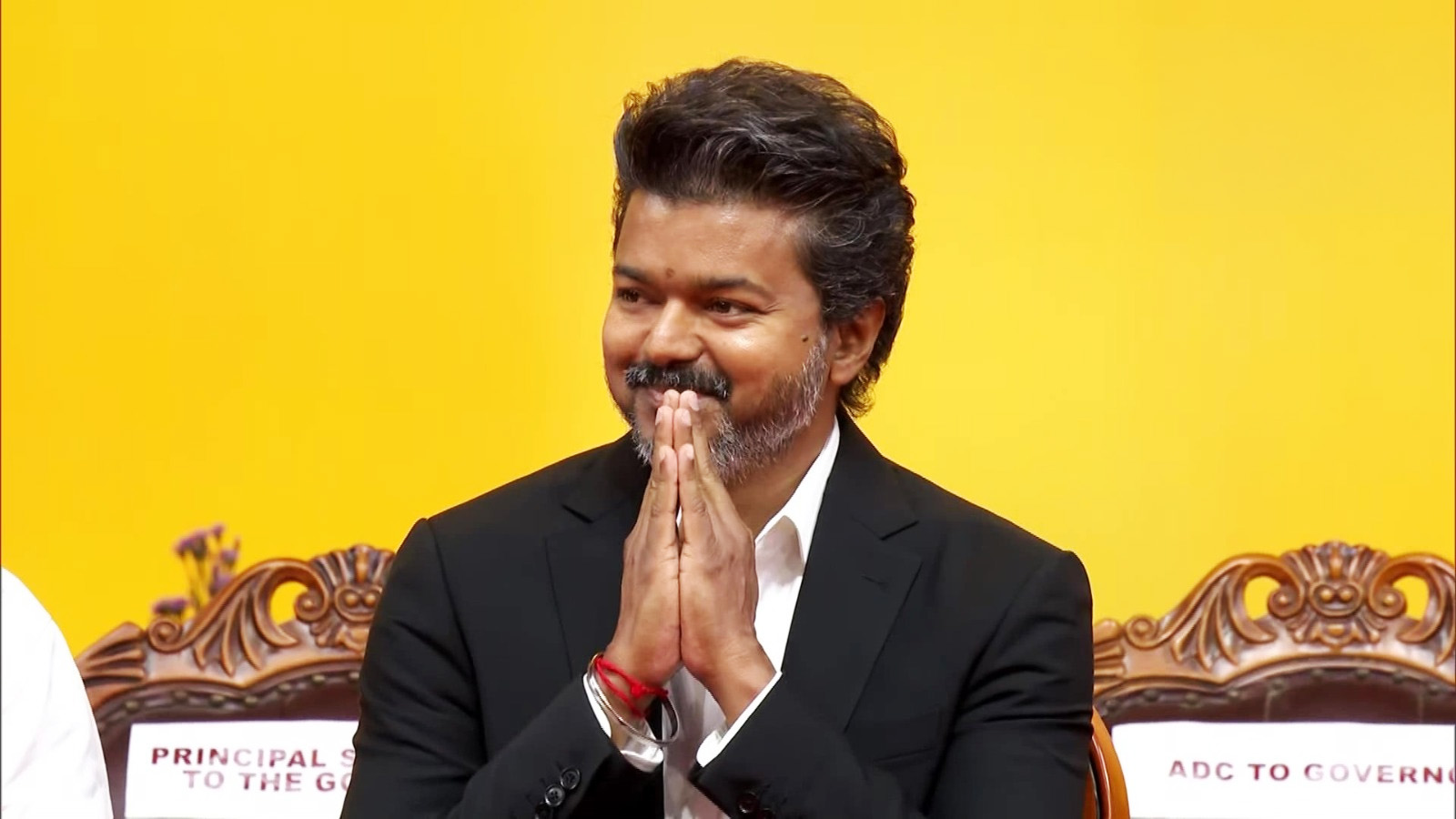
C Joseph Vijay today (November 10) completes six months as Tamil Nadu Chief Minister — a milestone that many detractors had predicted he would never reach. Yet, despite early political turbulence and challenges from the Opposition, his TVK government has managed to stay afloat. Considering it challenged six decades of the two Dravidian majors’ duopoly in the state, this is an achievement in itself.
As the Vijay government, which calls itself “a government for generations”, moves beyond its honeymoon period, we examine its main political, governance, economic and federal approaches so far.
Politics: Teetering on edge to steadier footing
Despite initial hiccups in government formation after emerging as the single largest party, Vijay assumed office as chief minister on May 10. The support of coalition partners and parties such as the CPI and CPM, which extended outside support, proved crucial in getting the government off the ground.
Since then, surviving a no-confidence motion has given the fledgling administration an opportunity to consolidate its numbers and relationship with its allies. The arrangement has subsequently evolved into a broader political platform under the Secular Social Justice Victory Alliance (SSJVA), comprising the Congress, VCK, IUML and MDMK. Although there have been occasional murmurs of discontent, particularly within the Congress, the alliance has largely remained intact.
Also read: Periyar Arivulagam library: What is the row over AI-generated books and fake authors?
The TVK also secured a boost through its victories in the Maduranthakam and Dharapuram bypolls, where it fielded AIADMK turncoats. The results were significant because the elections were widely viewed as a referendum on allegations of horse-trading involving AIADMK MLAs and also a sign of how well they could work with their allies on the ground.
Both the AIADMK and DMK had made the issue a central campaign plank. By winning the contests, TVK managed to blunt some of the criticism.
Governance: Law-and-order, other challenges
However, the victories also offered a reality check on Vijay’s electoral appeal. Despite the actor-turned-politician leading an aggressive campaign, the margins were not as emphatic as the party may have hoped for. The star power also has limitations, as bypolls are largely very localised elections, political observers said. The government’s bigger political challenge, however, lies in delivering on its promise of maintaining law and order.
In the run-up to the polls, TVK had positioned itself as an alternative to the previous DMK government’s “failure to tackle crime, violence against women and drug abuse”. Every major crime reported under its watch, therefore, gives the Opposition an opportunity to question its credibility. The DMK has been quick to pounce on such incidents, targeting initiatives such as Singappen, launched to curb violence against women, and dismissing them as lacking teeth.
Also read: First ex-DMK minister arrested under TVK govt: Anbil Mahesh held in Rs 100 cr ‘scam’
On Sunday (November 8), that is Diwali, more than 10 murders were reported across the state. Leader of Opposition Udhayanidhi Stalin said, “On a festive day, the sound of machetes being brandished is louder than the sound of firecrackers.”
Battle against corruption
The government’s anti-corruption drive has, meanwhile, emerged as one of its most visible political positions. It has pursued alleged corruption cases against several former DMK ministers through the police and the DVAC. Former school education minister Anbil Mahesh Poyyamozhi is the latest to face action, having been arrested in an alleged corruption case involving licences for private schools.
“Eradication of corruption has definitely been a goal. To what extent it is possible remains a question. However, there is fear among officials about taking bribes. The flip side is that the anti-corruption drive has also caused paralysis in some departments that cannot function without corruption,” political observer Tharasu Shyam said.
Announcement. Flak. Rollback. Repeat
The administration has also faced questions over decision-making, with repeated rollbacks of government orders. “More than previous governments, the present government seems to be depending on bureaucrats and is being run by them. But there appears to be a disconnect between the government and officials,” Shyam said.
The withdrawal or modification of controversial orders, including the RTI exemption for the Public (Law and Order) department and restrictions on students participating in Left-led protests, has also exposed the government’s dependence on alliance partners and supporting parties to navigate political disagreements.
Also read: Stalin slams TN govt on rising crimes, drug menace, blames CM Vijay
Frequent power cuts and the decision to procure electricity from the open market at high prices have added to the administration’s troubles. Political analyst R Kannan said the government had been bogged down by controversial decisions, including expensive spot-market power purchases. With law and order appearing unsteady, the chief minister remains “a towering cult figure who must continually exert himself to sustain that status”, he said.
Economics: Promises galore, where’s the money?
On the economic front, the TVK government has sought to project itself as investment-friendly while moving ahead with key electoral promises. At the Vettri Tamil Nadu Investment Conclave, it signed 97 MoUs involving proposed investments of Rs 67,542 crore, with an employment potential of more than one lakh people. It has also set an ambitious target of making Tamil Nadu a $1.5 trillion economy by 2036.
At the same time, the government has expanded its welfare commitments. The Perunthalaivar Kamarajar breakfast scheme has been extended to another 15 lakh students in Classes 6 to 8, with Rs 710 crore allocated for the expansion.
The Vettri Laptop Scheme for college students has an allocation of Rs 2,000 crore, while Class 11 students in government and government-aided schools will receive bicycles, helmets and water bottles.
The government has retained the monthly Rs 1,000 Magalir Urimai assistance for eligible women heads of households, while a proposed increase to Rs 2,500 remains under consideration. Other promises include a one-gram gold ring for newborns delivered at government hospitals under the Thaimaaman Thanga Mothiram Scheme and an eight-gram gold coin and silk saree for eligible brides under the Annan’s Seer Scheme.
Also read: TN govt shuts prison-run fuel outlets after jailbreaks amid heightened security
While these initiatives help Vijay maintain his welfare-oriented political appeal, they also raise questions about the state’s ability to finance an expanding list of commitments. “For example, even grocery prices have gone up manifold. Ultimately, the affected are going to be common people,” Shyam said.
The political risk is twofold. Any delay in implementing electoral promises could give the Opposition an opportunity to accuse the TVK of making unrealistic commitments to secure votes. On the other hand, excessive expenditure without corresponding growth in revenue could invite criticism over fiscal mismanagement.
Federal policy: Cautious middle ground
One of the more significant aspects of TVK’s first six months has been its approach towards the Union government. Unlike the previous DMK regime, which frequently found itself in confrontation with the BJP-led Centre, Vijay has attempted to adopt a more pragmatic approach.
While maintaining that the TVK is ideologically opposed to the BJP, he has indicated that his government would not oppose the Centre merely for political reasons and would cooperate on issues concerning Tamil Nadu’s development.
This was evident at the NITI Aayog governing council meeting, where Vijay sought the release of Rs 3,284 crore under the Samagra Shiksha scheme without conditions. He also reiterated Tamil Nadu’s demand for exemption from NEET and sought greater central assistance for flood mitigation.
Modi, Rahul, et al
His public interactions with Prime Minister Narendra Modi during the latter’s Chennai visit, followed by a meeting with Rahul Gandhi, were also seen as attempts to maintain a thin political balance pushing neither the Congress or the BJP too far.
Also read: Mekedatu: Vijay urges Centre to halt clearances without Tamil Nadu’s consent
However, the government’s decision to scrap the high-level committee headed by retired judge Kurian Joseph on Union-state relations has given the DMK an opportunity to question its commitment to federal rights. The Dravidian party accused the TVK of sacrificing state autonomy and alleged that the move exposed its backdoor understanding with the BJP.
The government’s non-confrontational approach will also be tested on issues where Tamil Nadu’s position directly conflicts with that of the Centre. The National Education Policy, the three-language formula and NEET remain contentious. Vijay has reiterated the state’s commitment to the two-language policy and opposed the imposition of a three-language formula. The withholding of Samagra Shiksha funds has further complicated matters, forcing the government to balance its opposition to the Centre’s education policy with the need to secure funds for students and schools.
MGR as role model?
Delimitation could prove to be an even bigger test. Vijay has opposed any exercise that reduces Tamil Nadu’s parliamentary representation or penalises states that successfully implemented population-control measures. Given the broad political consensus on this issue in Tamil Nadu, the government may have little room to avoid confrontation with the Centre.
Its relationship with the governor has also marked a departure from the previous administration. While the DMK government had sought to appoint university vice-chancellors without the governor’s interference, the TVK government appears willing to work with Governor RN Ravi, including on search committees with a UGC nominee.
This could help fill long-pending vacancies. “Vijay has shown signs that he wants a working relationship with the central government. It resembles more the approach MGR adopted back in the day,” Shyam said.
Also read: TN’s decision to buy power at up to Rs 37 per unit triggers political row
Unlike his actor-turned-politician predecessors MGR and Jayalalithaa, Vijay has had little time for a conventional political honeymoon. “Although his governance record remains mixed, he has rapidly transitioned from a cinematic icon into a pragmatic politician. The past six months have seen an aggressive anti-DMK push, driven by the need to secure the majority threshold of 118 seats, alongside swift efforts to fulfil key electoral pledges,” Kannan added.