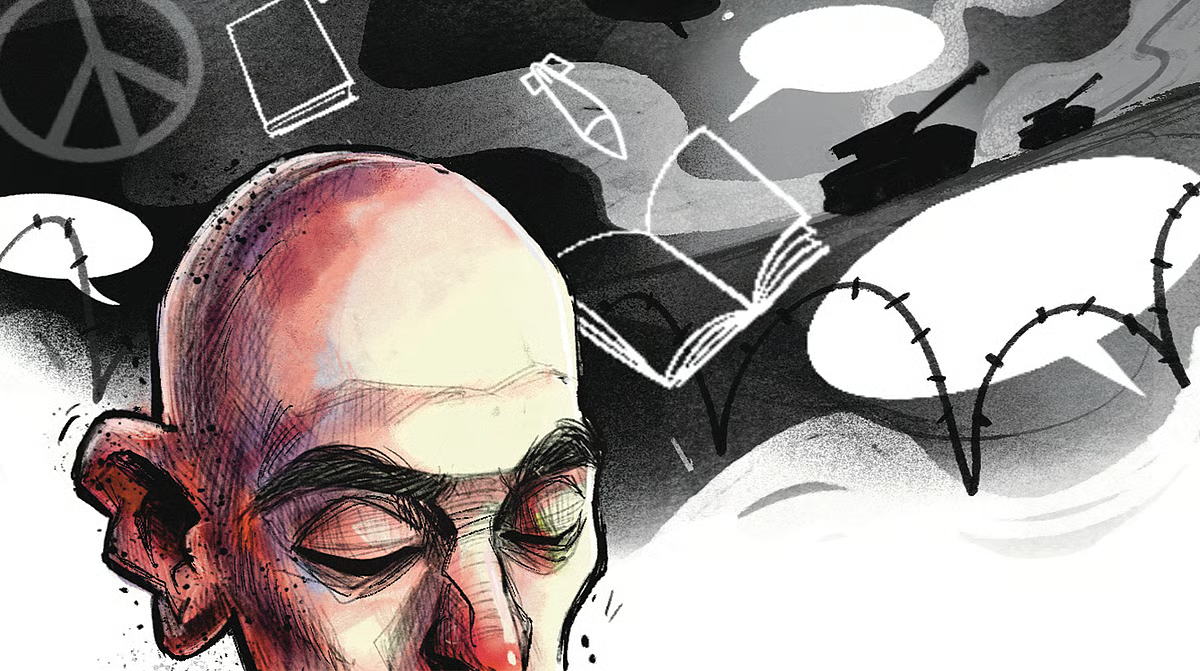
The second idea he often talked about was of genocide. He said it’s something we don’t understand, though we make it a big issue. We talk of it in numbers, but a philosophy of genocide is missing. In this context, he discussed Hannah Arendt’s book, Eichmann in Jerusalem. For Arendt, Eichmann was eventually understandable in terms of management theory. It was merely a profound extension of Taylorism, which analyses workflows to maximise efficiency, and Gilbrethian ideas for scientific management through motion study and ergonomics.
Eichmann saw himself as a clerk and the concentration camp as an organisation. But for Ramu, such depiction was not complete. One had to, in a fundamental way, articulate Eichmann not just as a managerial technique, but as a profound form of life. One had to understand his ontology, by studying his being.
Arendt, for all her profundity, eventually brought genocide down to a certain kind of management theory. Ramu said to reduce Eichmann to theory would be a profound mistake.
The third issue he pointed out was a deep understanding of what he called obsolescence, defined as an attempt to declare irrelevant a way of life that was once relevant. For Ramu, Western civilisation could be profoundly understood between vivisection and obsolescence.
And because of these three issues, one needs a new understanding of violence as a way of life. First of all, a new centre for ethics is needed, where a new language can be invented after understanding the inventive nature of evil.
One needs to understand violence in a variety of ways. Ramu would have pointed out that Hindi movies at one time served as a powerful myth for understanding the nature of violence. It was also a profound way of understanding Partition. Saadat Hasan Manto went to the extent of saying that Bollywood couldn’t exist without Hindus and Muslims working together. So the Hindi movie was a transcending act of solidarity at the time of Partition.
Recent Hindi movies have changed in the way they conceive violence. It is no longer a kind of easy, convenient correlation that could be visualised on, say, Amitabh Bachchan. On-screen violence today is excessive. One can look at Animal and Dhurandhar to understand the change, though violence itself is a form of excess.
But it’s so very extremely depicted today that it breaks down the film as a myth, as it often has no corresponding reality. For Ramu, it would have been a profound crisis if he felt that violence had no categories of understanding in a literary or a philosophical sense.
One must go back to the ontology, epistemology and cosmology of violence. This is what Ramu Gandhi would have argued for. For him, non-violence was a profound act of understanding the inventiveness of violence. And to do this, one had to explore silences of the day. In the silences of today one might find the violence of tomorrow.
Ramu Gandhi would have added that one of the most destructive elements in modern philosophy is the elimination of the body as a metaphor. It no longer exists in a profound way in philosophy. It’s no longer the body that shapes body politics. We need another set of metaphors. We need a new set of concepts, a new narrative. Ultimately, we need new kind of storytelling.
Pedagogues like Gandhi created a new philosophy, a new language to understand evil. Today, we need to do it all over again.
Shiv Visvanathan | Social scientist associated with the Compost Heap, a group researching alternative imaginations