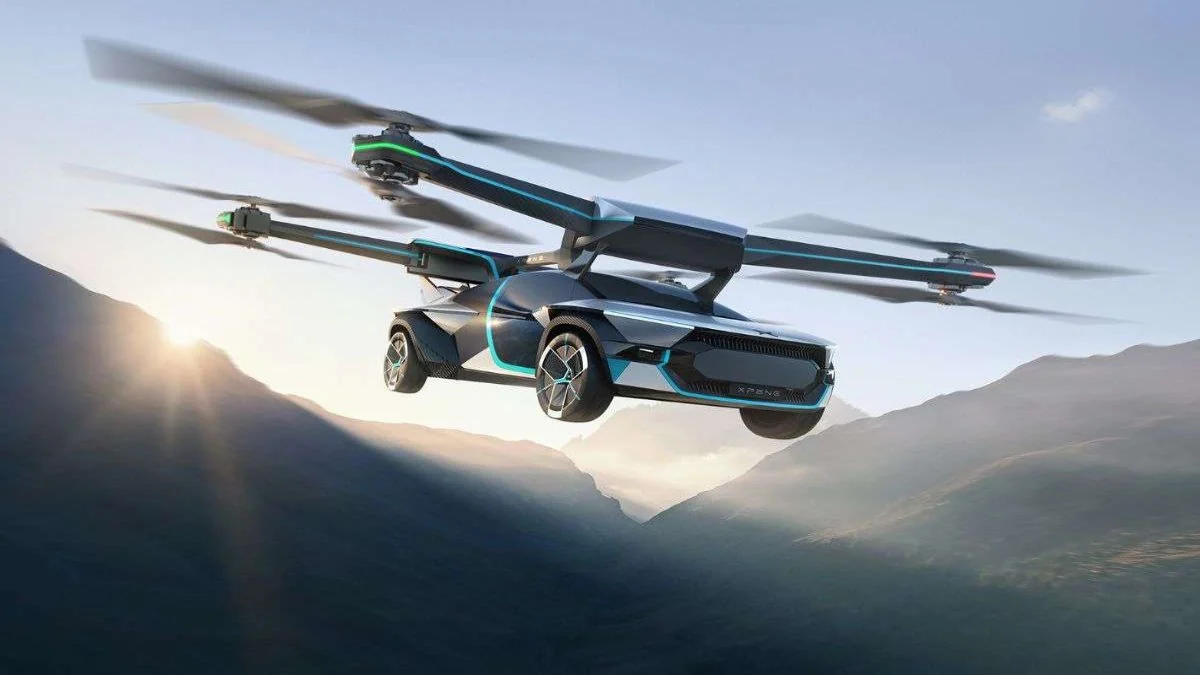
Automobile Desk: In the world of technology and automobile, the dream of flying cars now seems to be fast turning into reality. After American giant Elon Musk's Tesla, now China's leading electric vehicle manufacturer XPeng has intensified the race. The company is preparing to launch its new two-seater flying car in the market by the second half of 2027. At the global level, there is a lot of curiosity about this unique confluence of automobile and aviation sectors.
Deli Zhao, Chief Executive Officer (CEO) of the company's Flying Vehicle Division, unveiled this ambitious project during the recently held Web Summit. He clarified that Xpeng has been working on the design, development and safety testing of this aircraft for the last decade. This vehicle has also received the initial green signal for limited use from the Civil Aviation Authority of China. In the initial phase of launching, it will be made available for rural areas, adventure tourism and entertainment. Additionally, it can also be used for quick emergency and medical services in areas with difficult geographical conditions.
In terms of technology and design, this flying car is completely different from traditional vehicles. It is not provided with wheels to run on roads, rather 6 powerful electric propellers have been installed to lift and control it in the air. For this reason, its structure looks like a huge passenger drone instead of a car. Its small cabin has a seating arrangement for two people, whose size is like that of compact cars. To control it, a joystick is provided in the cabin. The special thing is that due to the advanced navigation system provided in it, it can be flown on a pre-determined route without constant manual control.
The company claims that the operation of this aircraft is very easy and any common man can be taught to fly it by giving just a few minutes of basic training. However, detailed information about the licensing and regulatory rules related to its commercial use is yet to be revealed for common customers.
Talking about the price, the company has fixed its estimated cost at around 3 lakh dollars (about Rs 2.18 crore). At this price, the customer will not only get a flying aircraft but will also get a huge 6-wheel van to take it from one place to another. The flying vehicle can be easily taken out from the rear part of this van, after which its wings automatically come into flight position. The company has compared this transformative mechanism to the vehicles in famous Hollywood science-fiction films.
On the functionality front, this flying aircraft can cover a distance of about 30 kilometers once fully charged and can go up to a maximum height of 1 kilometer in the air. The company is working on the target of doubling its range in the coming time by using new generation high-density battery technology.
This step of China is part of strengthening its national policy 'Low-Altitude Economy', under which a network of low-flying drones, air taxis and cargo ships is being created. The Chinese government plans to recognize these modes first for freight transportation and then for human travel. Compared to Tesla's gas-pressure based concept in the market, Xpeng considers its electric propeller model to be more practical for long and stable air travel. China is now eyeing Asia as well as European and Middle-East markets.