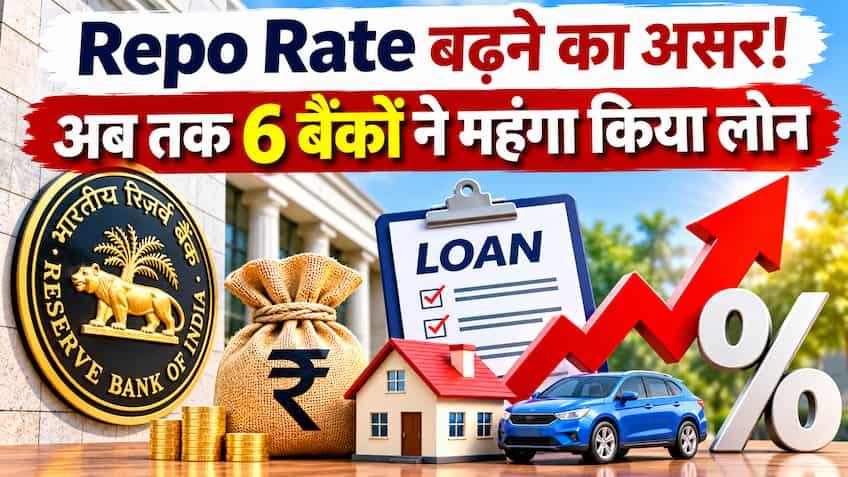
The turmoil in the country’s banking sector has intensified after the Reserve Bank of India (RBI) took a strict stance on the policy rates (Repo Rate) under inflation control and monetary management. The direct impact of increasing cost of funds on banks has now started falling on the pockets of common consumers. Six major commercial banks in the government and private sector of the country have announced an increase in their Marginal Cost of Funds Based Lending Rate (MCLR) and Repo Linked External Benchmark Lending Rate (EBLR/RLLR). Due to this decision, a direct increase in the monthly installment (EMI) of home loan, car loan, personal loan and education loan is considered certain. Its impact has been implemented with immediate effect on customers whose loans are linked to external benchmarks.
Detailed details of the new interest rates and hikes implemented by the country’s top public and private banks are as follows:
1. State Bank of India (SBI)
The country’s largest government bank SBI has increased its MCLR of various tenors by 5 to 10 basis points (bps).
-
1 year MCLR: Increased from 8.95% to 9.00%.
-
Repo Linked External Benchmark Rate (EBLR): Since it is directly linked to the repo rate, new effective rates above 9.15% have been implemented.
-
Bearing: Most of the home loans and auto loans linked to SBI are linked to 1 year MCLR or EBLR, which will increase the EMI for both old and new customers.
2. HDFC Bank
HDFC Bank, the largest private sector lender, has increased its MCLR by 5 to 15 basis points (bps) for select tenors.
-
1 year MCLR: Reached the level of 9.45%.
-
Overnight and 3 month MCLR: Revised in the range of 9.10% to 9.25%.
-
Bearing: There has been an immediate increase in the interest rates of personal loans and unsecured loans.
3. Punjab National Bank (PNB)
PNB, the second largest public sector bank, has increased its Marginal Cost Based Lending Rate and RLLR for all tenors by 10 basis points.
-
1 year MCLR: Increased from 8.85% to 8.95%.
-
Repo Linked Lending Rate (RLLR): Increase from 9.25% to 9.35% effective.
-
Bearing: Working capital and term loans have become expensive for MSME and retail borrowers.
4. ICICI Bank
ICICI Bank has revised its lending rates by 5 to 10 basis points.
-
1 year MCLR: Has increased to 9.20%.
-
I-EBLR: The repo linked rate of the bank has crossed 9.25%.
-
Bearing: Customers with floating rate home loans will see an increase in their repayment period or monthly EMI.
5. Bank of Baroda
Bank of Baroda has notified an increase of 5 bps in MCLR of various tenures.
-
1 year MCLR: Increased from 8.95% to 9.00%.
-
BRLLR: The repo based rate applicable for retail customers has been adjusted to 9.15%.
-
Bearing: New applicants for mortgage loans and vehicle loans will have to pay higher interest rates.
6. Axis Bank
Axis Bank, the third largest private bank, has also increased its MCLR by 10 basis points due to increase in its cost of funds.
-
1 year MCLR: It has increased from 9.30% to 9.40%.
-
Bearing: Its impact will be visible on both corporate credit and retail consumer lending categories.
| bank name | 1 year revised MCLR | RLLR/EBLR (Repo Linked Rate) | effective increase |
| State Bank of India (SBI) | 9.00% | 9.15% + spread | 5 – 10 bps |
| HDFC Bank | 9.45% | 9.20% + spread | 5 – 15 bps |
| Punjab National Bank (PNB) | 8.95% | 9.35% | 10 bps |
| ICICI Bank | 9.20% | 9.25% + spread | 5 – 10 bps |
| Bank of Baroda (BoB) | 9.00% | 9.15% | 5 bps |
| Axis Bank | 9.40% | 9.35% + spread | 10 bps |
Understand the monthly and total impact on a 20 year home loan of an average 0.25% (25 basis point) to 0.10% increase in interest rates:
-
Loan amount: ₹30,00,000 (Rs 30 lakh)
-
Duration: 20 years (240 months)
-
Old interest rate (8.50%): Monthly EMI = ₹26,035 | Total interest = ₹32,48,335
-
New interest rate (8.75%): Monthly EMI = ₹26,511 | Total interest = ₹33,62,735
-
Net additional burden: per month Additional EMI of ₹476so that in 20 years the total ₹1,14,400 Additional interest will have to be paid.
(Note: Instead of increasing the monthly EMI amount, many banks increase the tenure of the loan, due to which customers do not get an immediate shock but have to pay additional interest in the long run.)
In the rising interest rates cycle, existing borrowers can take the following steps to control their financial burden:
-
Part-Prepayment: If you have any bonus, maturity fund or additional savings available, deposit 5% to 10% of the principal in lump sum from time to time. This results in a significant reduction in the loan tenure and total interest payable.
-
Switch from MCLR to EBLR: If your old loan is still running on the base rate or the old MCLR system, get your bank to directly transfer it to the repo-linked (RLLR) regime by paying a nominal switching fee.
-
Home Loan Balance Transfer (Refinancing): If your current bank is charging excessive interest rates (like more than 9.50%) and your CIBIL score is above 750, you can consider transferring your outstanding loan to a bank with a lower interest rate.
-
EMI vs Tenure Reset: Contact your bank to clarify whether they have increased your monthly EMI or loan tenure due to increase in rates. If budget allows, it makes more financial sense to continue paying the increased EMIs rather than extending the tenure.