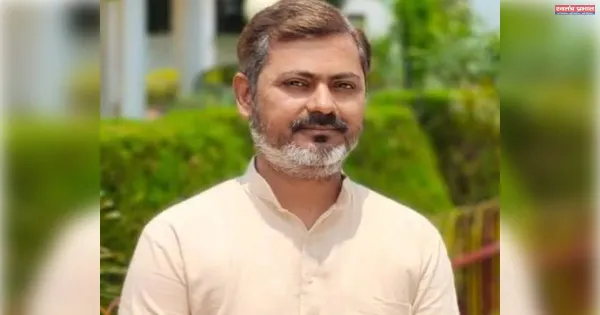
Rajeev Kumar Shukla
In the politics of Uttar Pradesh, alliance is not just a name for electoral manipulation, but it is also a continuous exercise of sharing power, political respect and preserving one's social base. With the 2027 assembly elections looming, the political activities and statements of the leaders of BJP's allies are being viewed from this perspective. Especially the political discussions are intense regarding Suheldev Bharatiya Samaj Party President Omprakash Rajbhar and Nishad Party President Sanjay Nishad.
Both the leaders are ministers in the Yogi Adityanath government and are also part of the alliance with the BJP. But the question is whether his political ambitions have been fulfilled just by getting the ministerial post in power? Are they getting as much political importance in the government and organization as they want to display among their supporters? Or is this discontent merely a political strategy to increase its bargaining power before the upcoming assembly elections?
These questions cannot be ignored in the politics of Uttar Pradesh. Because both Rajbhar and Nishad are leaders whose politics has developed around their respective social base and regional influence. His relationship with BJP is not only about sharing in power but also about electoral equations.
To understand the politics of Omprakash Rajbhar, it is important to look at his old political journey. Rajbhar first aligned with Samajwadi Party and later joined BJP. His party was part of the SP alliance in the 2022 assembly elections, while later he joined the NDA. His political history shows that in coalition politics he keeps his options open according to the circumstances.
In September 2026, Rajbhar wrote a letter to Chief Minister Yogi Adityanath accusing senior officials of his department of not cooperating and demanded the removal of the officials. This controversy is an example of the questions being raised within the government regarding departmental rights and administrative hold of ministers. However, it would not be appropriate to consider this as evidence of his personal displeasure with the Chief Minister.
On the other hand, Sanjay Nishad has continuously raised the demand of giving Scheduled Caste status to Nishad community in front of BJP. His argument is that the Nishad community should get its constitutional rights. On October 22, 2026, he talked about reviewing the alliance with BJP before the 2027 assembly elections. He said that any decision will be taken only after taking opinion from the core committee of the party and workers and supporters of all 75 districts of the state. This statement became a topic of special discussion in political circles.
The thing to be noted here is that Sanjay Nishad did not announce breaking the alliance, but talked about reviewing the alliance. For them, the issue of reservation is not just a political demand but also a question of maintaining their leadership ability and credibility among their society. There has been a discussion among political analysts regarding the working style of Yogi Adityanath, how centralized is the decision-making process in the government and how much freedom do ministers of allied parties have. But to say that the Chief Minister does not give any importance to these two ministers is a political allegation or perception, not an established fact.
In the official council of ministers list of the government, Omprakash Rajbhar holds the portfolios of Panchayati Raj, Minority Welfare, Muslim Waqf and Haj, while Sanjay Nishad is the Cabinet Minister of Fisheries Department. That means both have got the responsibility of important departments. The real question is not about getting the department, but about their participation in political decisions, administrative rights and election strategy.
The political strength of leaders like Rajbhar and Nishad comes from their social base. In such a situation, if they feel that their views are not being listened to with the required seriousness in the government or organization, then they can resort to public rhetoric and pressure politics to strengthen their political position. There is a difference in the political circumstances of the two leaders. Rajbhar's emphasis is visible on political participation, representation for his society and strengthening his role in the politics of Purvanchal. In September, he had also talked about the Chief Minister of Rajbhar Samaj in the event of dividing Uttar Pradesh into four parts and creating a separate Purvanchal state. Sanjay Nishad had expressed disagreement on this statement. It is clear from this that both the allied leaders are not unanimous on every issue.
Sanjay Nishad's concerns are mainly related to the reservation, political representation and seat share of the Nishad community in the assembly elections. In September, his party had also raised the demand for more seats from BJP. There were also reports of Rajbhar's demand for 25 seats in the assembly elections. This is the point where the challenge of alliance management comes to the fore for BJP. Keeping allies together and at the same time maintaining your organization's political priorities is not an easy task.
Rajbhar and Sanjay Nishad have old political contacts with opposition parties in Uttar Pradesh politics. Sanjay Nishad has also made a political alliance with SP earlier. Rajbhar has also contested elections with Akhilesh Yadav. Therefore, it is not unnatural to discuss the political options of both the leaders. A report also mentioned political discussions between the two leaders on the possibility of their separation from the BJP. However, the report also clarified that both the leaders had not publicly announced leaving the BJP alliance.
There is also an important political contradiction here. Rajbhar has been continuously criticizing Akhilesh Yadav and Samajwadi Party. In such a situation, it will not be easy for him to return to the same political camp. In the case of Sanjay Nishad also, the issue of reservation will be important in deciding the direction of any possible alliance. The next elections to be held on 403 assembly seats of Uttar Pradesh will not be only a question of competition with the opposition for BJP. It will also have to strike a balance between the expectations of its allies, social representation and seat distribution.
The political utility of allies like Rajbhar and Nishad for the BJP lies in their access to supporting social groups and local electoral influence. On the other hand, these leaders also face the challenge of how much they are able to advance the demands of their society while being in power.The biggest problem in a coalition arises when one party considers its share in power adequate, while the other party wants more respect and share in proportion to its political contribution.
Therefore, the political ambitions of colleagues cannot be limited merely by giving them ministerial posts. They also have to demonstrate participation in the decision-making process, a proper place in the electoral strategy, and concrete progress on promises made among their supporters.
There is no definite answer yet whether Rajbhar and Sanjay Nishad will leave BJP or not. Sanjay Nishad has talked about reviewing the alliance, whereas Rajbhar has a history of changing alliances in his political behaviour. But on the basis of these facts, it would be premature to accept the future decision as already decided. It is possible that both the leaders will stay with BJP and put pressure on more seats, political respect and issues related to their society. It is also possible that as the elections approach, new political situations may arise regarding the terms of the alliance.
After all, the question in politics is not who is with whom, but who is together on what conditions. The real challenge before Yogi Adityanath is not only to run the government, but also to assure his allies that their identity, political respect and stake in the alliance is safe. At the same time, Rajbhar and Sanjay Nishad will also have to decide whether their priority is participation in power or maintaining independent political pressure to fulfill the demands of their society. The 2027 elections will tell whether coalition politics in Uttar Pradesh remains limited only to power sharing or it also sets new conditions for social representation and political respect. Because discussions about a turnaround in politics often start before the elections, but the real test of the alliance comes when the time comes for seat distribution and power sharing.