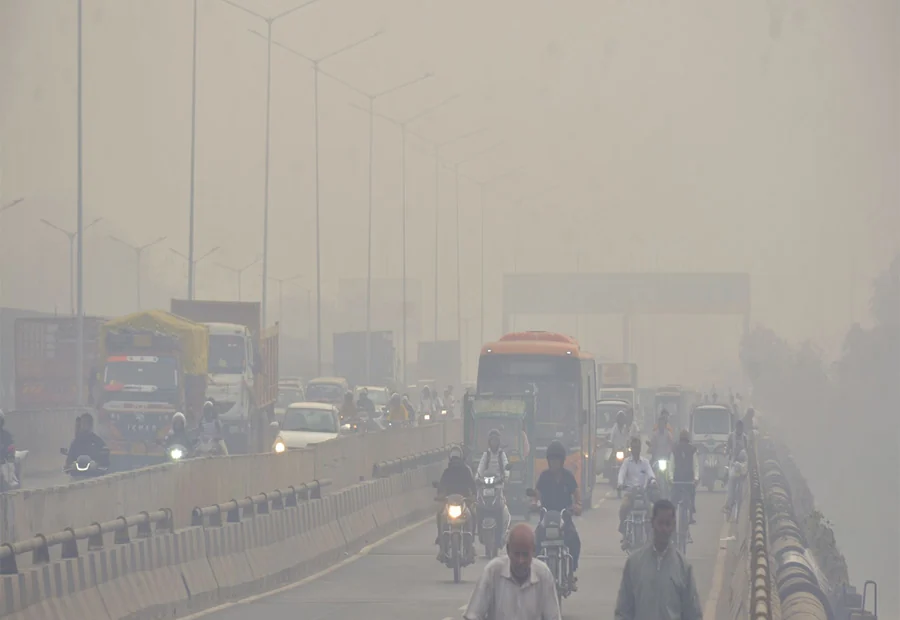
At present, people do not seem to be getting any relief from the poisonous air in Delhi-NCR. Despite the implementation of GRAP-3, the pollution level is continuously increasing. Delhi's average AQI was recorded at 313 on Wednesday night, which falls in the very poor category. In view of the continuously deteriorating air quality, the administration has taken several precautionary measures. Pollution can have the biggest impact on the health of children and the elderly. In view of this, orders have been given to conduct education of children up to class 5 in hybrid mode in Noida and Greater Noida. Under this, schools will have to make arrangements for studies through both online and offline mediums.
Administration alert on pollution, strictness on everything from schools to construction works
The effect of increasing pollution in Delhi-NCR is now visible from children's education to the everyday life of common people. In view of the harm caused to the health of children due to poisonous air, the Gautam Buddha Nagar district administration has issued many important instructions for schools. At the same time, Noida Traffic Police has prepared to take strict action against vehicles causing pollution. Apart from this, construction works have also been banned to control pollution. The administration has advised people not to step out of the house unnecessarily and take necessary precautions to prevent pollution.
1. Children up to class 5 will study in hybrid mode
In view of the increasing pollution in Delhi-NCR, an order has been issued to conduct education of children up to class 5 in hybrid mode in schools of Noida and Greater Noida. After the implementation of GRAP-3, District Basic Education Officer Rahul Panwar issued this instruction. This order will be applicable to all council, aided and recognized schools in the district. Under this, schools will have to give children the option of studying through both online and offline mediums. Schools which have online class facility will have to conduct online classes also. Its objective is to protect children from exposure to pollution.
2. Ban on BS-3 petrol and BS-4 diesel vehicles
To control pollution, strictness has also been imposed regarding vehicles in Noida. A ban on operation of BS-3 petrol and BS-4 diesel vehicles has been implemented. The traffic police has prepared to take action against the drivers who violate the rules. Apart from this, the ban on operation of diesel vehicles older than 10 years and petrol vehicles older than 15 years will also remain in force. If such vehicles are found plying on the roads, action will be taken against them as per rules.
3. Surveillance will be done through CCTV cameras, challan will be issued if rules are broken.
Noida Traffic Police will take the help of Command Control Center to keep an eye on polluting vehicles. Vehicles will be monitored through CCTV cameras installed in different areas of the city. Action will be taken against drivers violating the rules under the Motor Vehicles Act. The administration has made it clear that along with government efforts, cooperation of common people is also necessary to control pollution. In such a situation, an appeal has been made to the drivers to follow the rules and play their role in reducing pollution.
4. Ban on construction and demolition works also
Under GRAP-3, a strict ban has also been imposed on construction and demolition works that spread dust in Delhi-NCR. Under this, non-essential construction and demolition activities will remain closed. Activities like digging, earth related work, trenching, piling, road construction and repair will also be banned. Apart from this, works like painting, polishing and varnishing will also be prohibited. The main objective of these restrictions is to control dust flying from construction sites. In fact, fine particles of dust increase the level of pollution in the air and also have a bad effect on people's health.
5. Wear N-95 mask, avoid exercising outside
In view of the increasing pollution in Delhi-NCR, people have been advised to take special care of their health. Especially in the morning and late evening, people have been asked to avoid walking outside, running and doing heavy exercise. Go out of the house only when absolutely necessary and use an N-95 or N-99 mask instead of a normal cloth mask. Children, the elderly, pregnant women and people suffering from asthma, heart disease or lung disease need to take special precautions.
Delhi's pollution increasing due to transportation and stubble burning
Transportation and stubble burning are also emerging as major reasons behind the increase in pollution in Delhi-NCR. The transport sector was estimated to be the biggest contributor to Delhi's air pollution on Wednesday. At the same time, the impact of stubble burning is expected to increase on Thursday. According to estimates, the share of stubble burning in Delhi's pollution was around 7 percent on Wednesday, which may increase to 20 percent by Thursday. According to the data, a total of 927 incidents of stubble burning were recorded in six states on Tuesday. Due to this, the pressure of pollution on Delhi's air is likely to increase further.
The air is very bad in most areas of Delhi
On Wednesday, air quality was recorded in the very poor category at 34 out of 58 monitoring centers in Delhi, while the AQI remained in the poor category at 22 centres. At the same time, the air quality at a monitoring center reached the severe category. However, Delhi Cantonment area recorded AQI 117, which falls in the moderate category. It is clear from this that the level of pollution remains different in different areas of the capital.
Follow the LALLURAM.COM MP channel on WhatsApp