Mysterious Object 1998 KY26: The speed of a mysterious object passing near the Earth is continuously increasing. Even scientists are not able to understand why this is happening. Earlier it was considered only a space rock. Now a new study by researchers at the Georgia Institute of Technology has revealed that a possible asteroid named '1998 KY26' is moving so fast that it cannot be explained by the gravity of the Sun and other planets alone.
In simple words, some other force is also working to propel this so-called space rock moving in our solar system.
'Near-Earth objects' (objects present near the Earth) are those rocky bodies present in space that revolve around the Sun and sometimes come very close to the Earth. The object is about 36 feet long (the size of a school bus) and rotates once every 5.35 minutes, which is a very high speed for a space rock. Although it is currently about 189 million miles away from Earth, but according to its current path, by 2028 it will come at a distance of 32 million miles from our planet. According to the European Space Agency (ESA), it will come even closer in 2039 when its distance will reduce to 10 million miles.
Although '1998 KY26' is generally considered to be a small rock, given the mysterious increase in its speed, a scientist claims that it is actually a spacecraft lost four decades ago. Harvard Professor Avi Loeb believes that this object may actually be 'Phobos 1', a spacecraft that was launched by the then Soviet Union in 1988.
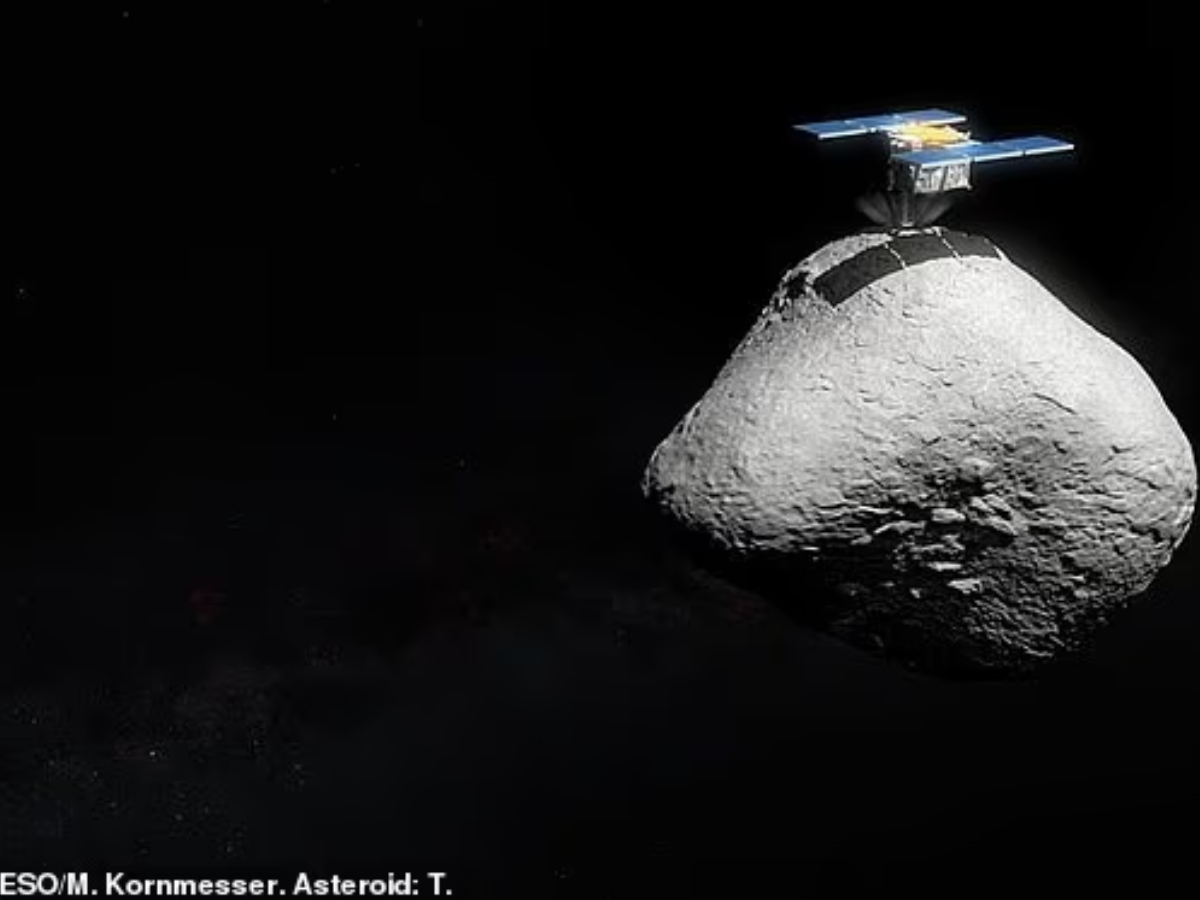
This spacecraft got lost and disappeared just a few months after its journey to Mars began, but Professor Loeb believes that the size of '1998 KY26' and its mysterious movements could be evidence that astronomers have finally found that lost spacecraft. This picture is an artist's imagination, in which Japan's 'Hayabusa 2' probe is seen landing on an object named '1998 KY26'. This probe will try to reach this object in 2031.
1998 KY26 moving towards earth at high speed
An imaginary picture of the near-Earth object '1998 KY26', on which Japan's 'Hayabusa2' probe is landing. This probe will try to reach this object in 2031. In 2023, scientists analyzed telescope data from the last 25 years and found that '1998 KY26' is moving faster than normal. These measurements taken over a long period of time revealed that this object is receiving a slight continuous push. Because of this, its path deviated from the path that scientists had expected based only on the effect of gravity.
1998 KY26 is too hot
Now a new study by aerospace engineers Corbin Hansen and Masatoshi Hirabayashi has revealed that this mysterious jump in speed is not the result of any natural phenomenon occurring inside '1998 KY26'. According to Hansen and Hirabayashi, it is not possible that the ice present on or inside its surface is melting and coming out into space like a jet engine, giving it this speed. According to new research published in the journal 'Icarus', '1998 KY26' is so hot that it is not possible for water ice to survive in it.
The temperature in its coldest parts as it orbits the Sun also averages -53°F to -78°F or more. For ice to last long in space, temperatures must be very low. Approximately below -198°F.
There is no water in the asteroid
In their report released this month, the researchers wrote that we have concluded that '1998 KY26' is probably an asteroid that does not contain water at all. However, the team's findings have rejected the 'dark comet' theory. According to this theory, the ice hidden inside the asteroid was slowly turning into gas and was giving it a slight push. Even though no visible tail or cloud of dust was seen.
A model of the Phobos 1 spacecraft, a Soviet probe lost en route to Mars in 1988. Professor Avi Loeb has given the theory that 1998 KY26 is actually Phobos 1. A model of the Phobos 1 spacecraft, this Soviet probe was lost en route to Mars in 1988. Professor Avi Loeb has given the theory that 1998 KY26 is actually Phobos 1.
This leads to Loeb's theory that this mysterious object is not actually a 36-foot rock revolving around the Sun. Loeb and his co-authors Adam Hibbard and Adam Crowell have released their study on arXiv. It has been argued that this object's size, unusually high brightness, rapid rotation and its orbit, all these things match that of a man-made spacecraft.
Harvard physicist and 'Frank B. Loeb, who holds the post of Baird Junior Professor of Science, said that the acceleration provided to this object comes from the energy of the Sun. This energy exerts pressure on Phobos 1's shiny metal surfaces and solar panels – creating a condition called 'solar radiation pressure'. They also found that a simple 3D model of Phobos 1 closely matches the variations in brightness of 1998 KY26 (called 'light curves') observed by telescopes from Earth.
Also read: Ghaziabad Crime: Dead body carried 1000 meters 'sitting' on scooter! Repeated scene of 'Jaane Bhi Do Yaaron'
Also read: UP Chunav 2027: Bad news coming from Lucknow for Akhilesh Yadav! Alliance may be announced in AIMIM-ASP
Also read: Agniveers Rules: Agniveer will be able to get married after 4 years, extension of leave is also being considered.
The post Mysterious Object 1998 KY26: After 40 years, chaos is moving towards the earth, so hot… it is not possible for ice to survive appeared first on Tezzbuzz.