Remembering the Indian Soldiers Who Helped Win the Second World War
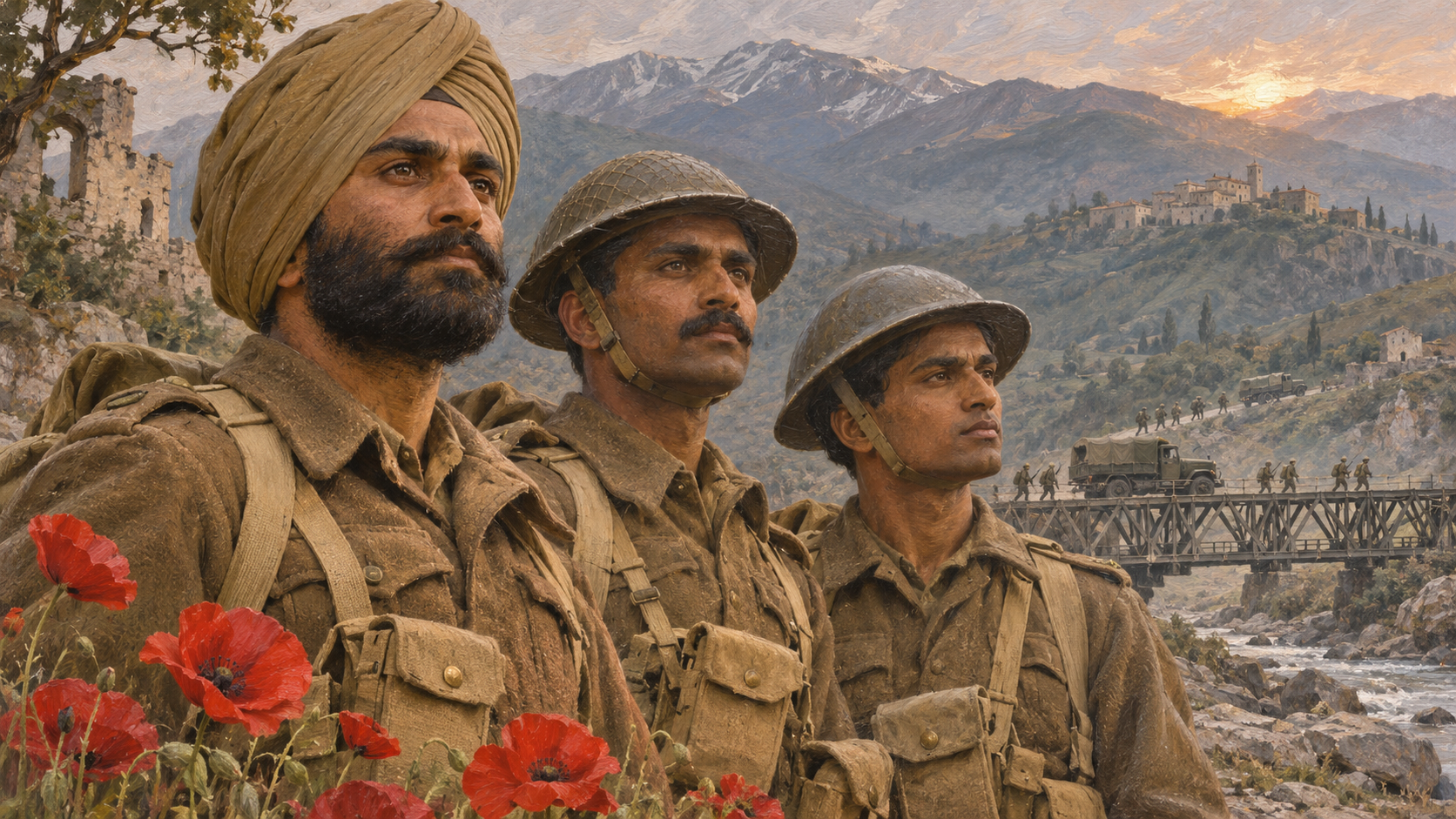
As Canadians pause to remember those who served and sacrificed in war, the story of the Indian soldiers who fought across Europe, Africa and Asia deserves a prominent place in that remembrance. Their service helped shape the outcome of the Second World War and created a shared military history with Canada that remains unfamiliar to many Canadians.
From the deserts of North Africa to the mountains of Italy and the battlefields of Burma, Indian troops formed a major part of the Allied war effort. By the end of the conflict, the British Indian Army had expanded to approximately 2.5 million men, becoming widely recognised as the largest volunteer army in history.


These soldiers served before Indian independence and Partition in 1947. The army drew recruits from across undivided India, including territories that now form India, Pakistan and Bangladesh, alongside Gurkhas from Nepal. Hindus, Muslims, Sikhs, Christians and others served within its ranks, bringing different languages, traditions and experiences into a military force deployed far beyond the subcontinent.
For South Asian Canadians, that history offers a direct connection between ancestral service and the country they call home. Canadian and Indian troops fought together in Italy, where their cooperation is recorded in official Canadian military histories.
During the advance towards Florence in 1944, Canadian Sherman tanks supported the 8th Indian Division as Allied forces worked to break through German defensive positions. Canada’s Department of National Defence documents how Canadian armoured units helped the Indian division protect the flank of the advancing force.
Another example emerged during the crossing of the Gari River in May 1944. The river formed a formidable obstacle along the German Gustav Line, with exposed approaches and enemy positions making the construction of a bridge exceptionally dangerous. The 1st Canadian Armoured Brigade was supporting the 8th Indian Division in the operation.

Canadian officer Tony Kingsmill developed a method of moving a completed Bailey bridge into position using tanks. Indian engineers helped test the concept and assemble the bridge for the crossing. The account preserved by the Royal Canadian Electrical and Mechanical Engineers Museum illustrates how soldiers from both armies combined technical skill and determination under battlefield conditions.
The scale of Indian service in Italy was considerable. According to India’s Ministry of Defence, more than 50,000 Indian Army soldiers from the 4th, 8th and 10th Divisions participated in the campaign. They suffered 23,722 casualties, including 5,782 deaths. Their service is remembered in Commonwealth war cemeteries across the country.
Indian formations fought in some of the Italian campaign’s most demanding battles, including Monte Cassino. Progress required crossing rivers, climbing exposed slopes and confronting deeply prepared German positions. Each advance depended on infantry, artillery, armour, engineers, medical personnel and supply units working together.
Their contribution had already been established in Africa. The 4th Indian Division, known as the Red Eagle Division, fought extensively against German and Italian forces. Its service included El Alamein and the Tunisian campaign, during which the National Army Museum credits the division with capturing General Hans Jürgen von Arnim, the Axis commander in North Africa.
In East Africa, Indian troops helped defeat Italian forces in Eritrea and Ethiopia. At Keren in 1941, British Indian forces fought for positions controlling the routes towards Asmara and the port of Massawa. The campaign demonstrated the importance of Indian formations in Allied operations well before the final years of the war.
The conflict eventually reached India itself. In 1944, Japanese forces launched a major offensive into the northeast, seeking to seize strategic bases and disrupt Allied communications. The battles of Imphal and Kohima became a decisive test of the forces defending the region.
The defence of Imphal included the 17th, 20th and 23rd Indian Divisions, reinforced by the 5th Indian Division, which was transported into the battle by air. At Kohima, the Assam Regiment and elements of the 161st Indian Brigade fought alongside British troops in exceptionally close and destructive combat.
The Allied victory stopped the Japanese offensive and helped establish the conditions for the subsequent reconquest of Burma, now Myanmar. Indian formations played a central role in the fighting that followed, advancing through difficult terrain towards major objectives including Meiktila, Mandalay and Rangoon.
Behind these campaigns were individuals whose actions give human meaning to the enormous wartime figures.
During the Ethiopian campaign in 1941, Second Lieutenant Premindra Singh Bhagat of the Corps of Indian Engineers supervised the clearance of 15 minefields over 55 miles in four days. Working under enemy fire and intense pressure to keep the advance moving, he helped secure the passage of the troops following behind him. His actions earned the Victoria Cross.
Naik Gian Singh of the 15th Punjab Regiment received the same decoration for his actions in Burma on March 2, 1945. He attacked a Japanese position containing an antitank gun and remained with his company despite serious wounds. After independence, he continued serving in the Indian Army.
Sepoy Ali Haidar of the 13th Frontier Force Rifles, a Pashtun soldier from Kohat in present day Pakistan, distinguished himself during the crossing of Italy’s Senio River on April 9, 1945. Despite being wounded repeatedly, he overcame two German positions, enabling the rest of his company to cross. His Victoria Cross citation records how his initiative prevented a dangerous situation from becoming far more costly.
Indian participation also reached events often remembered mainly through a European lens. Around 300 Muslim soldiers from Punjab, serving with Force K6 of the Royal Indian Army Service Corps, were among those awaiting evacuation at Dunkirk in May 1940. Their presence forms another documented chapter in the wider history of the Allied forces.
The human cost of Indian wartime service was immense. The Commonwealth War Graves Commission commemorates more than 87,700 Indian personnel who lost their lives during the Second World War. Its figure includes personnel from the Army, navy, air force and merchant fleet. It represents a broader loss than soldiers killed directly in combat.
Remembering that sacrifice also requires an honest understanding of the circumstances in which these men served. India remained under British rule, and Viceroy Lord Linlithgow declared it a belligerent without consulting its elected provincial representatives. Military service unfolded alongside an intensifying independence struggle, including the Quit India movement launched in 1942.
The description of the army as a volunteer force refers to its system of enlistment. It does not mean that India entered the conflict through the decision of an independent national government. Wartime hardship also shaped recruitment, with Imperial War Museums noting that conditions including famine drove people to enlist.
The period contained competing visions of India’s future. The separate Indian National Army, later led by Subhas Chandra Bose, sought independence with Japanese assistance and fought against Allied forces in Burma. Its history must be distinguished from that of the much larger British Indian Army serving on the Allied side.
Public memory has often struggled to accommodate this complexity. European accounts frequently centre the fighting in Europe, while South Asian accounts give understandable prominence to the struggle for independence. The soldiers who served across distant battlefields can fall between those narratives.
For Canadians, the records of cooperation in Italy offer a concrete way to understand that shared past. Canadian tank crews supported Indian infantry. Indian engineers worked with Canadian personnel to overcome battlefield obstacles. Their operations depended on one another, and their losses became part of the same campaign.
On Remembrance Day, the names of Bhagat, Gian Singh and Ali Haidar belong alongside the countless others whose service is recorded in regimental histories, family memories and war memorials. Remembering them brings the people behind the statistics into view and gives fuller recognition to the South Asian contribution to the Allied victory.