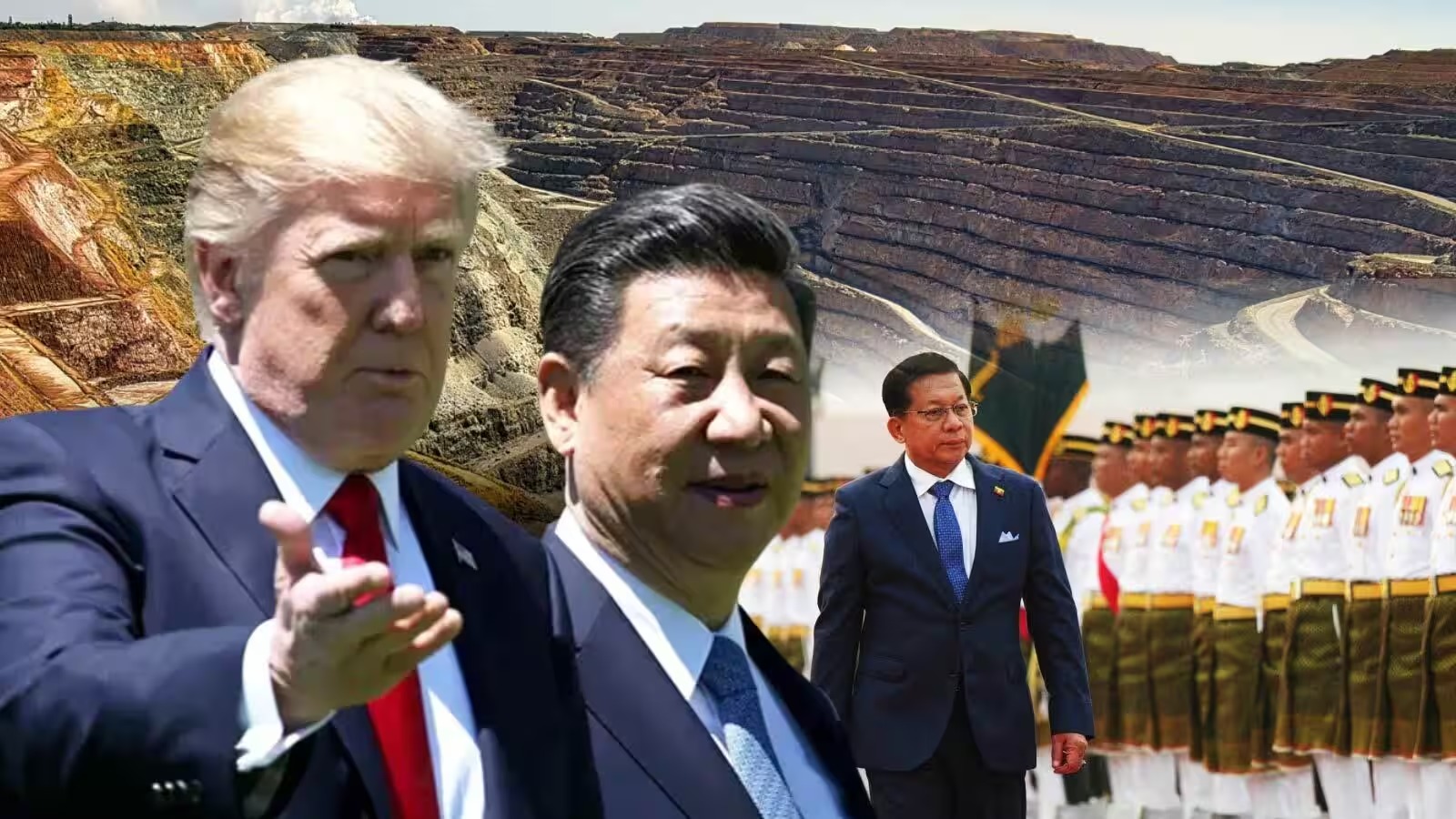
A secret strategic treasure spread across the borders of South-East Asia and India's neighboring Myanmar, on which China had its eyes fixed for years, has now transformed into the biggest arena of global politics. Regarding 'Rare Earth Elements', which are considered the lifeblood of the world's tech industry, electric vehicles, fighter planes, radar systems, semiconductors and green energy infrastructure, Myanmar has played such a masterstroke that it has given Beijing sleepless nights. Myanmar's military regime has sent a direct invitation to the United States for massive commercial investment and partnership in its rare mineral deposits. This news, which came to light after the recent strategic documents and secret talks of the US State Department, has brought a new twist in the ongoing 'Mineral War' between the superpowers. Myanmar's invitation to America: Direct challenge to Beijing's dominance Since the 2021 coup, Washington had imposed stringent economic sanctions on Myanmar's military government and froze Myanmar's assets in the New York Federal Reserve. But due to diplomacy going on behind the scenes and the efforts of Washington's lobbying firms (DCI Group), America has changed its policy. The US State Department has drawn up initial business deals worth at least $5 million in Myanmar's rare earth sector for US companies under the 'Burma Integrated Strategy'. Myanmar's capital Naypyidaw has made a clear proposal to America that if Washington wants to end China's dominance and monopoly, it will have to make Myanmar's minerals its strategic priority. 'Heavy Rare Earths' minerals like Dysprosium and Terbium found in Myanmar are in high demand across the world. Till now, China used to import more than 50 percent of the raw rare minerals from Myanmar, refine them and sell them to the world on its own terms. But with Myanmar opening its doors to America, China's monopoly is in danger. What are rare earth minerals and why is the dragon angry? Rare Earth Elements are a group of 17 special chemical metals and minerals, without which the technology of the modern world can come to a halt. Be it iPhone displays, powerful magnets in wind turbines, efficiency of electric vehicle (EV) motors, missile guidance systems or satellite technology—they all require the use of rare earths. China currently controls more than 90% of rare earth magnet production and refining processes globally. Beijing has often used bans or restrictions on rare earth exports as a weapon to subdue other countries in trade and strategic battles. Troubled by this attitude of China, America, India, Australia and the European Union are making efforts to de-risk their supply chains from China. This step of Myanmar has blunted the edge of China's coercive weapon, due to which the Dragon has become irritated and Beijing's Foreign Ministry has registered a strong protest against the politicization of trade. Ground reality: Control of Kachin rebels and Chinese networks On paper, the Myanmar government has invited US investment, but its path on the ground is extremely complex and full of conflicts. Due to the ongoing civil war in Myanmar, the government does not control the north-eastern areas bordering China—particularly the Pangwa and Chipwe mining areas in Kachin State. These areas are dominated by rebels i.e. Kachin Independence Army (KIA) and pro-Chinese armed groups. Till now, the raw ore originating from Myanmar has been going directly to the refineries of Yunnan province via the Chinese border. If the US wants to enter these mines directly, it will have to deal not only with Myanmar's military administration, but also with the Kachin rebels on the ground and the vast network of Chinese middlemen present there. Beijing is making every effort to stop the entry of American companies by increasing its influence on these rebel groups. What are the strategic implications and future opportunities for India? This major geopolitical event taking place in Myanmar is very decisive from the point of view of India's national security and economic self-reliance. India has about 8% of the world's reserves of rare earths, but we are yet to develop huge potential for commercial extraction and high-level refining of these minerals. India is currently heavily dependent on China for its electronics, automobile and defense needs. The crack in China's dominance in the neighboring country Myanmar has brought a big opportunity for India. India's Ministry of External Affairs and Mines has already sent a study team to Myanmar to sample rare minerals and explore possible supply agreements. If Washington and its allies Quad (India, US, Japan, Australia) succeed in taking Myanmar's mineral resources out of China's grip, then India's 'National Critical Mineral Mission' will get a new impetus and the era of China's economic blackmailing in the Indo-Pacific region will end.