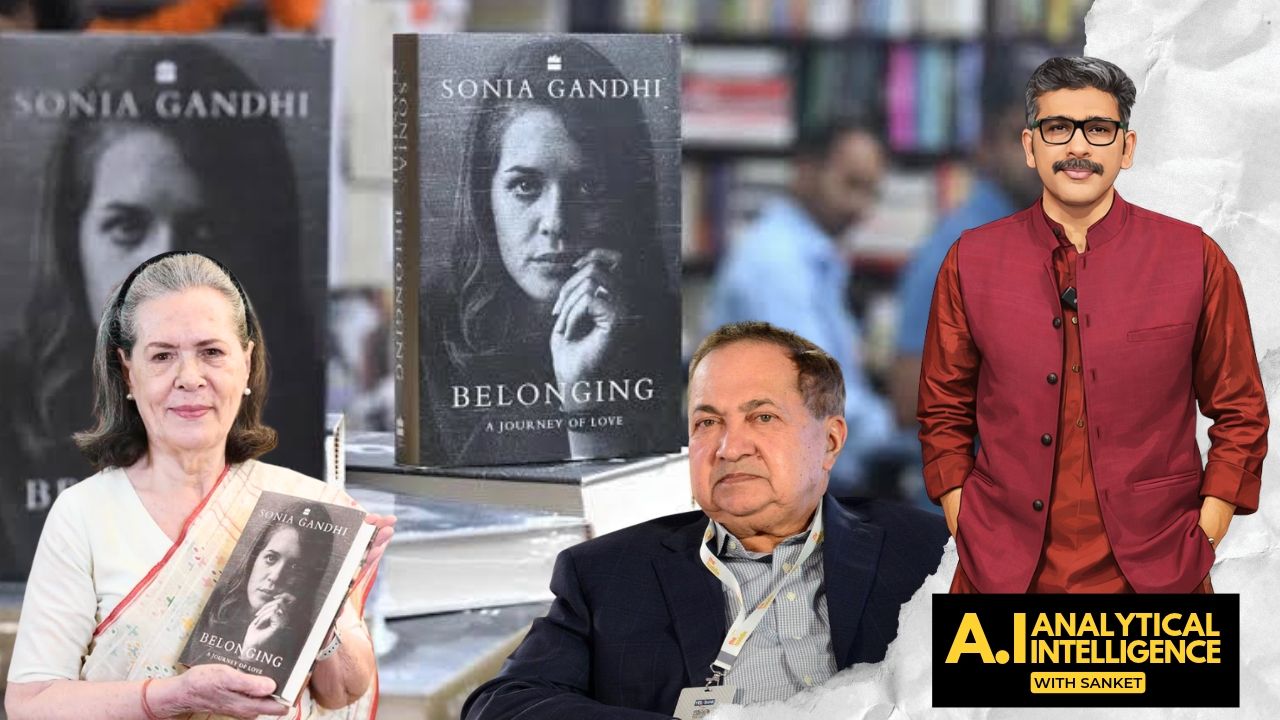
Veteran journalist N Ram recently interviewed Congress veteran Sonia Gandhi about her newly released memoir, Belonging: A Journey of Love. In the book, Sonia reflects on how her personal love story with Rajiv Gandhi evolved into a lifelong commitment to India, examines the impact of 12 years of BJP-RSS rule on Indian democracy, and defends the Congress party’s ongoing fight for a level playing field.
In an interview with The FederalRam shares his candid impressions of the book — from Sonia Gandhi’s unvarnished, “clear-glass” storytelling to her coalition-building pragmatism and the political controversies surrounding the memoir.
Edited excerpts:
You got the book ahead of its release. What were your initial impressions?
I think this is a love story at its heart. As Sonia Gandhi puts it, it is a personal memoir with politics providing the background and framework. It begins with an instant bond of love forged at a Greek restaurant in Cambridge, which eventually transformed into a political life after she married into Indira Gandhi’s family. When she arrived as a young bride, she says she knew nothing about politics; what she learned — secularism, a sense of duty, and commitment to the Constitution — came from Indira and Rajiv Gandhi.
More than anything, the book is candid. Once she takes up a subject, she doesn’t hold back anything of significance, including frustrations within the family and the weaknesses of its members. She worked on this book for around 10 years.
For a long time, she and Rajiv had decided not to engage with the muck written about their family. Eventually, she felt her journey — from a personal love story to a love for the family and the people of India — was worth telling in her own words.
Watch/Read | ‘The political masala you expect from Sonia Gandhi’s memoir is largely missing’
She also writes candidly about how deeply hurt she was in 1999. After taking over the Congress presidency — following Sitaram Kesri’s somewhat awkward exit — Sharad Pawar, PA Sangma, and Tariq Anwar wrote a letter objecting to her foreign origin and arguing she could not hold high office. Her hurt wasn’t so much about their political opposition; it was because she had trusted them, yet after all those years, they still saw her as an outsider.
Throughout these chapters, her sincerity comes through in a plain, unornamented, “clear-glass” writing style — direct and straightforward. I think it will surprise political leaders who read the book.
How does her writing style compare with other political autobiographies? Does she prioritise directness over diplomatic language, such as in the episode involving Pranab Mukherjee?
Yes, there are passages that could be described as undiplomatic. She says what she feels, including about Sanjay Gandhi, Maneka Gandhi, and other political leaders. That is why I describe her writing as direct — it is not self-conscious. She is a plain, straightforward storyteller recounting her journey of belonging.
At the same time, there are areas she touches upon only briefly. Bofors is one example, to which she devotes just over a page. She notes that while Rajiv Gandhi had maintained there were no middlemen, agents did take commissions. She argues that he did his best and that there was no cover-up — a claim I do not agree with. She emphasises his declaration in Parliament that neither he nor anyone in his family took any consideration for the deal, contrasting that accountability with the present BJP-RSS dispensation.
By contrast, there is considerable discussion of the Emergency, including new details about what followed the Allahabad High Court judgment.
On the question of her turning down the Prime Minister’s post in 2004, I asked her during my interview whether the UPA government’s policies and strategy would have differed had she accepted. She insisted the thought had never entered her mind. She denies stories that government files were sent to her residence, maintaining that Manmohan Singh — for whom she has great respect — headed the government while she led the party, as a team.
She was a highly successful Congress President and UPA Chairperson, even though Singh’s insistence on the India-US nuclear deal eventually cost the government the Left’s support, and the Congress was clearly in decline by the end of UPA-II. Ideologically, I believe she was more of a social democrat than Manmohan Singh and many other Congress leaders — which leaves open the fascinating question of how India’s trajectory might have differed had she agreed to become Prime Minister.
You mentioned that she is more of a social democrat. The book also acknowledges that the Congress lost power in 2014 partly because industrialists felt the government was not sufficiently reform-oriented or favourable to their interests. Was that an important factor?
Yes, I think that is true. The support of industrialists shifted, in large measure, towards the right and the emerging political force at the time. Narendra Modi had acquired considerable backing and resources, campaigned hard, and Sonia Gandhi saw this shift coming.
While the Congress still had plenty of support from industrialists, the scale of backing that the BJP — and particularly Narendra Modi, as the incoming man of the future — received from big business was unprecedented. I do not think any previous government had enjoyed that kind of overwhelming corporate support. That remains a central theme in the Congress today; Rahul Gandhi constantly talks about it, and I think there is truth in that assessment.
Is there anything you felt the book is lacking or missing?
I think it’s the corruption issues that haunted the UPA towards the end — not Manmohan Singh, whose personal integrity nobody doubted, though there were quite a few scandals. Some may have been exaggerated, but they were there. Earlier, there was Bofors, where she goes halfway in acknowledging there were issues and that the law must take its course.
I also think more attention could have been paid to the historical context of political relationships in Tamil Nadu — between the DMK, AIADMK, and Congress, as well as the entry of the BJP — making her references to the DMK feel a bit casual. However, an autobiographer chooses their subjects, and this is not meant to be a political history, so I wouldn’t call it a serious fault.
Still, she was focused on building that coalition. In the Congress, there is always a tussle between those who want to dominate — say, in Uttar Pradesh, where they are being very difficult with the Samajwadi Party, or in Bihar — which is a tactical, or even strategic, mistake if you aren’t realistic. Sonia Gandhi was a much better coalition builder and leader than the present lot in the Congress.
Also read | Sonia Gandhi recalls emotional dilemma over 2004 alliance with DMK
That comes across in the book. Without boasting, she notes that while others wanted to go it alone, she was clear that the party had declined and had to build alliances, even though those compromises weighed heavily on her conscience. When I asked her about this, she mentioned something very significant — which is also in the book — that some in her party felt they shouldn’t be too “black and white” on the issue of secularism.
Yet, she was clear that they had to make compromises with parties holding different ideological positions or policies because their primary objective was to counter the BJP and the RSS. She felt they had to do it, and she was right — that is how she resolved her doubts and moral dilemmas about making compromises.
That is a very interesting point: not being “so black and white” on secularism. That dilemma still exists within the Congress today, and the whole debate around “soft Hindutva” ties directly into what you are saying.
Yes, and I think she is very forthright about it. It’s a very good book that will do well because it contains interesting, candid, and largely truthful details. When she takes up a subject seriously, she doesn’t withhold information or sanitize things. She uses direct, plain language, which is often more powerful.
For someone who is not a native English speaker, producing a book like this is a considerable achievement. She has acknowledged the help she received, and clearly, they have done their research, even though there are a few errors.
The BJP has alleged that this book is an attempt to whitewash history — particularly regarding crucial issues like the 1984 anti-Sikh riots, the Emergency, corruption scandals, and leadership changes. What is your view on that?
That is completely untrue and unfair, because she does deal with 1984 in this book. Of course, there was a statement attributed to Rajiv Gandhi — something to the effect of, ‘When a great tree falls, the ground around it shakes’ — which I didn’t find in my reading of the book. Other than that, she addresses the violence directly, calls the attacks barbaric, and recounts visiting the victims. So, it is untrue to say she whitewashes the genocidal violence against Sikhs following Indira Gandhi’s assassination, in which several Congress leaders, activists, and cadres took an active part. She clearly condemns it.
As for the Emergency, the book deals with it substantially, particularly by providing new information on exchanges between Rajiv Gandhi and Indira Gandhi, as well as Sanjay Gandhi entering the picture with a totally different approach.
Watch/Read | Centre wary of Sonia’s biography? ‘Paranoia at its worst’
On corruption scandals like Bofors, one could argue there isn’t enough detail, yet she acknowledges that commissions were taken and needed to be investigated, while maintaining that neither Rajiv Gandhi nor any family member was involved. I didn’t see any reference to Ottavio Quattrocchi — though, of course, this is not a book about Bofors. That could be one point of criticism, I suppose, but it is certainly not a whitewash.
What is equally notable is the dignified language. There is no abuse of any kind. Instead, there is a sharp dissection of the BJP and the RSS — their ideology, divisiveness, authoritarianism, and the damage done to our institutions, particularly singling out the Election Commission of India.
Above all, the central thread running through the book is a powerful plea for defending Indian pluralism and respect for all sections of our multi-religious, multi-cultural, multi-linguistic, and multi-ethnic society.
Having come from a small town in Italy and a family clearly more conservative than the one she married into, she learned all of this in India. That comes through strongly in the book, and I think the outcry from the other camp is simply because it hit home.
Coming soon: Sonia revived Congress-DMK ties in 2004. Can she do it again? N Ram weighs in
Watch the full interview here.