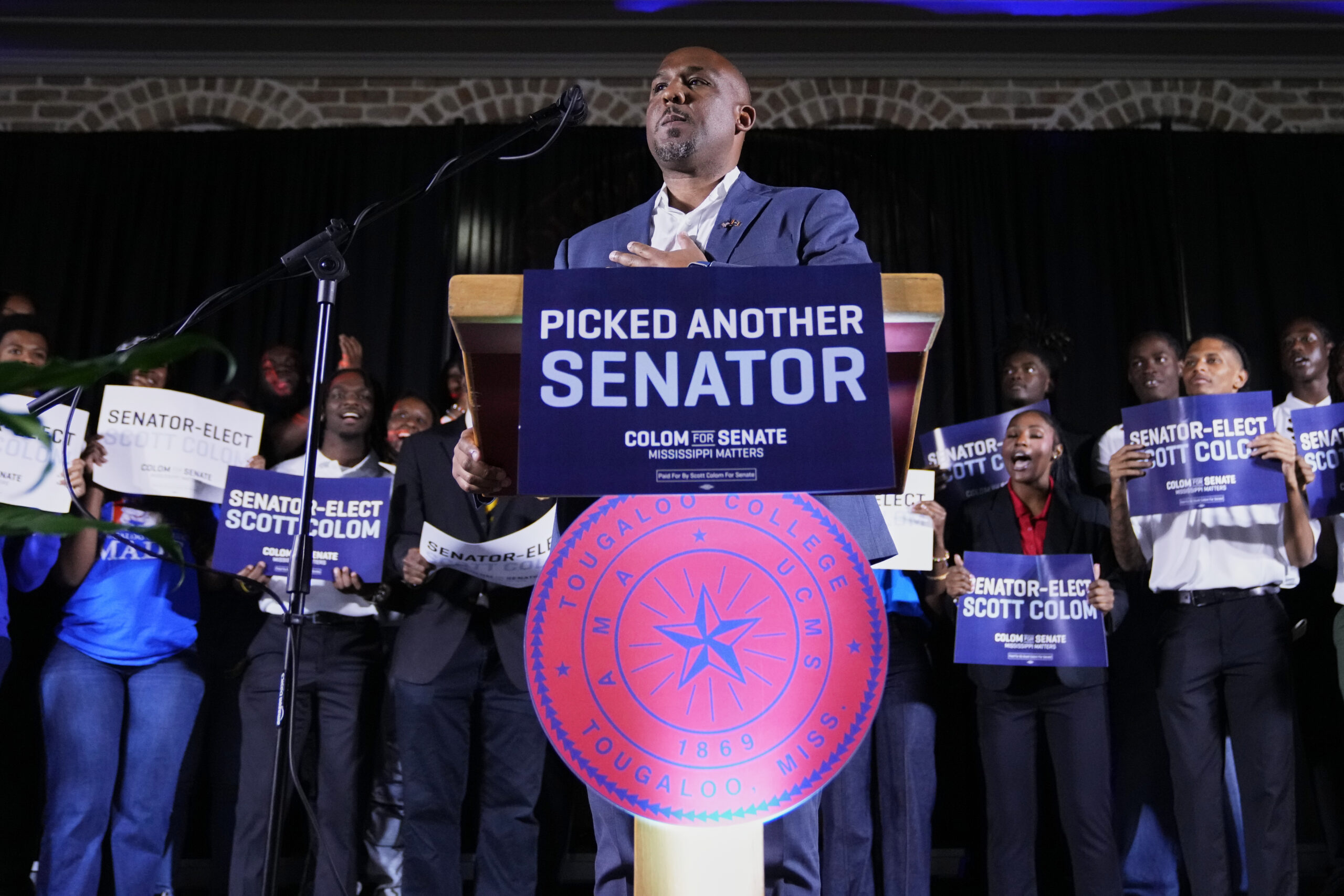
Black Voters See Scott Colom’s Senate Win as a Turning Point for Mississippi/ NEWSLOOKS/ WASHINGTON/ J. Mansour/ Black voters are celebrating Scott Colom’s Senate victory as a historic breakthrough shaped by Mississippi’s long struggle over racial equality and voting rights. Colom will become the state’s first Black US senator since Reconstruction after defeating Republican incumbent Cindy Hyde-Smith. Supporters say his achievement carries both symbolic importance and an obligation to improve conditions for Mississippians across racial lines.

Quick Look
- Historic milestone: Colom will be Mississippi’s first Black US senator since Blanche K. Bruce left office in 1881.
- Civil rights connection: His victory speech honored Medgar Evers and earlier generations denied equal political participation.
- Shared coalition: Supporters emphasized that Black and white voters contributed to the result.
- Community expectations: Voters want improvements in education, healthcare and economic opportunity.
- Earlier trailblazers: Hiram Revels and Bruce represented Mississippi in the Senate during Reconstruction.
- Personal memories: Older residents recalled poll taxes and police interference with civil rights organizing.
- Washington partnership: Rep. Bennie Thompson welcomed Colom as a new ally representing Mississippi.


Deep Look
Colom’s Victory Resonates Across Generations
Scott Colom’s election to the US Senate has given many Black Mississippians a moment of celebration rooted in generations of exclusion, violence and struggles for political representation.
The Democrat defeated Republican Sen. Cindy Hyde-Smith, a Trump-endorsed incumbent, in a race called Wednesday after a prolonged count.
Colom will become Mississippi’s first Black senator since Reconstruction, ending a gap dating to Blanche K. Bruce’s departure from the Senate in 1881.
For Janice Johnson of Greenville, in the Mississippi Delta, the result was overdue.
“In the last few years we have seen great strides,” she said.
But supporters also stressed that the election’s meaning extends beyond representation. They expect Colom to address problems affecting families throughout the state.
Victory Speech Honors Medgar Evers’ Faith in Progress
Colom celebrated at Tougaloo College, a place closely connected to Mississippi’s civil rights history.
Rep. Bennie Thompson, who organized for civil rights leader Fannie Lou Hamer while studying there, introduced the senator-elect.
“From my perspective, I now have a partner in Washington,” Thompson said.
Colom used his Veterans Day victory speech to honor Medgar Evers, the World War II veteran and NAACP organizer assassinated in 1963.
“I can’t help but think about Medgar Evers on Veterans Day,” Colom said. “A moment like this, where he served his country and came home to Mississippi, when they wouldn’t let him vote. But he had the faith that Mississippi could make progress. … He had faith that a day like this was possible.”
“All I did was have the courage to imagine a night like this,” he added.
Supporters Emphasize a Victory Across Racial Lines
Johnson said Black voters alone could not have delivered the result. White voters also had to respond to concerns about the economy, schools and deteriorating healthcare infrastructure.
“The most important part is we’ve got to have faith that Mississippi is ready to do the right thing,” she said Thursday.
“We as a people — and Mississippi as whole — are ready to show the nation. We have to work together, and that was his message. He wants to help pull us together.”
Jerome Dunn, a 59-year-old barber in Jackson who voted for Colom, offered a similar assessment.
“It takes everybody to vote, not one single race,” he said. “I think people are looking for him to work for everybody. People are tired of Republicans and what they believe.”
Their comments frame the victory as both a milestone for Black representation and a mandate to serve a broader coalition.
Revels and Bruce Preceded Colom in the Senate
Two Black men represented Mississippi in the Senate during Reconstruction.
Hiram Revels, a Republican, was seated in 1870 to fill a vacancy that had remained open since the Civil War began. His term ended about a year later.
Bruce, also a Republicanserved a full six-year term from 1875 to 1881 after being elected by the state Legislature.
They were among 16 Black men from Southern states who served in Congress during Reconstruction.
After that period ended and federal troops withdrew, Southern governments used segregation laws and other restrictions to strip away freedoms gained after slavery.
White conservatives dominated Mississippi’s government and congressional delegation for generations. During the Jim Crow erathat political establishment was overwhelmingly Democratic; later, conservative white political leadership shifted toward the Republican Party.
Mississippi’s History Gives the Result Particular Weight
Mississippi occupies a central place in the history of racial oppression and resistance in the United States.
Mississippi-born journalist Ida B. Wells-Barnett investigated lynchings across the South. The 1955 kidnapping and murder of 14-year-old Emmett Till helped galvanize the Civil Rights Movement.
Evers organized Black voter registration before his assassination. Hamer challenged Mississippi’s all-white delegation at the 1964 Democratic National Convention.
The Rev. Martin Luther King Jr. captured the state’s reputation in his 1963 “I Have a Dream” speech, describing Mississippi as “sweltering with the heat of injustice, sweltering with the heat of oppression.”
Against that history, Colom’s election carries significance beyond a change in party control.
Older Voters Recall Barriers Their Families Faced
Elnora Fisher, 68, of Greenville, said her memories of Mississippi include persistent inequality and direct obstacles to civic participation.
“As I understood, my grandparents always tried to save up to vote,” she said. “They had to pay a tax to vote.”
She also recalled attending an NAACP meeting with her mother during the 1960s.
“While we were there the white police stopped the meeting and made us leave,” Fisher said.
For her, celebrating Colom’s election goes hand in hand with expecting him to respond to longstanding economic disparities.
“Here in Mississippi, so much has been taken from the poor people and given to the rich people,” she said. “I hope Colom will give back to the people who helped get him where he is.”
Voting Rights Concerns Added Urgency
The election also unfolded amid redistricting efforts across the South aimed at reducing Black representation.
Those efforts followed an April Supreme Court ruling weakening protections under the Voting Rights Act of 1965 and helped motivate voter participation.
For many Black voters, the present debate over representation reinforced the connection between casting a ballot and protecting rights secured through earlier struggles.
Historian Sees Opportunity for a More Open Conversation
Brian Shoup, head of political science and public administration at Mississippi State Universitycalled Colom’s victory “a pretty significant change in Mississippi politics.”
“We haven’t had an African American senator since the era of Reconstruction, so this is obviously a very significant and important election in Mississippi history,” he said.
Shoup also suggested that the close contest and strong engagement could create space for a more constructive discussion of the state’s past.
“This race, the fact that it has been so close, and it has activated so much turnout, might portend the prospects of maybe being able to talk about these things in a more civil and open fashion,” he said.
For supporters, the historic breakthrough is a beginning. Their expectations now turn toward whether Colom can translate representation into improvements in everyday life.
More on US News