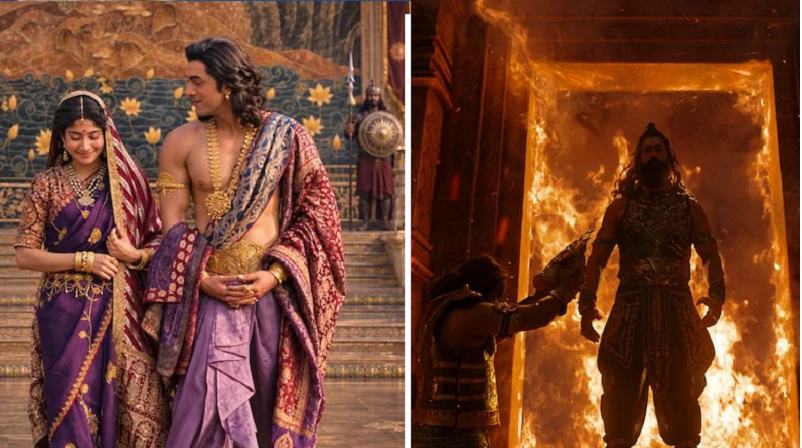
New Delhi .'Ramayana', one of the most ambitious films of Indian cinema, is in the news for its story, cast and big budget as well as its grand visual world. Ranbir Kapoor is playing the role of Lord Ram in the film, while Yash will be seen in the role of Ravana. The production team has taken the help of modern technology and traditional Indian architecture to bring alive the mythological places like Ayodhya, Mithila and Lanka in front of the audience. The production designers worked for almost three years to create the world of this film with a budget of around Rs 4000 crore.
The film's production designer Subrata Chakraborty and his creative partner Amit Ray studied Indian history, temples and the architecture of ancient buildings in depth while working on the project. When the duo joined the project, the film had been in the works for more than five years. An international team was already involved in designing the film along with director Nitish Tiwari and producer Namit Malhotra.
The initial designs were created under the leadership of Oscar-winning production designer Ramsey Avery. However, they were more influenced by Western architecture. After this, Subrata Chakraborty and Amit Ray worked on giving Indian cultural identity to these designs. For this, Indian temples, historical buildings and traditional construction styles were studied. The team also took inspiration from the architecture of Sri Lanka, Cambodia and other regions of South-East Asia.
In the film, it was planned to show Ayodhya and Lanka as two completely different worlds. Light and cool colors were used for Ayodhya, so that an atmosphere of peace and dignity could be seen there. Along with this, the grandeur of the city was also maintained. Lanka, on the other hand, was designed as a symbol of power and arrogance. The buildings, colors and structures here were imagined to have a different kind of grandeur.
The design of Pushpak Viman was also an important part of this entire process. Its initial design was largely retained, but the Indian team made some necessary changes in it. Other parts of the aircraft incorporated architectural elements inspired by historic Indian buildings such as the Sun Temple at Konark.
During the production designing, preparing the chariot of King Dasharatha was also a big challenge. Work was done on its chassis and engineering for about one and a half months. The designers had made chariots before, but this level of structure was a new experience for them.
Special arrangements also had to be made for the scene of Lord Shiva's huge bow in Mithila. The size of the bow was so large that it was not possible to pick it up and carry it from one place to another in the normal way. For this, a special platform and supporting structure was prepared. Associate Production Designer Pallavi Petkar and her team contributed significantly to this work.
The most interesting feature of the film is the balanced use of real sets and visual effects i.e. VFX. However, there was no uniform ratio of 70 percent sets and 30 percent VFX for the entire film. Both techniques were used according to the needs of different scenes. About 70 percent of the throne room of Ayodhya was created on real sets, while the remaining 30 percent was created through digital technology. Even the dream courtyard scene involving Dasharatha's death comprised 70 to 80 percent of the actual set.
In contrast, Lanka's action sequences used approximately 30 percent actual sets and 70 percent VFX. The contribution of both the techniques in the abyssal scenes was almost equal. Most of the Pushpak Vimana was created digitally, while about 10 percent of it was created as an actual set.
To make these scenes look real, the team used 3D modeling, textures and software like Blender. It was important to maintain the right distance and proportion between the green screen, digital background and the actors' movements. According to the designers, even slight differences in the position of any element could affect the realism of the scene. With this precision, the vast world of the film has been created by combining Indian art and modern technology.