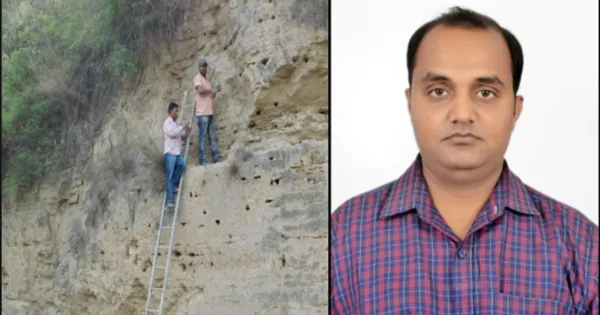
Nainital/Read: The climate of Kumaon region was not like today thousands of years ago. Scientists have done research in the sediments of Ramganga for 40 thousand years and have discovered monsoon rainfall, dryness and environmental and environmental changes in the Himalayas. Since then there have been tremendous fluctuations in the monsoon. This information has come to light in a joint research by scientists of Sir Soban Singh Jeena Almora Campus and DSB Campus Nainital.
Geologist of Nainital, Dr. Anoop Kumar Singh said that this research was done to understand the activity of monsoon in the Himalayan region thousands of years ago and the changes in climate over time. The research was conducted in the sediments of an ancient lake located at Bhikiyasain near the Ramganga River.
The climate history of 40 thousand years ago is hidden in this ancient lake. To find out, 110 samples were collected in about five meters long sediment of the lake. The samples were analyzed for particle size, carbon isotopes, organic carbon and chemical elements. Which showed that the monsoon was not uniform then, rather tremendous fluctuations were seen in the monsoon.
According to research, about 39700 to 25000 years ago, monsoon activities in this area were weak and the climate remained relatively dry. During the last glacial maximum, between 25,000 and 18,000 years ago, extremely dry conditions developed. After this, with the increase in temperature and retreat of glaciers, the monsoon gradually started strengthening. Especially during the years 11700 to 8200, monsoon rains started reaching their peak.
Kumaon's weather patterns were different 4200 years ago
Nainital: Dr. Anup Kumar Singh said that in the study, information about the weather of Kumaon in the past has also been obtained. About 4200 years ago, when dryness was increasing in many parts of the world, relatively humid conditions prevailed in the Ramganga region. According to scientists, the geographical structure of the Himalayas, mountain rainfall and moisture received from western disturbances may have been the reasons for this. He told that this ancient lake is a treasure of the ancient climate of the Himalayan region. Its study can help in predicting the future climate by assessing the past climate of the Himalayas.
Scientists remained involved in research
Nainital: In this research, along with Dr. Anoop Kumar Singh of Kumaon University, Prof. Rajiv Upadhyay, Dr. Manmohan Kukreti, Prof. Biswajit Palar, Dr. Anupam Sharma, Dr. Harish Bisht, Dr. Pradeep Gairola, Pooja Chand and Neha Kholia were included.