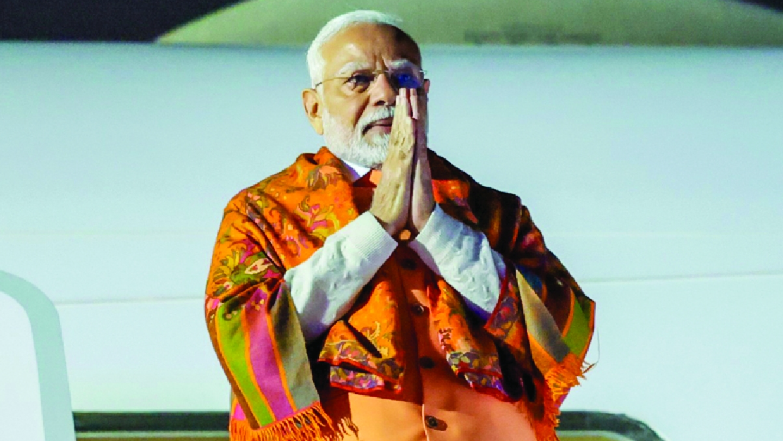
New Delhi, 13 November 2026: Prime Minister Narendra Modi in Bengaluru, Karnataka today Rs. Inaugurated various development projects worth more than Rs 15,600 crore, dedicated them to the nation, laid the foundation stone and flagged off. Addressing the gathering on this occasion, the Prime Minister greeted in Kannada language and paid homage to the city's presiding deities Devi Amma Tai and Nadaprabhu Kempegowda, considering the day as a day to give a new impetus to the development journey of Bengaluru and Karnataka through projects covering connectivity and energy security. Modi had emphatically said, “From metro and rail related projects to energy security works, all these projects are going to give new strength to the infrastructure of Karnataka.”
Noting that infrastructure and improved connectivity create new avenues for growth, employment and industry that reach every section of society and strengthen the fight against poverty, which is reflected in nearly 50 crore citizens being freed from extreme poverty in recent years, the Prime Minister extended his warm greetings to the people of Karnataka for the newly launched projects. PM Modi confirmed that, “It will give a new impetus to building a developed India through a developed Karnataka, and will also further strengthen Bengaluru's identity as a 'Tech City'.”
Highlighting the dedication of Bengaluru Metro's new Pink Line, the Prime Minister had noted that this corridor will significantly improve connectivity with IIM Bengaluru, numerous educational institutions and major business, technology and commercial hubs across the city. Modi observed, “Lakhs of people in Bengaluru will not only get convenience in their daily commute, but will also be able to save money and time.” Recalling that yesterday was the death anniversary of late Ananth Kumar, who had close ties with this area, the Prime Minister paid heartfelt tribute to the late leader. PM Modi commented, “His soul must have been elated after seeing this metro line today.”
-
More than one-third contribution in IT exports
Describing Bengaluru as the Silicon Valley of India, which contributes more than one-third of the country's IT exports and serves as the main engine of innovation and economic growth, the Prime Minister said that the Central Government has given priority to the rapid development of the Bengaluru region and has expanded the Namma Metro from just 17 kilometers in 2014 to over 100 kilometers today, making Bengaluru the second largest metro network after Delhi-NCR and Mumbai Metropolitan Region. It has become the third Indian city to cross the 100 kilometer metro milestone. Shri Modi stressed that, “The success of Namma Metro is the result of the country's new thinking on 'ease of living' and 'ease of travel', and the country's commitment to making the lives of middle class families better.
Stating that Indian Railways is abandoning its British era mindset to create a new legacy system with India's unique identity on stations, engines and coaches through Vande Bharat Trains and Amrit Bharat stations, the Prime Minister said how these stations, along with Chamarajanagar, Chikkamagaluru, Sakleshpur and Subrahmanya Road in Karnataka and more than 60 stations, are bringing modernity with sensitivity by providing special facilities for senior citizens and disabled persons. Had shed light on the way it is connected. PM Modi noted that, “Efforts are being made to provide the same facilities to poor and middle class families at railway stations, which were earlier available at airports.”
-
India's railway budget increased manifold
Stating that India's railway budget has increased manifold with Karnataka's allocation increasing nine times in the last 10 to 12 years, Prime Minister Modi noted that the state has today got four AMRUT stations and two doubling and electrification projects, and within a few days of getting its first Vande Bharat sleeper train, it has also got the new Vande Bharat train connecting Karnataka with Goa. Shri Modi observed that, “Through this train, the passengers on the entire coastal route of Karnataka including Mangaluru will get a new experience of semi-high speed train.”
A major boost to Karnataka's growth! Projects worth over ₹15,000 crore are being launched today to strengthen connectivity and energy security.
— Narendra Modi (@narendramodi) November 13, 2026
Emphasizing that the ongoing wars around Iran and the Gulf region have demonstrated the critical importance of energy security, the Prime Minister explained that India has weathered these challenging times with confidence due to measures taken over the past decade, including petrol, diesel and LPG production, crude oil storage, expansion of solar, hydro and wind energy, almost complete rail electrification and metro network, and detailed three new projects in Karnataka: The Mangaluru LPG Project adding 80,000 metric tonnes storage capacity, the Devangathi Marketing Terminal streamlining the supply of petrol, diesel and aviation fuel, and the Bengaluru CBG plant producing 13 tonnes of biogas per day. PM Modi noted that, “This will improve waste management and will also save money spent on importing natural gas.”
Highlighting the need for reliable power generation as India strives for global leadership in new technologies from chips to ships and from AI and data centers to quantum computing, the Prime Minister noted that the nation is expanding its nuclear power plants to achieve clean energy goals. Shri Modi observed, “Today India's renewable energy capacity has crossed 300 GW.”
-
Karnataka's food givers now become energy givers
Noting that central schemes are transforming Indian citizens from electricity consumers to electricity producers, the Prime Minister said that under the PM Surya Ghar Free Electricity Scheme, more than 60 lakh families across the country, including over 40,000 families in Karnataka, have installed rooftop solar plants with central assistance of approximately Rs 80,000 per family, while Karnataka under the PM Kusum Scheme has been launched to reduce electricity costs and generate new income and employment. Irrigation arrangements are being made for farmers through more than 8 lakh solar pumps. PM Modi commented, “At the same time, the food givers of Karnataka are now also becoming energy givers.”
Observing that the post-2014 pledge of 'Sabka Saath, Sabka Vikas', purposeful national implementation, public participation and efficient use of taxpayer money has expanded the middle class and created a new aspirational class demanding home appliances, two-wheelers, quality education, nutrition, healthcare and tourism experiences, the Prime Minister pointed out that these rising aspirations will be reflected in automobiles, electronics, tourism. And the services sector is fueling new industrial and employment growth, creating a new middle class (neo-middle class) that has become the main engine of India's economic growth. Mr Modi confirmed that, “The interests of these nine middle classes, which are present in large numbers in Karnataka and also in Bengaluru, are among the priorities of the Central Government.”
-
Today's projects will give more impetus to the nation's development path.
Saying that the central government is continuously working to promote savings of the middle class and put more disposable income in the hands of them, the Prime Minister highlighted steps like exempting annual income up to Rs 12 lakh from income tax, reforming TDS rules to benefit senior citizens and rental income earners, and reducing the price of everyday goods through the next generation GST reforms. PM Modi noted, “By eliminating GST on individual health and life insurance, we have made insurance more affordable.”
At the end of his address, the Prime Minister stressed the government's commitment to empowering the middle class families by saying that today's projects being undertaken in Karnataka will give more impetus to the development path of the nation and conveying his good wishes to the people. Shri Modi confirmed that, “Our effort is to increase the savings of the middle class, strengthen their purchasing power, and help them fulfill the dreams of their families and also become partners in the economic progress of the country.”