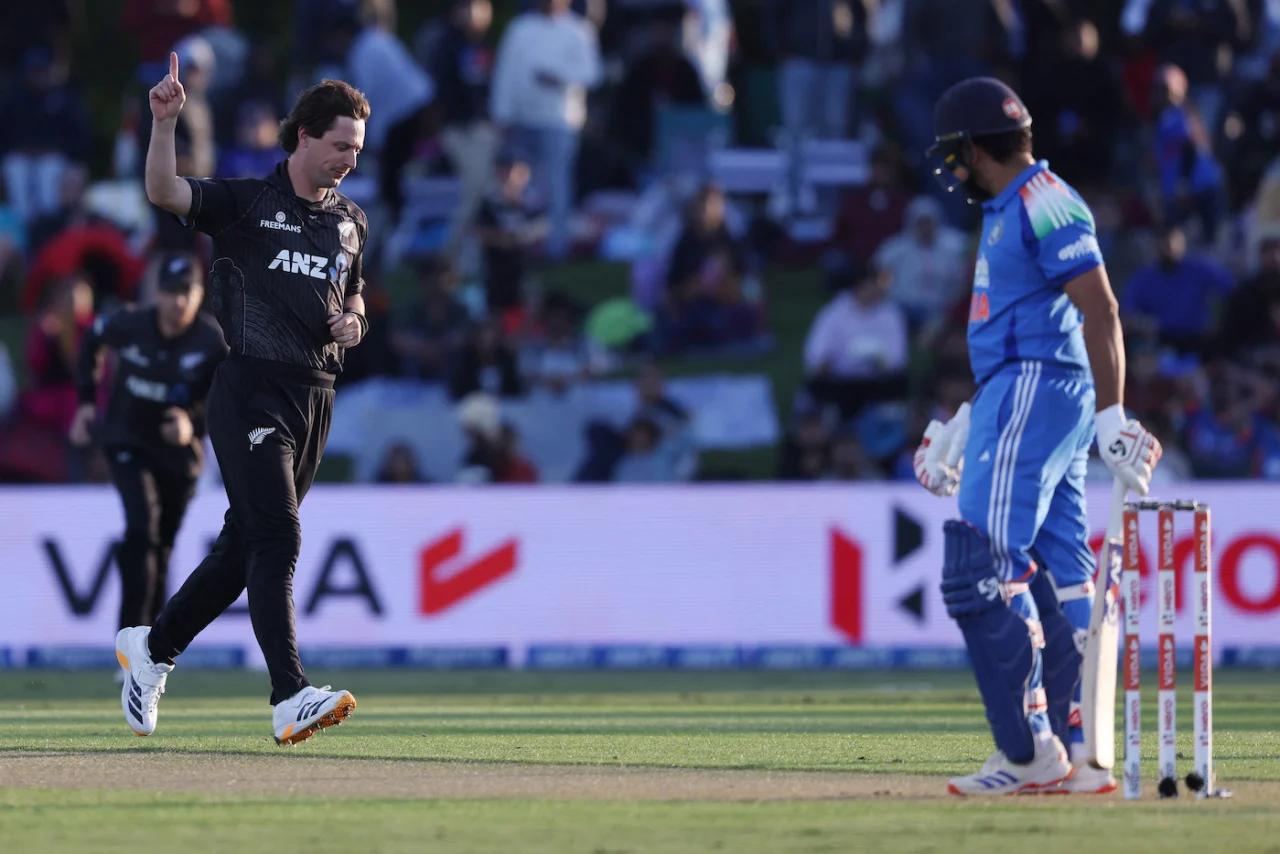
New Zealand defeated India in the fourth ODI by 244 runs. Not only did this result keep this series alive, but it also changed its momentum.
The New Zealand vs India 4th ODI of this five-match series was played at the Bay Oval in Tauranga. India won the toss and decided to bowl first.
The Kiwis batted first and started strong. The opening stand between Tim Seifert and Will Young was worth 85 runs, with Seifert scoring a half-century. And while a couple of wickets fell quickly after that, Young played the anchor role and eventually scored his fifth ODI century and then his highest score in the format of 125 runs.
Finn Allen made 41 off 30, and the pair of skipper Mitchell Santner and youngster Kristian Clarke played some helpful innings, eventually taking the team total to 333 runs in 50 overs.
Coming in to chase an above-par total, India lost three of their biggest batters, those being Rohit Sharma, Virat Kohli, and stand-in captain Shreyas Iyer, for ducks in the very first over.
There was not going to be any competition in this match following that. Ruturaj Gaikwad departed for cheap as well. And while the likes of Ishan Kishan, Axar Patel, and Naman Dhir scored some runs, the Men in Blue were packed up for just 89 runs within 27 overs, losing the match by 244 runs.
With this result, New Zealand stays alive in this series. A win in the fifth and final ODI will mean that the hosts could escape with a draw after losing the preceding T20I series.
But now, we will look at 3 reasons why India lost to New Zealand 4th ODI –
3 Reasons Why India Lost To New Zealand 4th ODI
3) New Zealand Batters Capitalise On Decent Conditions
The New Zealanders were put to bat first after losing the toss to India. But this might have been a decision that fell into the hosts’ favour, as the BlackCaps made the most of the pitch conditions to put up a solid total.
The tracks at the Bay Oval in Tauranga have historically been quite bouncy at the start of a game, which was also the case tonight. And while, on occasion, a pacer can take full advantage of the situations, that was not the case today, and India’s inexperienced fast-bowling attack served juicy half-trackers on a silver platter for the Kiwi top order.
The opening duo of Will Young and wicketkeeper/batter Tim Seifert survived a massive change in the New Zealand line-up. The Kiwis made a whopping six changes in their playing XI today, with Young and Seifert among the five that remained from the previous game’s squad.
The two made the most of their chances today. The pair made 34 runs in the first six overs, and then stole the show. 14 runs came in the seventh over, while 15 came in the ninth. By the end of the 10th over, New Zealand were cruising at a score of 72/0, and Will Young had scored a half-century.
The first wicket did not fall until the end of the 12th over, as Gurnoor Brar dismissed Seifert for 58 off 48 after the two had exchanged words for a few overs by this point. While scoring his first ODI 50, Seifert showcased his quick bat swing, insane power, and ability to dispatch most balls to the boundary.
After the wicket of his opening partner, the onus of scoring runs fell to Will Young, who took the charge quite naturally. The run rate threatened to fall to sub-par levels after Nick Kelly, playing his first match in this series, was gorgeously stumped by Axar Patel for four off eight in the 15th over. However, Young was about to play one of the best innings of his international career.
Will Young kept hitting a boundary or two in each over while wickets fell around him, mostly playing an anchor role. By the end of the 20th over, New Zealand had lost three wickets, as Dean Foxcroft had been cheaply dismissed as well, and the score was a respectable 125/3. Meanwhile, Will had reached his half-century in 49 deliveries.
The next 10 overs or so were net positive for the Kiwis. The pair of Will Young and Finn Allen scored 90 runs together. While Young picked up the pace, Allen was in attack mode for much of his time on the crease.
New Zealand had already crossed the 200-run mark before the 31st over and threatened to reach close to, or even cross, 400 runs. However, Finn Allen was out for 41 off 30 off a brilliant catch by Rohit Sharma.
Young reached his ton in the 32nd over, doing so in 88 deliveries. And by the time he fell to Naman Dhir in the 37th over, he had reached his highest ODI score of 125 runs.
And while his wicket meant the Kiwis were not going to reach anywhere near 400 runs, a solid effort by the likes of Kristian Clarke and captain Mitchell Santner took the team total to an above-par total of 333 in 50 overs.
Check Out: 3 Reasons Why India Lost To New Zealand 4th ODI
2) A Horror Show: Staring Matt Henry
India came into this game with three changes in their playing XI. The decision to bring Kuldeep Yadav into the squad had already backfired, with the wrist-spinner conceding 73 runs in just eight overs. And as far as the second innings is concerned, two of these changes were going to matter, those being Ruturaj Gaikwad replacing a rested Shubman Gill and Ishan Kishan coming in place of KL Rahul.
However, even before the two of them could make any impact with the bat, India was all but out of this match, thanks to veteran pacer Matt Henry and his wobble-seam. For those unaware, wobble-seam is a trick that some pacers use where the seam of the ball seems to wobble in the air. This makes the ball’s movement after pitching quite unpredictable.
The likes of James Anderson, Pat Cummins, and Josh Hazlewood have found great success with wobble-seam. And one of the biggest practitioners of this technique is New Zealand pacer Matt Henry. And he put his wobble-seam on full display towards the start of the Indian innings in this fourth ODI.
The first ball of the innings, Henry ran in and pitched the ball well. Rohit Sharma, expecting an in-swinger, looked to defend the ball. Instead, the leather took a fine edge off the bat and was caught at first slip; the score was 0/1, as the former national team captain was out for a golden duck.
This brought the legendary Virat Kohli to the strike. Even an icon of the sport like Kohli struggled for a couple of balls after he came to the crease.
Then, on the fifth ball of the over, and the fourth played by Virat, the ball pitched around the same place where it had been landing for the last four deliveries, in the line of the fifth stump. But this time, along with a lower bounce, the ball moved into the stumps as Virat Kohli was bowled, and all ended up for a four-ball duck.
With two of the biggest names in international cricket getting out for a duck in the first over of a 300+ run chase, incumbent captain Shreyas Iyer walked in with the weight of the world on his shoulders. And to say that the skipper crumbled under said pressure would be an understatement.
The first ball Iyer played was still just the final ball of the first over of the innings. No runs had been scored so far, and two massive wickets had fallen. The ball pitched a little inwards and headed straight towards the stumps. Shreyas looked clueless as to what to do with this delivery and caught the leather with his pad. The Kiwis appealed, the umpire signalled not out, and a review was taken, which confirmed that India’s third wicket had indeed fallen, with the team score still being zero.
After hunting three ducks in his very first over, Matt Henry went on to take three more wickets in this game, finishing the game as the Player of the Match with an insane 9.4-over spell of 6/27.
Check Out: 3 Reasons Why India Lost To New Zealand 4th ODI
1) Failure To Recover
At the end of the first over of India’s 50-over innings, where they had to chase a fairly massive total of 334, the Men in Blue were all but tapped out at 0/3, with three of their biggest names sitting back in the dressing room.
This left a lot on the shoulders of the two batters who were now on the crease. Ruturaj Gaikwad, playing his first match in this series, had watched the dismantling of some of the best batters in world cricket from the non-striker’s end. The other man was Ishan Kishan, who too was playing his first game in this series and had walked in after Shreyas Iyer’s dismissal.
All the two could do against a lethal-looking Kiwi bowling attack was to dig in and survive the onslaught. Gaikwad did not manage to stay out there long. In the sixth over, lanky pacer Kyle Jamieson bowled a little wider. Ruturaj, looking to drive it, threw the bat onto the ball. He found nothing but an edge and was caught, caught finely by Michael Bracewell at the second slip.
The score was now 9/4 in the sixth over; India still needed to make 325 runs to win this match. Suffice it to say, the result of this match was already being written in the books. All the Men in Blue could do now was avoid humiliation and bat the overs out. Well, that did not happen.
Axar Patel and Ishan Kishan batted for the next 12 overs together and made some runs. Axar was eventually caught in the slips in the 17th over off a shorter delivery by Matthew Fisher, making 21 off 36. Kishan was out soon after for 27 off 53, playing on and bowled in the 21st over, becoming Matt Henry’s fourth wicket of the evening.
Naman Dhir made a respectable (under the circumstances) 21 off 24, while the tail provided no resistance to the New Zealand bowling attack as India was all out for 89 runs in the 27th over, losing the match by 244 runs.
Check Out: New Zealand vs India 4th ODI
Get the Latest Cricket Updates at IceCric.News. Also, Follow Our Social Media for live updates on Facebook and Instagram.