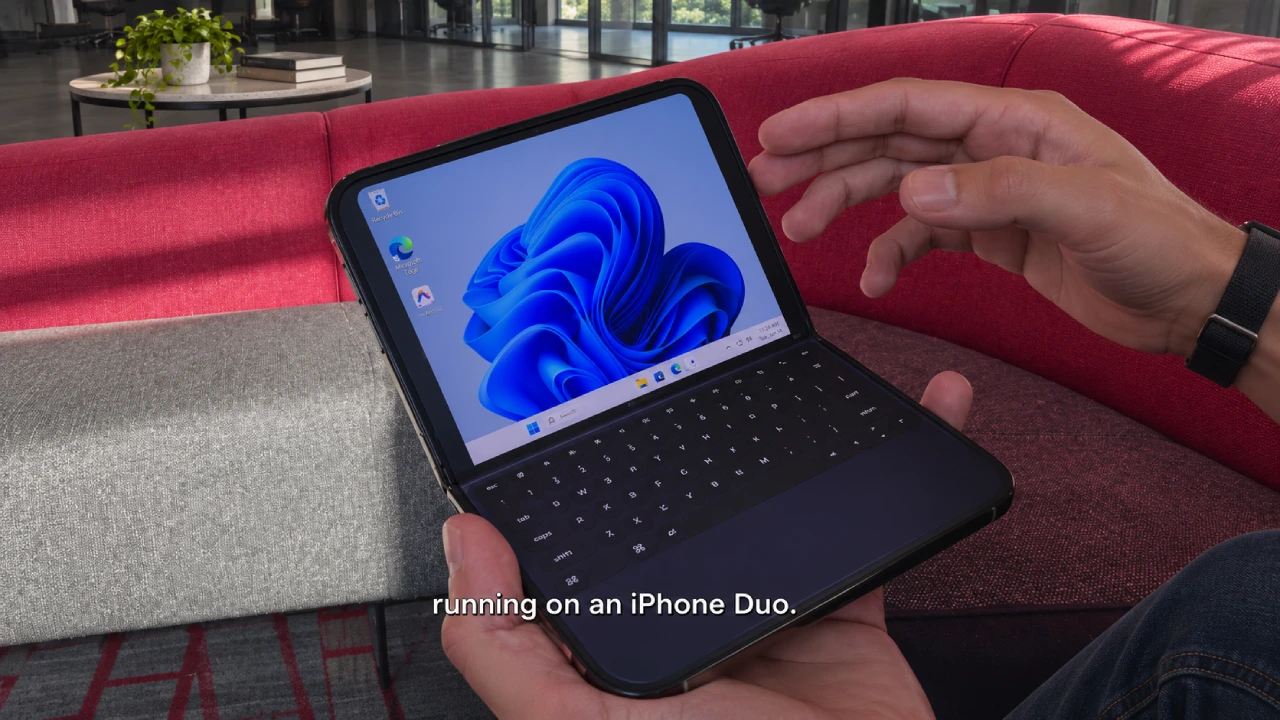
Running a desktop operating system on a smartphone has long been of interest to technology enthusiasts. However, a recent developer experiment has brought that possibility closer to reality.
Windows 11 is now running locally on Apple’s foldable iPhone duo through an open-source project called Window iOS, with assistance from Google’s Gemini 4 Carbon AI model.
Ammaar Reshi, who leads product and design at Google AI Studio, demonstrated Windows 11 running on the iPhone Duo on November 11, 2026. The experiment uses an ARM64 version of Windows 11 34H2 inside a virtual machine, allowing the smartphone to display a familiar desktop environment without depending on cloud streaming or remote desktop connections.
Google’s Gemini 4 Carbon assisted the development process, helping Reshi work through the technical challenges involved in bringing the desktop operating system to iOS.
The development is particularly interesting because it demonstrates how AI coding agents can assist developers in solving complicated software compatibility challenges. How Gemini AI Helped Bring Windows !! to an iPhone
The Windows iOS project demonstrates how artificial intelligence can support development. According to Reshi, Gemini 4 Carbon assisted the development process, with AI agents reportedly working for approximately two hours through a coordinated workflow called Swarm.
Rather than creating an entire new operating system, the project establishes an environment in which Windows!! ARM64 can operate on the smartphone through software-based virtualization and translation techniques.
This approach allows the device to run a desktop operating system without a conventional Windows computer. It also demonstrates how an AI coding tool can help developers work through technical challenges involving operating system compatibility, virtual hardware, and software configuration.
However, Gemini should not be considered the sole creator of Windows OS. The project is built on existing open-source development work and software components.
Its significance lies in how AI assistance helped accelerate the implementation process. Reshi did confirm that the agents worked for two hours with Swarm. The statement appears in his November 11 reply when someone asked how long the agents had worked.
How Windows iOS Runs Windows 11 Locally on the iPhone Duo
One of the most important aspects of WindowiOS is its ability to execute Windows 11 locally rather than stream the desktop from another computer. The project uses Windows 11 24H2 ARM64 inside a virtual machine.
This environment provides virtual hardware components that the operating system can recognize, including firmware, storage, networking, USB input devices, and audio hardware. It presents virtual hardware components that the guest operating system can recognize and use.
WinodiOS provides several components, including virtual firmware storage, networking, USB input devices, and audio hardware. Importantly, the demonstration does not require jailbreaking the iPhone.
Instead, WindowsiOS uses software-based techniques, including just-in-time (JIT) translation, to execute ARM^4 code without relying on Apple’s restricted hardware virtualization framework. However, running without a jailbreak does not make this an ordinary iPhone installation.
The setup still requires a specially built application, developer tools, a prepared Windows image, and a debugging process to enable the required JIT execution.
A foldable smartphone with a laptop-like interface
The iPhone Duo’s foldable display gives Windows/iOS a laptop-inspired interface. When the device is fully unfolded, Windows 11 occupies the larger inner display. In its partially folded position, the interface can use a clamshell-style layout.
The upper section displays Windows, while the lower section functions as a virtual keyboard and multitouch trackpad. The keyboard reportedly includes six rows of keys, function controls, and a dedicated Copilot key. Nevertheless, a 7.6-inch display remains considerably smaller than a conventional laptop screen. Although the arrangement looks interesting, extended typing, multitasking, and working.
Microsoft Edge demonstrates that the virtual Windows environment can run a conventional ARM64 desktop browser. The project documentation shows Edge accessing websites through a virtual Ethernet adapter, which connects Windows to the iPhone’s internet connection through user-mode networking.
Can smartphones replace laptops in the future?
The Windows OS experiment highlights an important direction in personal computing: the possibility of combining smartphone portability with desktop operating systems.
Modern smartphones already support advanced processors, high-speed connectivity, multitasking, and increasingly sophisticated displays. Foldable designs add another advantage by providing larger working areas without sacrificing pocket-sized portability.
AI-assisted development could also make it easier to experiment with software compatibility and alternative computing environments. Developers can use AI agents to investigate problems, generate code, test implementations, and accelerate repetitive development tasks.
The Bottom Line
Windows 11 running locally on Apple’s foldable iPhone Duo demonstrates how open-source development and AI-assisted coding can push the boundaries of smartphone computing.
Gemini 4 Carbon’s reported contribution makes the experiment particularly noteworthy, while WindowiOS offers an interesting example of desktop software operating beyond conventional PCV hardware. However, the absence of independent performance benchmarks, application compatibility limitations and reduced Windows security protections prevent the project from being considered an everyday computing solution.
The bigger achievement is not that smartphones can replace laptops today. It is that developers are finding new ways to bring desktop computing experiences to smaller devices, potentially changing how people think about portable technology in the future.