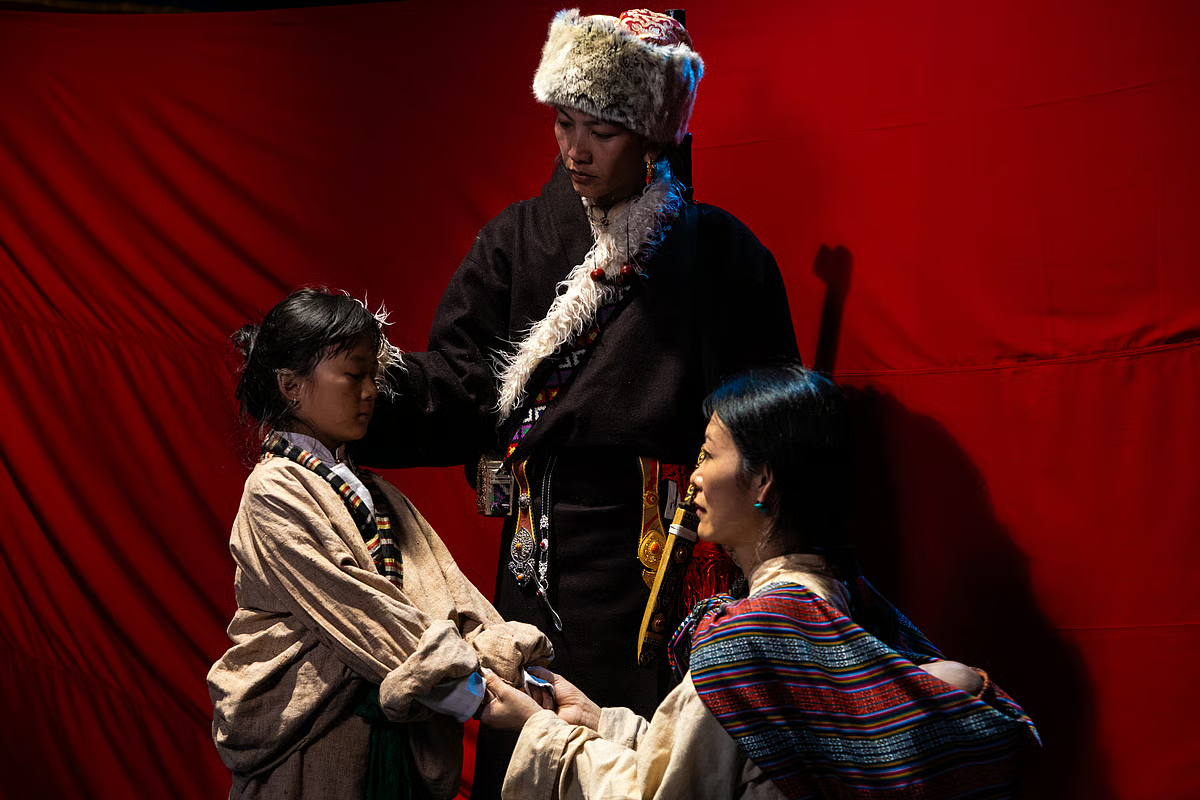
The history of resistance is often told through revolutionaries and political leaders. Phayul (Homeland), set in Tibet’s Kham region in 1956, brings these overlooked voices to the forefront, exploring their experiences alongside those of ordinary Tibetans during the violent occupation of their homeland.
Phayul at Prithvi Theatre Festival explores Tibetan women’s resistance
Written by Indian playwright Abhishek Majumdar and directed by Tibet Theatre founder Lhakpa Tsering and German director Harald Fuhrmann, the production features a Tibetan ensemble, traditional music, dance and Tibetan opera. Performed in Tibetan with subtitles, it will be staged in Mumbai as part of the Prithvi Theatre Festival.
In an exclusive conversation with Indulge Expressthe creative team opens up about bringing overlooked histories to the stage and preserving Tibetan cultural traditions.
For Majumdar, adapting real testimonies into theatre means retaining collective experiences while giving them a dramatic form. “Fiction is essentially truth distilled. The line between documentary and historical fiction lies simply in the treatment. It’s not that these things didn’t happen, but that they happened to many people, whereas in a play, they happen to a selected set of characters,” he explains.
His association with Tibet Theatre began 12 years ago. For Tsering, who founded the first contemporary theatre group in the Tibetan exile community, the story is deeply personal. “As a Tibetan living in exile, this story is deeply personal to me. It reflects our struggle for identity, homeland and the preservation of our culture,” he says.
He sees theatre as a way to take his people’s experiences beyond political narratives. “Performing in Mumbai allows us to share our story with a wider audience and create a human connection beyond politics and borders,” he adds.
For Fuhrmann, integrating endangered Tibetan performing arts into contemporary theatre is central to the production. “The aim is to integrate forms of Tibetan performing arts that are under threat of extinction into contemporary theatre, so that audiences become aware of these wonderful art forms that are in danger of being destroyed,” he says.
The epic of King Gesar informs the production’s use of traditional Tibetan dance, song and music. Through overlooked women’s experiences and Tibetan cultural traditions, Phayul presents resistance as a universal story of courage, belonging and survival.