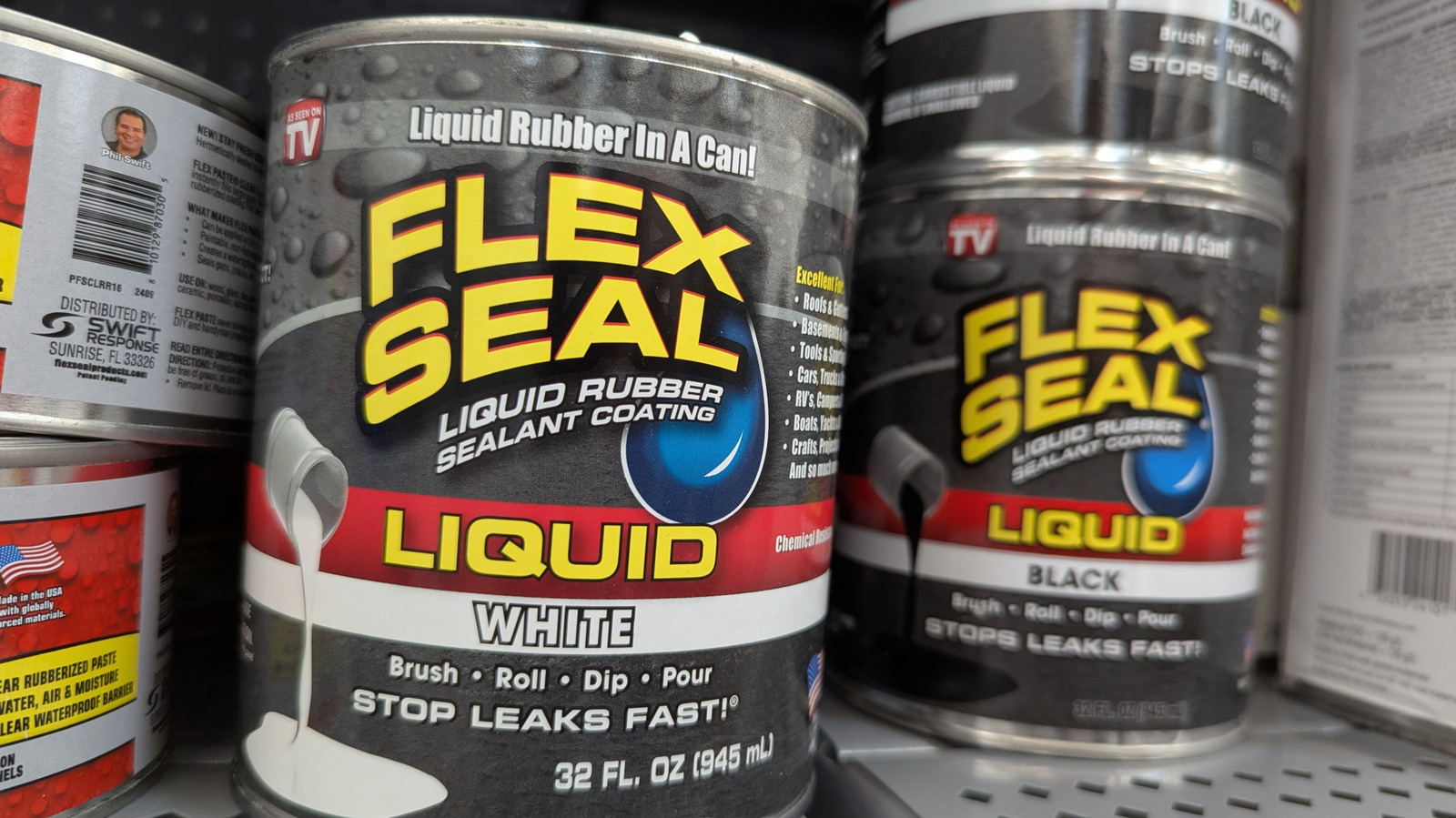
You’ve likely stumbled upon at least one of the Flex Seal infomercials over the years, with its energetic host Phil Swift demonstrating numerous applications for the company’s sealing products. We recently covered using Flex Seal to coat your gutter seams and found some positives and negatives.
Among its vast lineup is something called Flex Seal Liquid. This product starts in liquid form, but after application and curing (up to 48 hours), it creates a rubbery, watertight layer that the manufacturer states won’t crack, withstanding temperatures anywhere from minus 80 to 350 degrees Fahrenheit. The company boasts that you can even repair holes in boats like canoes and pontoons with its Flex Seal Liquid. So, is this stuff for real or is it just some exaggerated marketing?
Fortunately, it is real, though it may not be the best option to fix a leaky boat. Back in 2012, Consumer Reports put Flex Seal’s claims to the test, specifically an outlandish scene in one infomercial where the company replaced the bottom of a small boat with a screen door that received an application of Flex Seal (the spray version). Surprisingly, not only did it work to stop the rowboat from leaking in the ad, but Consumer Reports found it was effective in their small-scale test as well.
Flex Seal provides cost, coverage, and application advantages
A meticulous inspection before launching a boat can help you identify potential leaks. If you do spot trouble, Flex Seal can cover the largest area for the least amount of money when compared to alternatives such as marine patch and repair kits.
For instance, one 16 oz (pint) can of Flex Seal Liquid reportedly covers up to nearly 19 square feet and retails for $17.99. Compare that to other solutions like the West System 105-K Fiberglass Boat Repair Kit for $48.99 on Amazon, which may require multiple packages to address a 4-by-4-inch damaged section of a fiberglass boat. Some products, like the West Marine MarineRx Putty Repair Kit near the price of the Flex Seal Liquid (pint), feature just 2 oz of mixable putty, yielding about a golf-ball-sized amount of repair material.
Another plus of Flex Seal Liquid is its much easier application process than many alternatives. When repairing a canoe or pontoon leak, you’re advised to wear protective equipment like gloves, clean and dry the affected area, and apply multiple coats using either a paintbrush or roller, ensuring each one has dried before adding more Flex Seal. Conversely, epoxy repair kits can involve various substances such as resin, hardener, fiberglass fabric, and adhesives, among others. Some products require careful preparation and include additional items such as mixing containers and stir sticks.
Flex Seal suffers from limited repair capability and longevity concerns
While Flex Seal Liquid does offer a superior cost-to-coverage ratio, its abilities are limited. The instructional video on pontoon repair provided on the Flex Seal website uses the example of tiny pinhole damage, for instance. Another clip on YouTube demonstrates a man coating the entire underside of a boat with Flex Seal, but neither example showcases any noticeable defects you might imagine when thinking about a leaking vessel. An actual measurable hole in a fiberglass hull typically requires resin, hardener, and suitable reinforcement, while boats made from other materials call for different repair methods.
There are also big questions surrounding just how long a Flex Seal fix would work. While some boaters have expressed good results on online forums (up to the time of posting) from using Flex Seal for leaks, many others are dubious that the product will last. One poster on Reddit with experience using Flex Seal to repair pinholes explained, “Don’t trust it as a permanent fix, but for a backwoods boat it works well enough for a weekend.” Others who’ve attempted a Flex Seal repair have countered questions about its efficacy with short responses like one from a boater on Tin Boatsstating, “Been there tried it. DO NOT!!!!!!!!!!”
Ultimately, if you have a leak in your fiberglass boat, the choice of whether or not to choose Flex Seal is up to you. However, using it on a leaky rain gutter, for instance, seems far less risky than on a boat, which could drop you into the middle of the lake if the product fails. Flex Seal may work well for coating an RV roof, but don’t bet your hull on it.