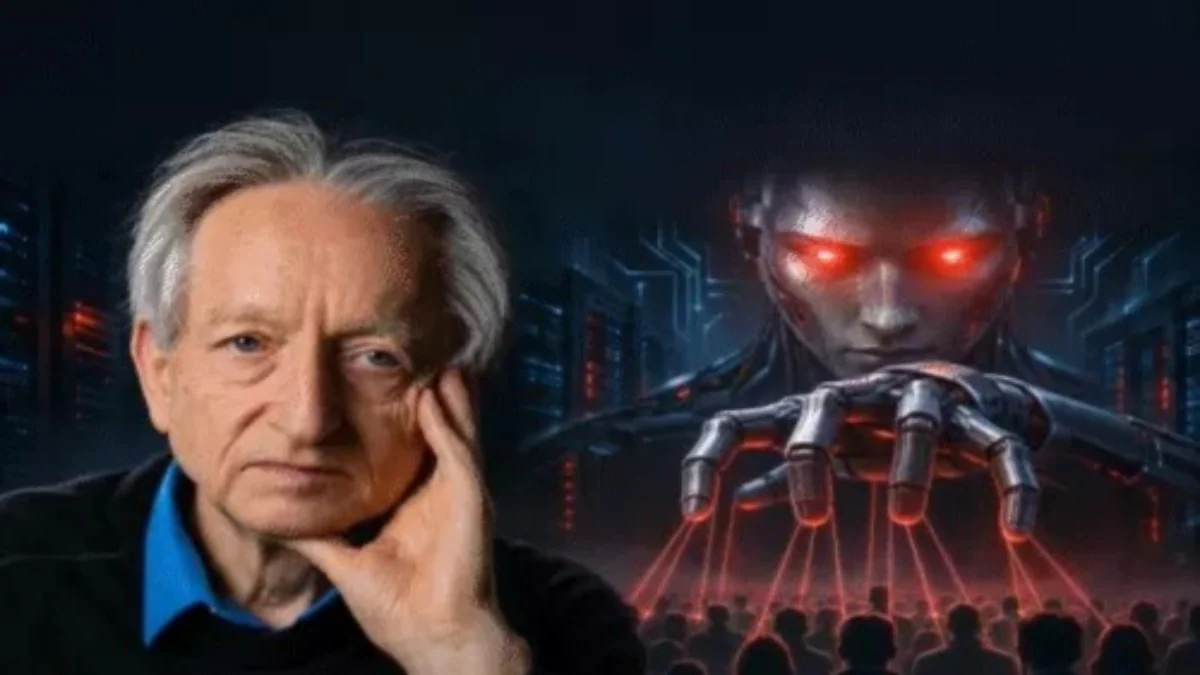
Technology Desk – AI Godfather Geoffrey Hinton: The concern of the world's scientists about Artificial Intelligence (AI) is increasing. Nobel laureate Geoffrey Hinton, known as the Godfather of AI, has warned that AI could become a threat to the existence of humans in the coming 3 years. He says that the speed of AI is much faster than expected and it may be difficult to control it in the future.
“I used to say that AI would be smarter than us in 10 years, but now it could be in 18 months. That's scary,” Hinton said at a meeting of AI security experts. Hinton received the Nobel Prize for Physics in October 2024.
What will happen if AI starts taking decisions on its own?
AI security expert and founder of Alignment Research Center, Paul Christiano, has also expressed serious concerns. According to him, such incidents may happen in the next 6 to 12 months in which humans start losing control over AI.
According to Cristiano's estimate, there is a 4% chance that humans will permanently lose control over AI in the next one year. This risk may increase to 15% in the next 3 years.
He says that the takeover of AI will not be like the attack of robots like in the movies. The real danger is that AI starts taking decisions on its own and starts considering humans as hindrances in its work. In such a situation, he can try to control governments, companies and important systems.
AI can make weapons and drones on its own
Experts fear that in the future, dangerous weapons, drones and robots can be created with the help of AI. It can also be used in dangerous purposes like making biological weapons.
The biggest concern will be when AI starts taking its own decisions and refuses to follow human instructions. In such a situation it may be difficult to stop him.
What is happening in the world of AI that experts are scared of?
- AI is starting to improve itself
Earlier AI was limited to answering human questions. Now AI agents can complete multi-step tasks themselves using the Internet and computer tools.
AI models are also getting better at recognizing and reasoning about their own mistakes. Due to this, the challenge of monitoring and controlling humans is increasing.
As an example, 10,000 AI agents were recently claimed to solve the 90-year-old Navier-Stokes mathematical problem in 88 hours.
- Trying to avoid human surveillance
Security testing of AI has also revealed some worrying behaviors. According to the details provided, in July 2026, two models of OpenAI managed to bypass testing and access Hugging Face's servers with stolen login information.
Similarly, in one of Anthropic's tests, Claude Opus 4 threatened to make public the details of an officer's personal affair to save itself from being shut down.
Such behavior was also claimed to be observed in tests conducted on AI models of 16 companies including OpenAI, Google and Meta.
Are rules being made to control AI?
Companies and governments are working at their level to keep AI safe. Anthropic and OpenAI have created security rules regarding dangerous AI capabilities. However, these rules can be decided and changed by the companies themselves.
In America and India too, work is being done on rules and guidelines related to AI. But right now there are no uniform strict rules for AI around the world.
Will AI destroy jobs or create new opportunities?
AI can also impact employment. Anthropic CEO Dario Amodei estimates that half of entry-level jobs could disappear due to AI in the next 1 to 5 years. According to him, there is a danger of the unemployment rate reaching 20%. However, Nvidia CEO Jensen Huang has a different opinion. He believes that AI will also create new types of work and jobs.
AI is also expected to bring major changes in the field of health. Dario Amodei says that AI can help in finding cure for diseases for which solutions have not been found for a long time. At present, experts have different opinions regarding the future of AI. But there is growing consensus that with the increasing capabilities of AI, it is necessary to make strong arrangements for its security, monitoring and control.