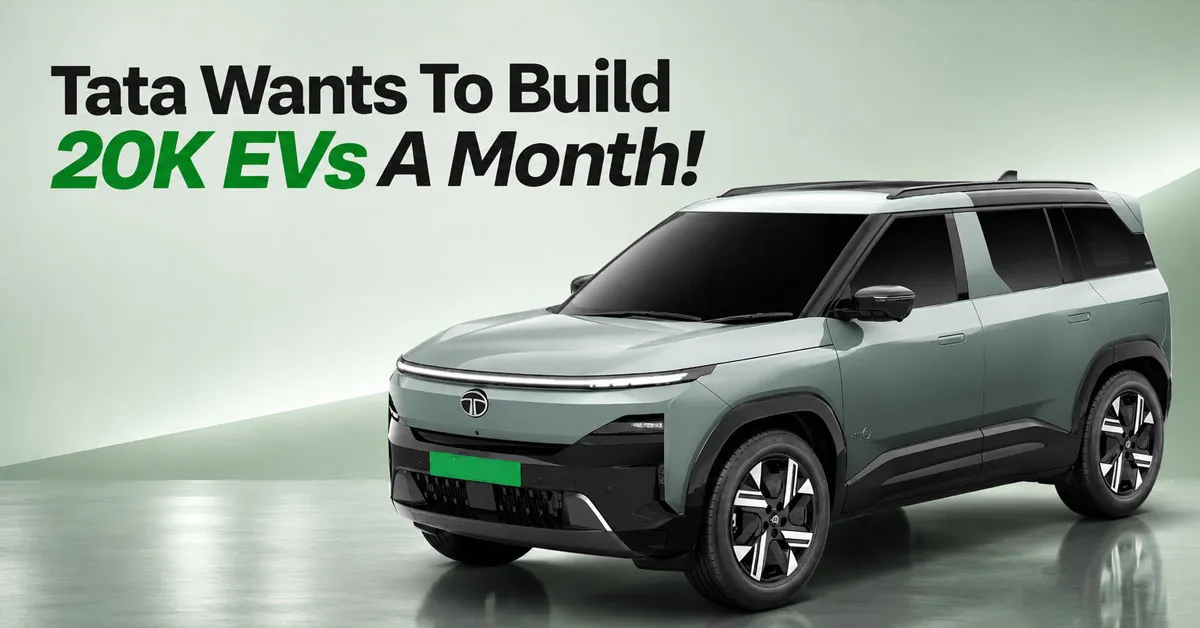
Tata Motors is preparing to increase its electric-car supplies to nearly 20,000 units a month over the next two to three months. The target follows a sharp increase in demand that has left the company unable to deliver as many EVs as customers currently want. It is an ambitious ramp-up, not a production level Tata has already reached.
During its latest quarterly earnings discussions, Tata Motors Passenger Vehicles managing director and CEO Shailesh Chandra said monthly EV supplies had risen from around 9,000 units in March-April to roughly 16,000 at present. The next goal is to move closer to 20,000. That would mean another increase of about 25% from the current level.
Tata says it is currently fulfilling only around 60-65% of demand for its electric cars. This is the crucial point behind the announcement. The company is not trying to manufacture more cars merely to fill dealerships. It is attempting to catch up with customer orders that are already coming in.
Dealer stock is reportedly down to around ten days for the electric range, which is unusually lean for a manufacturer operating at this scale. Low inventory can be good news when it reflects healthy demand, but it also means customers may face longer waiting periods or reduced choice of colours and variants. Producing more cars could make the buying process smoother.
The company sold more than 47,000 electric vehicles in the July-September quarter of FY2027, an increase of around 90% over the same period a year earlier. That works out to more than 15,600 EVs a month on average. Tata has also said it strengthened its share of the electric passenger-vehicle market to about 43% during the quarter.
Those figures show why Tata is putting extra effort into this part of its business. EVs are no longer a small side project. They now contribute a meaningful volume alongside petrol, diesel and CNG models. Across Tata’s passenger-vehicle range, CNG and EVs together accounted for more than half of sales during the latest quarter.
The EV portfolio now stretches from relatively accessible cars such as the Tiago.ev and Punch.ev to the Nexon.ev, Curvv.ev, Harrier.ev and Sierra.ev. These vehicles appeal to different customers: someone seeking an affordable urban runabout is not shopping for the same car as a family considering a larger electric SUV.
That spread has helped Tata reach buyers with different budgets and requirements. It also makes production planning more difficult. Different battery packs, motors and electronic components must arrive at the factories in the right quantities. Growing the model range is useful only if the company can deliver the cars people order.
The interesting constraint is not just assembly-line space. Tata says its manufacturing capacity can be shifted between conventional and electric vehicles, but it still has to secure a reliable supply of critical parts. Management is working with suppliers on around 26 important components to support higher EV volumes.
EV production depends on more than batteries. Power electronics, motors, controllers, wiring and other specialised parts have to arrive together. A shortage of a single essential component can hold up a vehicle even when the factory has the capacity and workers available to assemble it. Increasing output from 16,000 to 20,000 a month therefore requires coordination throughout the supply chain.
If Tata meets its target, buyers should see better availability and, potentially, shorter waiting periods. Greater supply could also help the company maintain momentum as rivals bring more electric SUVs to showrooms.
There is also a wider change taking place. Electric vehicles accounted for roughly 8% of passenger-vehicle sales in the latest quarter, while CNG reached around 25%. That does not mean petrol and diesel cars are disappearing. It does show that buyers increasingly have serious alternatives to conventional powertrains.