0
The BJP’s strategy combines direct interactions, college-level outreach through BJYM, digital communication and the employment and entrepreneurship promotion.
New Delhi
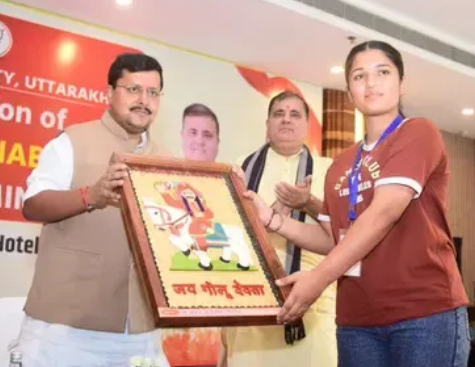
Nearly 40 questions on paper leaks, medical education, recruitment, migration and political participation were put to BJP national president Nitin Nabin and Uttarakhand Chief Minister Pushkar Singh Dhami during a youth interaction in Haldwani in September. The programme, organised under the party’s Yuva Samvad initiative, is part of the BJP’s wider effort to engage first-time voters and young people aged 18-29 ahead of the 2027 Assembly elections.
The BJP’s strategy in Uttarakhand combines direct interactions between young people and senior leaders, college-level outreach through the Bharatiya Janata Yuva Morcha (BJYM), digital communication and the promotion of employment and entrepreneurship initiatives.
At Haldwani, the questions raised by participants covered a range of issues, including super-speciality medical seats, stipends, paper leaks, employment, the New Education Policy, migration and opportunities to enter politics. Students also sought answers on time management and career choices.
Responding to questions on medical education, Nabin spoke about the expansion of medical colleges and the need to strengthen the country’s medical infrastructure. On paper leaks, he said action was being taken in earlier cases, with arrests and stricter laws. Dhami, responding to concerns about migration, referred to employment and self-employment initiatives in rural areas, including homestays and tourism-related activities.
The Chief Minister also told participants that their questions would receive written responses, which would subsequently be shared through social media. The interaction was attended by students from different educational institutions, who raised questions directly with the two leaders.
The Haldwani programme followed a Yuva Shakti Samvad held in Dehradun in May, attended by Nabin, Dhami and state BJP president Mahendra Bhatt. At the event, Nabin had released Naveen Sandesh, the first special magazine published by the Uttarakhand unit of BJYM.
The magazine is intended to carry material on youth leadership, education, innovation, employment and contemporary issues. The Dehradun programme brought together BJYM office-bearers, professionals, academicians, entrepreneurs and young participants.
Vipul Maindoli, state president of BJYM Uttarakhand, said the organisation was working to involve young people in politics, social service, education, sports, self-employment and skill development. Describing the Dehradun programme, Maindoli said it was “not merely a political event but a platform for dialogue among young people, professionals and different sections of society.”
The BJP’s organisational discussions have also specifically addressed the question of reaching younger voters. At a core committee meeting in New Delhi in August, the party’s central leadership discussed expanding its contact with first-time voters and those in the 18-29 age group. College contact campaigns, digital interactions, Yuva Morcha activities and other youth-oriented programmes featured in the discussions.
The party has also been seeking to communicate government initiatives through these platforms, particularly those relating to Skill India, Startup India and Digital India. In Uttarakhand, its messaging has included tourism, homestays, local products, startups and technology-based enterprises as avenues for employment.
At the Haldwani interaction, Dhami cited approximately 34,000 government appointments during his tenure and outlined initiatives relating to self-employment and skill development. Nabin urged young people to participate in politics and contribute to creating employment opportunities within the state, particularly through tourism, entrepreneurship and local businesses.
For young people preparing for competitive examinations, however, recruitment and employment remain central concerns. Arun Shrivastav, a 23-year-old competitive-examination aspirant from Dehradun, said, “Our biggest concern is employment. We want examinations conducted on time, vacancies filled and complete transparency in recruitment. Young people are looking for concrete results, not just assurances.”
The issue takes a different dimension in Uttarakhand’s hill districts, where migration for higher education and employment continues to be a concern among young people. Vaishnavi, a 21-year-old student from Almora, said, “Young people from the hills should have opportunities to study, work and build businesses in their own districts. We should not have to move to Dehradun or Delhi simply because suitable opportunities are unavailable at home.”
The BJP has sought to address this concern by highlighting tourism-based employment, homestay schemes, local entrepreneurship and self-employment initiatives. The party has also encouraged young people to explore opportunities in emerging sectors rather than depend exclusively on government recruitment.
Uttarakhand-based political analyst Ashish Badoria said the party’s outreach reflected the importance of issues such as employment, education and transparency in its engagement with younger voters. “Young voters are increasingly concerned about jobs, education and transparency. Direct interactions give political parties an opportunity to hear these concerns, but young people will also look at the government’s performance on these issues,” Badoria said.
The BJP’s youth outreach is taking place alongside the Opposition’s criticism of the Dhami government over unemployment, recruitment controversies and migration. The Congress has repeatedly raised these issues, while also attempting to bring national political debates, including the INDIA bloc’s allegations of electoral irregularities, into the state’s political discourse.
The BJP maintains that there is no significant Gen Z discontent in Uttarakhand and that youth-led mobilisation witnessed in Delhi has not generated a comparable response in the state. It has also dismissed the Opposition’s campaign on alleged vote irregularities as an issue that has failed to gain substantial public traction locally.
With elections approaching, the party’s organisational programme includes continued engagement through the Yuva Morcha, college-level contact campaigns and digital platforms. Its stated target includes first-time voters, students, young professionals and aspiring entrepreneurs, with employment, skill development and opportunities within Uttarakhand forming the central themes of its outreach.