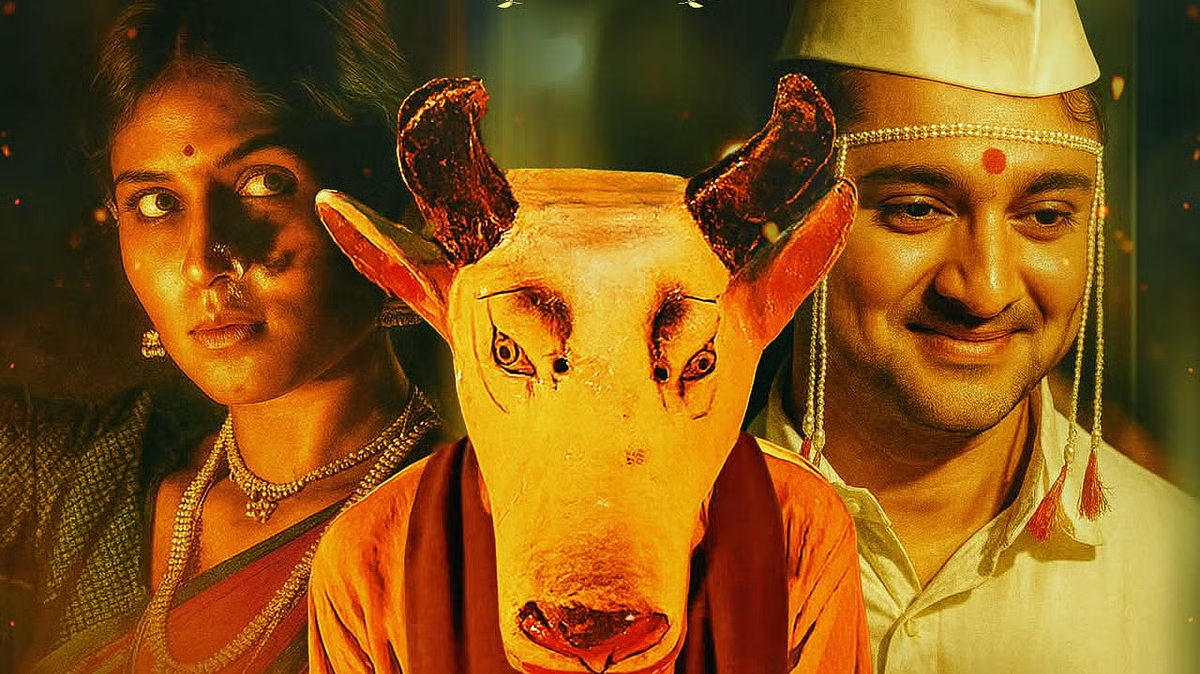
Music and visuals play an important part in Santosh’s film, which works better as an experiment with form and texture than as a drama with fully fleshed out character arcs. In fact, most characters function as archetypes, although Santosh’s film puts a refreshing spin on some of them. Take the female protagonist, Suman, for example. Despite a patriarchal upbringing, she is a boisterous woman with a way with words who does not fear expressing her opinion in front of anyone and who commands fierce agency. A lesser film would have treated her as just another victim of patriarchy, but Gondhal celebrates Suman by portraying her as a powerful character with characteristics similar to a femme fatale.
It is an absolute delight to see how Suman teases and even talks down to Sarjerao (Nishad Bhoir), the heir to a village chief named Patil (Suresh Vishwakarma). At the same time, Santosh Davakhar’s film shows the harsh realities of her life with conservative parents. At one point, her father (Sharad Jadhav) tells her not to loiter around the village and cozy up with men who often sneer at women and make sexually inappropriate comments to them. The old man’s concerns do not come from a place of care but rather conservatism. “I should have killed you the moment you were born,” the father tells his daughter, hinting at his brutal orthodoxy.
Then again, nobody in Gondhal is a pure soul. Even a small boy (Dhruv Thoke) harbours a strong sense of vendetta against one of the most powerful people in the village. He is too young to have such malice, but Santosh’s film effectively illustrates how an environment steeped in toxicity accelerates the loss of innocence. Even when something really brutal happens to him, the boy remains nonchalant, as if to say he is no stranger to such events.