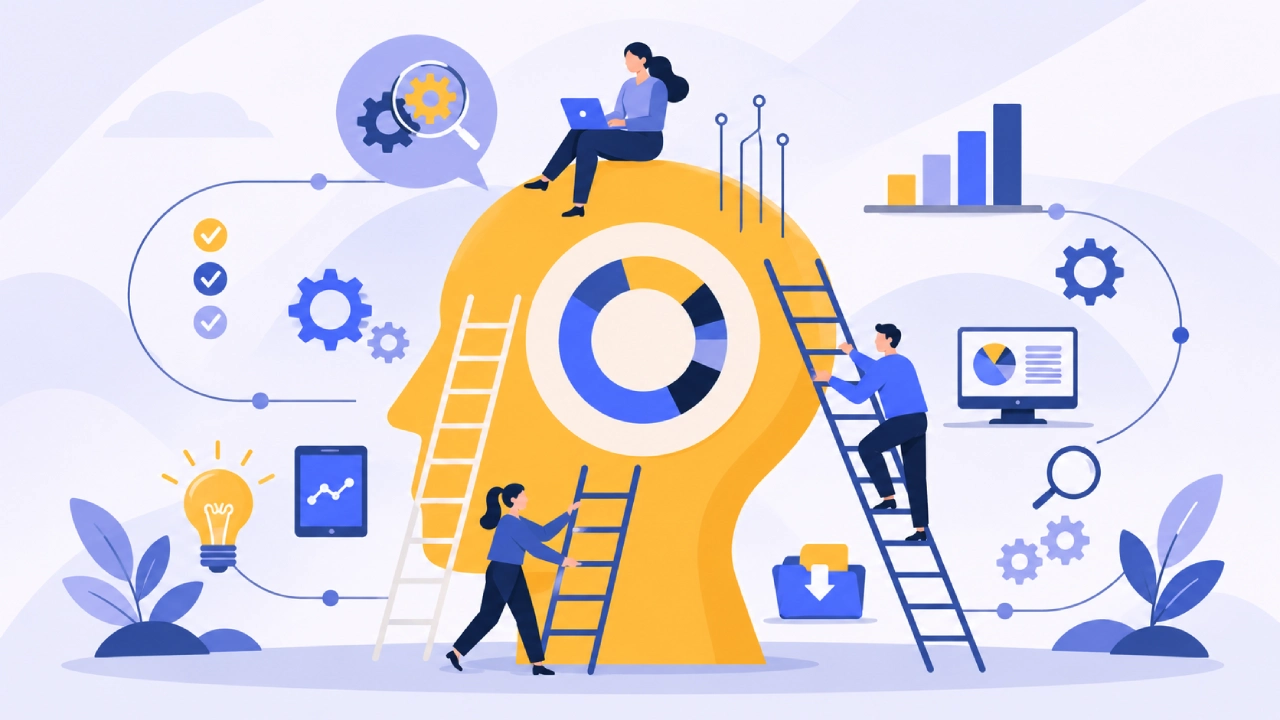
Knowledge Management: Something has gone wrong in the modern workplace. While employees enjoy unprecedented access to data, finding a single policy, document, or expert has never felt more difficult. Research indicates that knowledge workers spend over a third of their working time trapped in a frustrating cycle: hunting for existing information or recreating what they cannot locate. In an APQC survey of 677 knowledge workers, the median respondent reported spending 35% of their time on unproductive activities, including finding, recreating, and repeatedly sharing information.
This is a failure of retrieval. Corporate insight sits buried in transient chat threads, chaotic cloud drives, or the minds of veteran staff who spend their days acting as human search engines. Much of an organization’s critical operational knowledge may exist as tacit knowledge, embedded in employees’ experience rather than formally documented.
Organizations have essentially built massive libraries without a card catalog. Traditional wikis have often failed to bridge this gap because static pages cannot keep pace with dynamic workflows. A document without an owner rots in silence until a costly mistake exposes the error.
Static knowledge management is no longer just inefficient; it is a corporate liability. To stop paying the tax of lost information, modern teams must learn to abandon rigid archives and adopt living, intelligent systems that evolve in real time according to their needs.
Knowledge Management: From Static Wikis to Living Systems
The modern company wiki should be a single source of truth. In practice, it often becomes a graveyard. A 2026 Forbes Human Resources Council article highlights the importance of tacit organizational knowledge, which remains embedded in people’s minds rather than documented in accessible systems. Corporate wikis often hold outdated versions of events that fail to reflect current realities.
Standard operating procedures bridge the gap between theory and execution, but only when designed for how people actually work. Checklists outperform paragraphs; embedded videos outshine text walls, yet design alone will not carry the weight. Operational infrastructure demands interactive, adaptive logic.
Intelligent Search Changes Everything
The digital scavenger hunt ends when search stops being a destination and becomes ambient. Modern tools now use federated search—querying multiple platforms simultaneously to pull answers from Slack, Google Drive, Notion, and email in a single pass.
One developer tool, Nia, indexes repositories, PDFs, datasets, and Slack conversations into a unified semantic search layer. Its developer advertises sub-five-second search responses across supported indexed sources.
Another workflow can sync Notion and Google Drive into a vector database, then answer Slack questions with source citations automatically.
Contextual delivery means knowledge arrives before the search begins. A customer service agent opens a ticket about a billing discrepancy, and the relevant troubleshooting guide surfaces without a single query. The system has already read the ticket keywords, matched them against indexed content, and pushed the answer into the workflow.
Slack’s Chief Customer Officer described this shift: moving from a library model to a living system that proactively collaborates with workers. The document should not be the center of the experience; the person doing the work should be.
Ownership Is the Difference Between Living and Dead
Every document requires a human owner, not a team alias. Strip away individual accountability, and organizational knowledge decays in silence—until an outdated process finally triggers an operational failure expensive enough to demand attention.
Documentation habits are more likely to survive when contributions are visibly recognized and supported through performance reviews and career progression. Emerging AI tools can draft updates from ordinary daily communications, removing the blank-page friction that stalls so many well-intentioned processes.
Approval, though, must remain with the person whose name sits beside the document, and that is the line worth defending. When expertise sharing becomes a core metric rather than a voluntary gesture, systems are more likely to remain reliable.
Keeping Knowledge Alive: The Automated Update Loop
Information decays not through neglect alone, but through the slow erosion of relevance as markets shift, technologies turn over, and regulations redraw their boundaries. What worked well last year may mislead this year. Some processes hold their value for a decade; others collapse within weeks. Stale documentation, then, is less a housekeeping concern than an uninsured liability sitting quietly on the books.
Managing that decay asks for infrastructure. Automated verification moves the burden of vigilance away from memory and into code—systems that audit repositories on a fixed cadence, flag pages untouched for ninety days, and route anything unverified toward senior review before it can do harm.
Scale presents its own difficulty. Here, machine learning earns its place. Categorization, duplication, distillation—the cognitive labor that once consumed entire workweeks can increasingly be supported by automation. Reports can be tagged automatically, redundant entries identified before they multiply, and long discussions compressed into brief, usable records.
What remains, once routine maintenance is handled, is judgment. Teams stop policing format and start weighing substance. With continuous review folded into the ordinary rhythm of work, knowledge stops behaving like a project requiring periodic rescue. It becomes something closer to living infrastructure, maintained and corrected at the pace the business actually moves.
The Cultural Shift That Makes Automation Stick
Adoption depends on whether people trust the system enough to use it, and trust is earned through transparency rather than mandate. Teams need visibility into what the automation is doing: which documents were flagged, which owners were nudged, and which articles were retired.
Otherwise, the system becomes another black box that people quietly route around. Leadership matters here too. When executives reference the knowledge base in meetings, link to SOPs in their own communications, and visibly update their own documents, the behavior cascades downward without a single policy memo.
Resistance comes from employees who have watched previous knowledge initiatives launch with fanfare and die in silence six months later. Proving that this system is different—that it is regularly reviewed, that stale content is corrected or retired, and that contributions are noticed—is what converts skeptics into participants.
Building a Future-Proof Workplace
The organizations that thrive in the next decade will not be the ones with the most information. They will be the ones where information flows effortlessly to the people who need it.
The shift from passive wiki to automated knowledge workflow is not a technology upgrade. It is an operating model change. It can reduce onboarding time because new hires can find answers without interrupting senior colleagues. It prevents operational bottlenecks because expertise is distributed rather than concentrated. It protects institutional knowledge when employees leave because that knowledge was never solely in their heads.
The compound return on investment can be real, but it is also slow. This is not a switch you flip; it is a system you build. Knowledge that cannot be found is not an asset. It is a liability wearing the costume of one.
(Source)